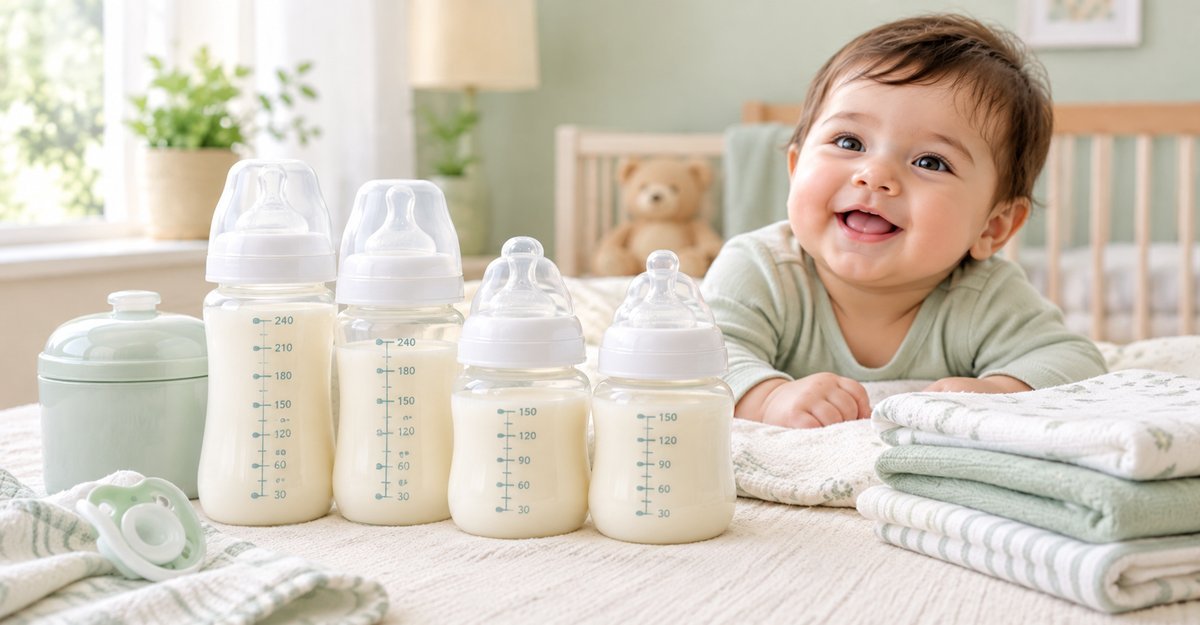
Most families do well starting with about 3–4 bottles if they’re breastfeeding, 4–6 if they’re combo feeding, and 8–10 if they’re formula feeding or exclusively pumping. That’s the short answer to “how many bottles do I need for a baby?” The right number for your family depends on how your baby eats and how often you like to wash.
At Zayapol, a baby care and parenting resource for US families, this is one of the most common registry questions we see. Online answers swing from “just a couple” to “eighteen,” which isn’t much help when you’re standing in the baby aisle. This guide explains why the numbers vary and gives you a simple rule for finding yours.
These are general stINarting points, not medical advice. Your pediatrician can tell you what’s right for your baby’s feeding.
Quick Takeaways
- Breastfed babies usually need only a few bottles. Formula-fed and exclusively pumping babies need more.
- Newborns feed about 8–12 times in 24 hours, so bottle needs are highest in the early weeks.
- Use the Wash-Cycle Rule: bottle feeds between washes, plus 2 spares.
- Start with a few 4-ounce bottles, then add 8-ounce bottles as feeds grow.
- Buy one or two bottle styles first. You won’t know which one your baby accepts until you try.
- Wash bottles after every feed, and sanitize daily if your baby is under 2 months.
How Many Bottles Do I Need for a Baby? The Quick Answer
Start with 3–4 bottles for a breastfed baby, 4–6 for combination feeding, and 8–10 for exclusive formula feeding or exclusive pumping. These are starting points you can adjust once you see your baby’s real routine.
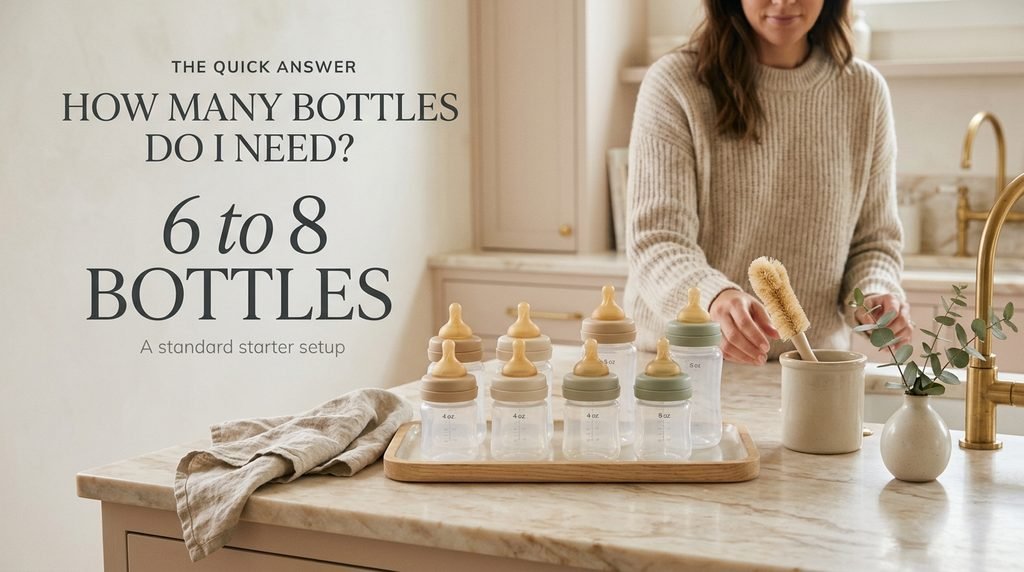
- Mostly breastfed, occasional bottle: 3–4 bottles. That covers a caregiver feed or two a day plus a clean spare.
- Combination feeding (breast and formula): 4–6 bottles, since some feeds still happen at the breast.
- Exclusively formula feeding: 8–10 bottles. If you wash only once a day, you may want closer to 12.
- Exclusively pumping: 8–10 bottles, because every feed is a bottle feed.
Why do the numbers differ from site to site?
The numbers differ because each source quietly assumes a different feeding style and wash routine. A parent who runs the dishwasher twice a day needs far fewer bottles than one who washes once. Retailers also tend to suggest larger sets.
Parents in online forums show the same spread. Some say three bottles was plenty because they washed after every use. Others describe ending up with around 30 after gifts and sample packs. Neither is wrong, and the next section shows how to land on your own number.
The Wash-Cycle Rule: How to Find Your Number
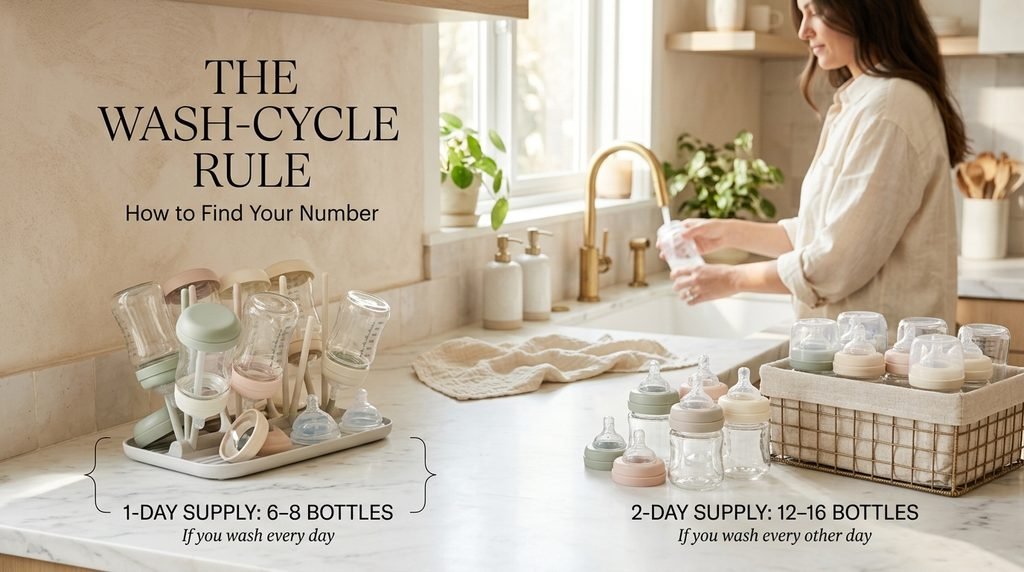
Here’s the rule: bottles needed ≈ bottle feeds between washes + 2 spares. It takes about a minute and works for any feeding style.
Step 1: Count your bottle feeds per day
The CDC says most formula-fed newborns feed 8 to 12 times in 24 hours. By 6 to 12 months, most babies need formula or solid foods about 5 to 6 times a day. If you’re breastfeeding, count only the feeds that will be given by bottle.
Step 2: Decide how often you’ll wash
The fewer times you wash, the more bottles you need on hand. Washing twice a day roughly halves the number of bottles you need compared with washing once. Pick a routine you can really stick with, because a dishwasher you forget to run will empty your shelf quickly.
Step 3: Add 2 spares
Spares cover the unplanned: a spill, a late-night feed, a missed dishwasher cycle, or a bottle that goes to a grandparent’s house.
Worked examples
- Formula-fed newborn, 10 bottle feeds a day, washing twice a day: 5 + 2 = 7 bottles (round up to 8).
- Same baby, washing once a day: 10 + 2 = 12 bottles.
- Breastfed baby, 2 bottle feeds a day, washing once a day: 2 + 2 = 4 bottles.
- 7-month-old, 5 formula feeds a day, washing twice a day: 3 + 2 = 5 bottles (in a larger size).
How Many Bottles Do I Need for a Newborn?
A newborn needs as many bottles as your feeding method and wash routine call for. That’s usually 3–4 if you’re breastfeeding and 8–10 if you’re formula feeding. What changes fast is the bottle size, not just the count.
How much do newborns drink?
Newborns drink very little at a time. According to HealthyChildren.org from the American Academy of Pediatrics, babies in the first week eat no more than about 1 to 2 ounces per feed. By the end of the first month, many take 3 to 4 ounces per feed every 3 to 4 hours. KidsHealth puts a typical newborn at about 1.5 to 3 ounces every 2 to 3 hours.
Why small bottles come first
Because early feeds are small, 4-ounce bottles are plenty for the first weeks. But babies grow quickly, and by around 2 months many take 4 to 5 ounces per feed. Plenty of parents report outgrowing 4-ounce bottles within the first month or two, so buy only a few small ones and plan to move up.
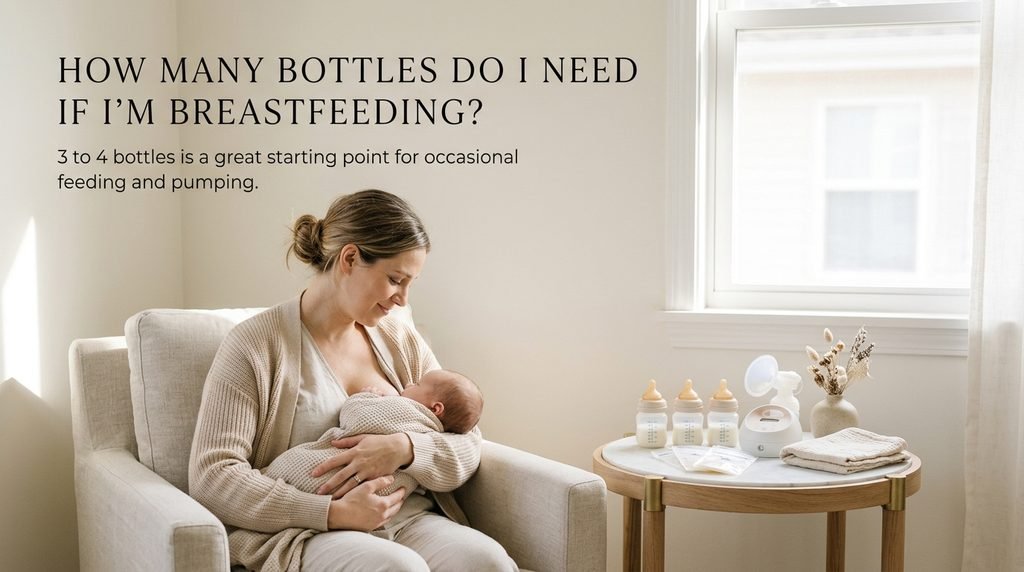
How Many Bottles Do I Need if I’m Breastfeeding?
If you’re breastfeeding, 3–4 bottles is usually enough to start. Many feeds happen at the breast, so bottles mainly cover time away, a partner’s turn, or pumped milk.
Do I need bottles if I’m exclusively breastfeeding?
You don’t strictly need them, but a few are handy. Even exclusively nursing parents often want a bottle for a partner feed, a return to work, or an appointment. If you’d rather wait and see, that’s a reasonable choice too.
When should I introduce a bottle?
Kaiser Permanente suggests that pumping after about 3 to 4 weeks is a good time to introduce a bottle if you want one in the mix. Some lactation resources point to roughly 4 to 6 weeks. Timing varies by baby, so ask your pediatrician or a lactation consultant what fits your situation.
How should I store pumped milk in bottles?
CDC guidance says freshly expressed milk can stay at room temperature (77°F or colder) for up to 4 hours. Once milk has been warmed or brought to room temperature, use it within 2 hours. Milk thawed in the refrigerator should be used within 24 hours of being fully thawed, and you should never refreeze it.
Smaller portions help you avoid waste. Kaiser Permanente suggests storing 2 to 4 ounces of milk per container, which is why a handful of small bottles or storage bags works well for pumping parents.
How common is combination feeding?
Quite common. The AAP recommends exclusive breastfeeding for about the first 6 months. But CDC’s Breastfeeding Report Card shows that for babies born in 2019, 55.8% were still getting some breast milk at 6 months while 24.9% were exclusively breastfed. Many families mix breast milk and formula, which is why the 4–6 bottle range is a practical middle ground.
How Many Bottles Do I Need if I’m Formula Feeding?
If you’re formula feeding, start with about 8–10 bottles and adjust to your wash routine. Every feed is a bottle feed, so you’ll go through them quickly, especially in the early weeks.
What do formula-fed babies drink at each age?
Here’s a general look at typical amounts, based on HealthyChildren.org, KidsHealth and the CDC:
- First week: about 1–2 ounces per feed
- End of the first month: up to 3–4 ounces per feed, roughly every 3–4 hours
- 2 months: about 4–5 ounces every 3–4 hours
- 4 months: about 4–6 ounces per feed
- 6 months: about 6–8 ounces, 4–5 times a day
- 6–12 months: formula or solid foods about 5–6 times in 24 hours
The AAP also notes that babies take in about 2½ ounces of formula per pound of body weight a day, and usually no more than an average of about 32 ounces in 24 hours. Every baby is different, so follow your baby’s hunger cues and check with your pediatrician about amounts.
How many 4 oz and 8 oz bottles do I need?
A common approach is a few 4-ounce bottles for the early weeks and the rest in 8-ounce bottles. For example, you might buy 3–4 small bottles and 5–6 large ones. The 8-ounce bottles will carry you through the rest of the first year, since feeds top out around 6 to 8 ounces.
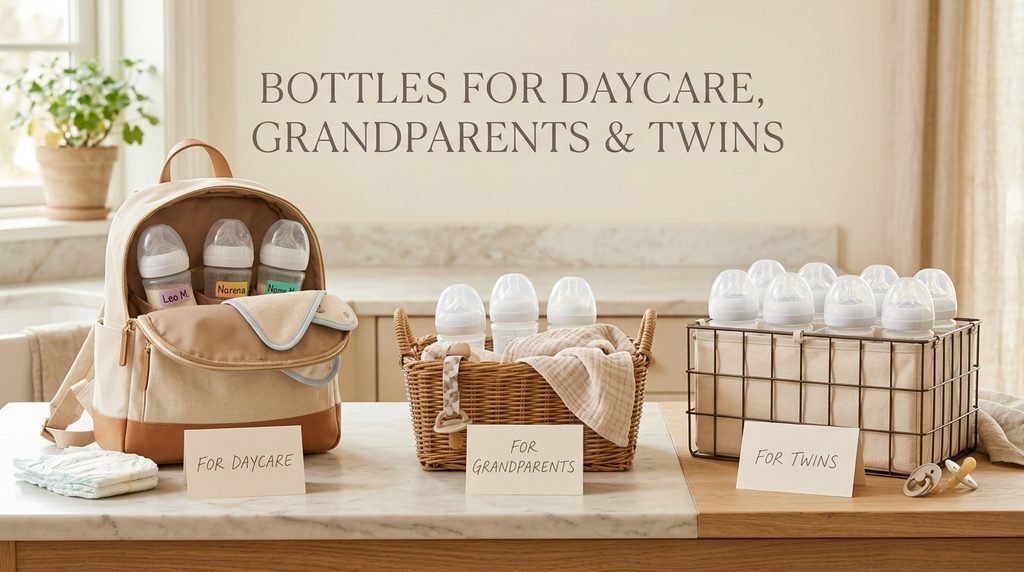
Bottles for Daycare, Grandparents and Twins
If other people feed your baby, plan for a small separate set for each caregiver. Having to wash bottles between drop-offs is one of the quickest ways to run short.
How many bottles do I need for daycare?
Parents commonly report sending 3–4 bottles per day to daycare, and many send one extra in case the baby is hungrier than usual or a bottle gets spilled. Ask your provider what they prefer, label every bottle clearly, and keep a total of 6–8 so you always have a clean set waiting at home.
What about grandparents and other caregivers?
Keep 2–3 bottles at any home where your baby is regularly fed. That way you’re not carrying a full set back and forth every time.
What about twins?
Count feeds per baby, not per family. Two babies means roughly twice as many feeds between washes, so the Wash-Cycle Rule gives you a bigger number. Many parents of multiples handle this by washing more often rather than doubling their bottle collection.
Smart Shopping: How to Avoid Buying Too Many
The best way to avoid over-buying is to test before you stock up. Babies can be picky about bottle shape and nipple style, and you won’t know what works until you try.
Try one or two styles first
Buy a single bottle or a small sample set of one or two styles, then stock up on the one your baby takes to. This is especially useful for breastfed babies, who may prefer a particular nipple shape. If you’re building a registry, our baby bottles category is a good place to compare options.
Glass, plastic or silicone?
- Glass: durable and easy to clean, but heavier and breakable.
- Plastic: light and widely available, though it may need replacing sooner.
- Silicone: soft and lightweight, and a favorite with some breastfed babies.
Many families mix materials, such as glass at home and plastic for daycare.
Extras that matter more than extra bottles
- Extra nipples, since you may need a different flow level as your baby grows
- A bottle brush and wash basin used only for infant feeding items, as the CDC recommends
- A clean spot to air-dry parts
- Storage bags if you’re pumping
How Often Should You Clean and Sanitize Baby Bottles?
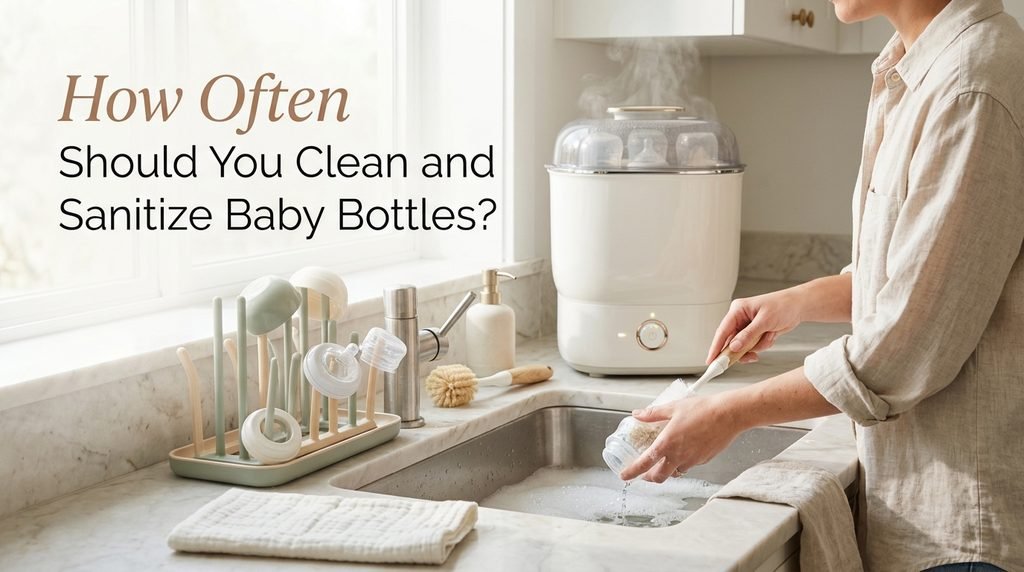
Clean bottles after every feeding, and sanitize them at least once a day if your baby is under 2 months old, was born prematurely, or has a weakened immune system. That’s the guidance in the CDC’s infant feeding item cleaning instructions.
Cleaning after every feed
Take each bottle apart, including the nipple, ring and any valves. Wash the parts in a clean basin reserved for infant feeding items, using a dedicated brush, dish soap and hot water. If the parts are dishwasher-safe, the dishwasher works too.
Drying
The CDC notes that air-drying parts on a clean dish towel or paper towel is probably more hygienic than a drying rack. Once everything is fully dry, store the clean parts in a protected spot like a closed cabinet.
When to replace bottles and nipples
Throw out any bottle that is cracked or cloudy, and any nipple that is torn, sticky or damaged. Follow the manufacturer’s guidance on how long each type lasts.
Frequently Asked Questions
How many bottles do I need for a newborn?
Most newborns need 3–4 bottles if breastfed and 8–10 if formula-fed. Use the Wash-Cycle Rule to fine-tune the number for your routine.
Do I need bottles if I’m breastfeeding?
Not strictly, but a few are useful. Bottles let a partner or caregiver feed your baby and give you flexibility for work or appointments.
How many bottles does a newborn use per day?
Newborns feed about 8–12 times in 24 hours. For a formula-fed baby that can mean 8–12 bottle feeds, though you can reuse bottles after washing. A breastfed baby may only use a bottle once or twice a day.
How many 4 oz and 8 oz bottles do I need?
A good mix is 3–4 four-ounce bottles for the first weeks and 5–6 eight-ounce bottles for the rest of the first year. If you’re mostly breastfeeding, you may only need a couple of each.
Can I have too many bottles?
Yes. Too many bottles clutter your kitchen and can leave you with a stockpile of a style your baby won’t take. Start with a small set and add more once you know what works.
How often should I sanitize baby bottles?
Daily if your baby is under 2 months, was born prematurely, or has a weakened immune system. For older, healthy babies, thorough cleaning after every use is generally enough, according to the CDC.
Conclusion
So, how many bottles do I need for a baby? Start with 3–4 if you’re breastfeeding, 4–6 if you’re combo feeding, and 8–10 if you’re formula feeding or pumping, then use the Wash-Cycle Rule (feeds between washes plus 2 spares) to fine-tune. Begin with small bottles, test one or two styles, and add more only when your routine tells you to.
Every baby eats differently, so treat these numbers as a starting point rather than a rule. Talk to your pediatrician about your baby’s feeding amounts and any concerns, and clean bottles according to CDC guidance.
Related Post:
How Long Does Baby Ear Piercing Take to Heal? A Simple Parent’s Guide
Does Tylenol Make Babies Sleepy? The Real Answer (2026)
Is Baby Formula FSA Eligible? The Real Rules for 2026
Can Babies Drink Cold Formula? The Honest Safety Guide
How Much Expressed Milk to Feed Baby Calculator: A Complete Weight-Based Guide
