
Somewhere around the time the nausea starts to fade and the belly starts to show, the question shifts from “is everything okay?” to “boy or girl?” It’s one of the most anticipated milestones of pregnancy, and depending on which method you choose, you might find out surprisingly early or wait until the pregnancy is nearly halfway through. Here’s exactly when each option becomes available, how accurate it really is, and why the timing isn’t the same for everyone.
Quick Answer
The earliest you can typically find out your baby’s sex is around 6 to 10 weeks of pregnancy, using a blood-based test that analyzes fetal DNA circulating in the mother’s bloodstream. Most people, though, find out at the standard mid-pregnancy anatomy scan, done by ultrasound around 18 to 20 weeks, when the baby’s genitals are usually visible enough for a technician to identify. Which option makes sense for you really comes down to how early you want the answer, whether you’re already having other prenatal testing done for medical reasons, and how much you’re willing to pay for a test outside the standard schedule of care.
Why You Can’t Find Out Your Baby’s Sex Right Away
A baby’s sex is determined at conception, but it isn’t something anyone not you, not your doctor can see or test for immediately. Early in pregnancy, all embryos develop the same basic structure, sometimes called the genital ridge, which hasn’t yet differentiated into male or female anatomy. That differentiation happens gradually between roughly weeks 6 and 12, which is exactly why the earliest blood-based tests can’t reliably detect fetal DNA markers until around that same window, and why an ultrasound can’t visually confirm anything before the anatomy has actually formed and grown large enough to see clearly.

This is also why two different couples asking “when can I find out” at the same point in pregnancy might get two very different answers depending on which method they choose. A blood test is reading DNA fragments that are already present in the mother’s bloodstream by a certain week, regardless of whether the physical anatomy is visible yet. An ultrasound, on the other hand, depends entirely on the baby’s genitals having developed enough and being angled toward the probe for a technician to actually see them.
Timeline by Method
Here’s how the main options compare, from earliest to latest:
| Method | When it’s available | Accuracy |
| At-home DNA blood test | As early as 6–8 weeks | Varies by brand; check for lab-certified results |
| Clinical NIPT (blood test) | Around 10 weeks | Highly reliable when performed by a lab |
| CVS (chorionic villus sampling) | 10–13 weeks | Highly accurate; primarily used for genetic screening |
| Amniocentesis | 15–20 weeks | Highly accurate; primarily used for genetic screening |
| Anatomy scan (ultrasound) | 18–22 weeks | About 95% or higher, depending on baby’s position |
| IVF genetic testing (PGT) | Before pregnancy begins | Determined at the embryo stage, prior to transfer |
Note that CVS and amniocentesis are diagnostic genetic tests typically recommended for medical reasons such as screening for chromosomal conditions rather than tests people choose purely to learn sex. If your doctor recommends one for medical reasons, learning the sex is often a secondary benefit rather than the primary purpose.
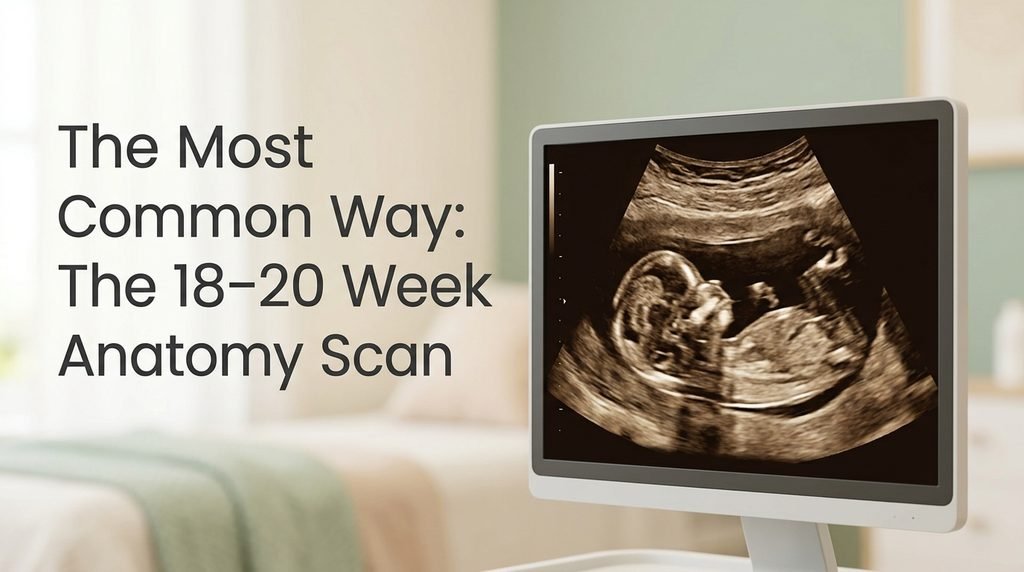
The Most Common Way: The 18–20 Week Anatomy Scan
For most pregnant people, the anatomy scan is where the big reveal actually happens. This detailed ultrasound, usually scheduled between 18 and 22 weeks, checks on the baby’s organs, growth, and development and along the way, the technician can typically identify the genitals if the baby is positioned well. Accuracy tends to run around 95% or higher at this stage, though it isn’t guaranteed; a baby curled up or facing the wrong way on scan day can make it hard to get a clear view, occasionally requiring a follow-up look.
If you’re planning a gender reveal party, this is usually the scan that sets everything in motion. Some practices will write the sex on a sealed card for you to hand off to a family member or bakery, while others will tell you directly in the room if you’d rather know right away. Either way, it’s worth asking your provider ahead of time how they handle the reveal, since policies vary by practice.
Earlier Ways to Find Out Your Baby’s Sex
If waiting until the halfway point of pregnancy feels impossible, a couple of earlier routes exist to find out the sex of your baby sooner with some important differences between them worth understanding before you book anything.
Clinical non-invasive prenatal testing (NIPT) is a blood test typically offered around 10 weeks, mainly used to screen for certain chromosomal conditions, with sex determination as an additional result. According to Healthline’s overview of prenatal sex-determination methods, while all of these testing methods are considered reliable, they aren’t all equally suitable for every pregnancy, and results typically take around a week to ten days to come back from the lab. Because NIPT is ordered through your provider and processed by a clinical lab, it tends to come with more oversight and better-documented accuracy than tests you order yourself online.
At-home direct-to-consumer DNA tests, marketed under names like early gender or sex-prediction kits, claim to detect fetal DNA even earlier, sometimes from around 6 to 8 weeks, using a simple blood sample you can collect at home and mail in. These can be a fun option for satisfying early curiosity, but it’s worth checking whether the company uses a certified lab and publishes its actual accuracy data, since not all direct-to-consumer tests are held to the same clinical standards as a test ordered through your doctor’s office. A quick look at a company’s lab certifications and published accuracy studies before paying for a kit can save you from a disappointing or unreliable result.
What About the Ramzi Theory and Old Wives’ Tales?
You’ll likely come across the Ramzi theory at some point the claim that a standard ultrasound as early as 6 weeks can predict sex based on which side of the uterus the placenta appears to be developing on.

It’s a popular idea in online pregnancy communities, but Healthline’s review of the Ramzi theory notes it isn’t backed by solid scientific evidence, and most doctors don’t use it as a diagnostic method. The same goes for classic folklore like carrying high versus low, cravings for sweet versus salty, or the position of your wedding ring on a string fun to talk about at a shower, but none of it has any real predictive accuracy. If you want a reliable answer, one of the tested clinical methods above is the way to get it.
FAQ
Is the anatomy scan 100% accurate for determining sex?
No method is guaranteed to be 100% accurate, though the anatomy scan is generally reliable when the baby is positioned well. Occasionally the view is unclear, which can lead to a wrong guess or the need for a follow-up scan.
Can my baby’s sex change during pregnancy?
No sex is determined at conception and doesn’t change. What can happen is that an early guess based on a less definitive method turns out to be inaccurate once a more reliable test or scan is done later.
Do I need to get an NIPT just to find out the sex?
Not necessarily. NIPT is primarily a screening test for certain chromosomal conditions; sex determination comes along with it, but most people don’t schedule it solely for that reason unless their doctor recommends it or they specifically want the earlier timing.
How long does it take to get results from a blood-based test?
Typically around a week to ten days, depending on the lab. Ultrasound results, by contrast, are available the same day, right at your appointment.
Can I find out my baby’s sex before I’m even pregnant?
If you’re going through IVF, yes preimplantation genetic testing (PGT) can identify the sex of embryos before one is transferred, meaning you could know before the pregnancy technically begins.
What if I’d rather not find out at all?
That’s entirely an option you can simply let your provider and ultrasound technician know you’d prefer to wait, and most practices will note that in your chart so it isn’t mentioned during appointments or written on any paperwork you might see.
Why did an early guess turn out to be wrong?
Early guesses, whether from a less-established test or a first-trimester ultrasound, carry more room for error than later, more established methods. If an early result and a later scan disagree, the later, more clinically validated method is generally the more reliable one.
Conclusion
Whether you’re the type who wants to know the moment it’s biologically possible or you’d rather wait for the classic anatomy scan reveal, there’s a method that fits your timeline. Earlier options like NIPT and at-home DNA tests can satisfy the curiosity around 6 to 10 weeks, while the 18–20 week ultrasound remains the tried-and-true option most people end up using to find out the sex of their baby. Whichever route you choose, keep in mind that this is general pregnancy information rather than personal medical guidance your own doctor is the best source for what’s right for your specific pregnancy, especially if you’re weighing a diagnostic test like CVS or amniocentesis for reasons beyond simply finding out sex.
Related Post:
How to Get Dried Boogers Out of Baby: 5 Safe Steps
Does Baby Oil Help You Tan? What Dermatologists Say
Do Babies Open Their Eyes in the Womb?
When to Take Baby to Dentist? Complete Guide for New Parents
Why Do Babies Grunt in Their Sleep? A Complete Parent’s Guide
