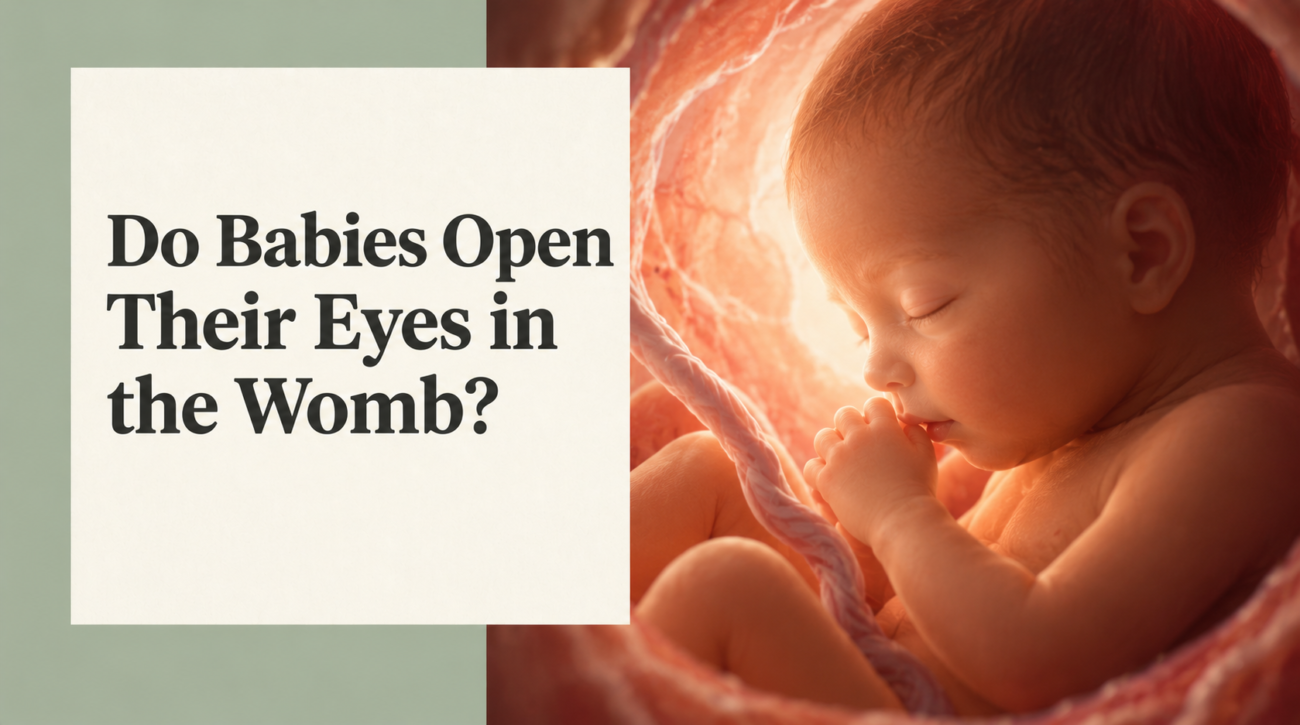
If you’ve ever watched a 4D ultrasound video and seen a tiny face blink or squint, you’ve probably wondered: do babies open their eyes in the womb, and if so, when does that actually happen? It’s one of those pregnancy questions that sounds simple but turns out to have a genuinely fascinating answer.
The short version is yes — babies do open their eyes in the womb, usually somewhere in the second half of pregnancy. But the full story involves weeks of quiet, behind-the-scenes construction work, protective biological seals, and a visual system that’s nowhere near finished by the time those eyelids first crack open. Understanding the timeline helps make sense of why it happens when it does, and it also explains why that glimpse of your baby’s open eyes on a scan is such a genuinely special moment.
This guide walks through the whole process in plain language, from the earliest eye formation to what your baby can (and can’t) actually perceive once their eyes do open.
Eye Development in the Womb: A Week-by-Week Timeline
Eye development is a gradual process that unfolds over most of a pregnancy, not something that happens all at once. Below is a simplified breakdown of the major stages, though it’s worth remembering that every pregnancy moves at its own slightly different pace.
| Weeks of Pregnancy | What’s Happening |
| 4–6 | Tiny eye structures called optic vesicles begin forming on the sides of the head |
| 8 | Eyelids start forming and quickly fuse shut, sealing the developing eye underneath |
| 10–15 | The eyes gradually shift from the sides of the face toward the front |
| 16 | Eyes remain closed, but the fetus starts reacting faintly to light through the skin |
| 20–22 | Eyebrows and eyelashes begin to appear |
| 26–28 | The eyelids finally unseal — this is when babies open their eyes in the womb for the first time |
| 31+ | Pupils begin reacting to light, widening and narrowing like an adult’s |
| 32–40 | The baby practices blinking, opening, and closing their eyes as the nervous system matures |
Looking at this table, you can see that eye-opening isn’t an isolated event — it’s the payoff of nearly seven months of gradual development. Everything before week 26 is essentially preparation, and everything after it is refinement.
When Exactly Do Babies Open Their Eyes in the Womb?
Most doctors and researchers point to week 26 as the point when a baby’s eyelids officially unseal, though for some babies it stretches into week 27 or 28. This falls right in the middle of the second trimester, around the same general window when a baby’s hearing sharpens and their movements become noticeably more coordinated.
It’s easy to picture this moment as dramatic — like a baby suddenly waking up and looking around — but in reality it’s much quieter than that. The eyelids simply separate, allowing the eyes to open and close on their own for brief stretches, largely in response to light rather than curiosity. There’s no fixed “hour” when it happens for every baby; some open their eyes a little earlier, some a little later, and both are completely normal.
Why Are a Baby’s Eyes Closed for So Long?
It can seem strange that eyelids stay sealed for roughly two-thirds of pregnancy, but there’s a good reason behind the timing. Around week 8, when the eyelids first form, the eye itself is still extremely delicate — the lens, retina, cornea, and optic nerve are all mid-construction, and none of them are ready to be exposed to fluid, light, or movement just yet.
Think of the eyelid fusion almost like a protective bandage placed over a wound while it heals underneath. As long as that seal stays in place, the eye structures can keep developing without interference. It’s only once those internal parts reach a certain level of maturity — generally around week 26 — that the body essentially “unlocks” the eyelids and allows them to separate.
This protective delay is also why premature babies born before that point often still have partially or fully fused eyelids, which is one of several reasons extremely early births require specialized medical care.
What Can a Baby Actually See Inside the Womb?
This is probably the most surprising part of the whole process: even after the eyes open, a baby still can’t see much of anything in the way we normally think of “seeing.” A few factors make this the case.
First, the womb itself is dark. Very little outside light naturally reaches inside, although a bright light source — like direct sunlight or a flashlight held against the belly — can create a faint reddish-orange glow that the baby may notice.
Second, the eyes are surrounded by amniotic fluid rather than air. Even a fully developed adult eye doesn’t focus clearly underwater, so a fetus swimming in fluid is working under similar limitations.
Third, and maybe most importantly, the parts of the brain responsible for processing visual information are still under construction. Having functioning eyes is only half the equation — the brain also needs to learn how to interpret what those eyes are picking up, and that learning process continues for roughly a full year after birth.
Put together, this means a baby in the womb can generally sense:
- Shifts between light and darkness
- Possibly some very blurry movement or shadow
- Brightness changes, such as light shone directly against the belly
What a baby cannot do yet is see clear shapes, recognizable faces, or anything resembling a focused image. That level of vision develops gradually after birth, as both the eyes and the brain continue to mature together.
Can You See a Baby’s Eyes Open on Ultrasound?
Yes, and this is one of the more delightful discoveries many parents make during a pregnancy scan. From around week 27 onward, a 4D ultrasound can sometimes capture the baby opening and closing their eyes, occasionally even appearing to glance around inside the womb.
A few practical things are worth knowing if you’re hoping to catch this moment yourself. The colors visible on a 4D scan aren’t accurate representations of real skin or eye color — the warm, skin-like tones you see are generated by the imaging software, not captured directly. The eyes themselves often appear darker or more shadowed on scan, since the fluid inside the eye doesn’t reflect sound waves as strongly as solid tissue does, which can make the eyes look less defined than the rest of the face.
It’s also worth setting realistic expectations: babies open and close their eyes on their own schedule, not on cue for a scan appointment. Plenty of parents attend a 4D ultrasound and don’t happen to catch the moment, and that’s completely normal — it doesn’t mean anything is wrong with the baby’s development.
Eye Color in the Womb: What’s Really Happening
Here’s something that surprises a lot of expecting parents: regardless of what color a baby’s eyes will eventually be, almost every baby is born with some shade of blue-gray eyes. That’s because eye color depends on a pigment called melanin, and melanin production hasn’t really kicked in yet at birth.
So even though a baby’s eyes are technically open and functioning by the later weeks of pregnancy, their true, permanent eye color is still a bit of a mystery at that stage. Melanin production increases gradually after birth, largely triggered by exposure to light, and a baby’s genetically determined eye color usually settles somewhere between six months and three years of age. In other words, those newborn blue-gray eyes you see right after delivery are often just a starting point, not the final result.
Other Milestones Happening Around the Same Time
Eye-opening doesn’t happen in isolation — it’s part of a broader wave of development that takes place around weeks 26 to 28. Several other systems are coming online during roughly the same stretch of pregnancy.
Hearing becomes noticeably sharper during this period, and many babies begin responding more clearly to familiar voices and sounds from outside the womb. The lungs also start producing a substance called surfactant, which keeps tiny air sacs from collapsing once the baby begins breathing independently after birth — a critical step in getting ready for life outside the womb.
Movements become more purposeful as well. Arms and legs can now move somewhat independently of one another, which is why this stage often brings noticeably stronger kicks, stretches, and grasping motions. On top of all this, early sleep-wake patterns start forming, loosely connected to the same light-sensitive cells involved in eye development.
It’s genuinely a busy period of growth, with the eyes being just one piece of a much larger developmental picture.
What Happens When the Baby Is Born?
Interestingly, not every baby opens their eyes the instant they arrive. Research looking specifically at eye-opening in the minutes right after birth found that out of just over a hundred newborns studied, roughly a third opened their eyes immediately, while most of the remaining babies did so within the first twenty minutes.
This early eye contact carries more significance than it might seem at first glance. Many midwives and healthcare providers consider those first moments of eye contact meaningful for early bonding between parent and newborn, which is part of the reasoning behind encouraging skin-to-skin contact right after delivery — it gives both baby and parent a calm window in which that first eye contact is more likely to happen naturally.
Frequently Asked Questions
Do all babies open their eyes at exactly the same week in pregnancy?
Not precisely. Week 26 to 28 is the general range most babies fall into, but like many developmental milestones, there’s natural variation from one pregnancy to the next.
Can a baby see faces or shapes in the womb?
No, not in any detailed sense. At most, a baby can detect changes in light and possibly some blurry movement, but not defined shapes, colors, or facial features.
Is it a problem if my baby’s eyes aren’t open yet on a scan at 26 weeks?
Not necessarily. An ultrasound only captures a single moment in time, and once a baby is able to open their eyes, they don’t keep them open constantly. Missing that particular glimpse during a scan isn’t usually a sign of any concern.
Do premature babies’ eyes open on the usual schedule?
It depends heavily on how early the birth occurs. A baby born before roughly week 26 may still have eyelids that are closed or only partially fused, which is one of several reasons extremely premature infants require close monitoring and specialized care.
What color are a baby’s eyes when they first open them in the womb?
Almost always some shade of blue-gray, regardless of what their eventual true eye color will be, since melanin hasn’t developed enough yet to determine permanent color.
Key Takeaways
Bringing it all together, here’s the simplest way to summarize the process: babies do open their eyes in the womb, typically between week 26 and week 28 of pregnancy, once their eyelids finish the developmental process that began around week 8. Once open, they can sense light and darkness but can’t yet make out clear images, since both the eyes and the visual-processing parts of the brain continue developing well into the first year after birth. It’s a slow, carefully staged process — and one more example of just how much quiet, remarkable work goes into building a baby before they ever take their first breath
Related Post:
How Long Does It Take Baby Villagers to Grow Up? Ultimate 2026 Guide

3 thoughts on “Do Babies Open Their Eyes in the Womb?”