When can baby sit in stroller? It sounds like a simple question, until you realize it has two answers. Newborns can ride in a stroller from the very first walk, as long as the setup is right. A regular upright seat is a different story, and it usually waits until around 6 months.
The tricky part is that “sit” can mean lying back in a deep recline or sitting tall and looking around. Each step depends on your baby’s head and trunk strength, not just their age. Brands and pediatric sources also give different ages, which leaves parents guessing.
In this guide from Zayapol, you’ll learn the ages experts mention, five signs of readiness, and the best setup for each stage. You’ll also get a safety checklist for every ride and the truth about naps in the stroller.
Quick Answer
- The short answer to “when can baby sit in stroller” has two parts. Newborns can ride from birth with the right setup, and an upright seat usually waits until about 6 months.
- Head control and trunk strength matter more than the calendar.
- Some makers allow a deep recline from about 3 to 4 months, but only if the manual says so.
- Use the five-point harness on every ride.
- Don’t let your baby sleep in the stroller, especially under 4 months.
When Can Baby Sit in Stroller? The Short Answer
Your baby can ride in a stroller from birth, but not in a regular upright seat. Young babies need a lying-down or deeply reclined setup. That could be a bassinet, a fully reclining seat approved for newborns, or an infant car seat on a compatible frame.
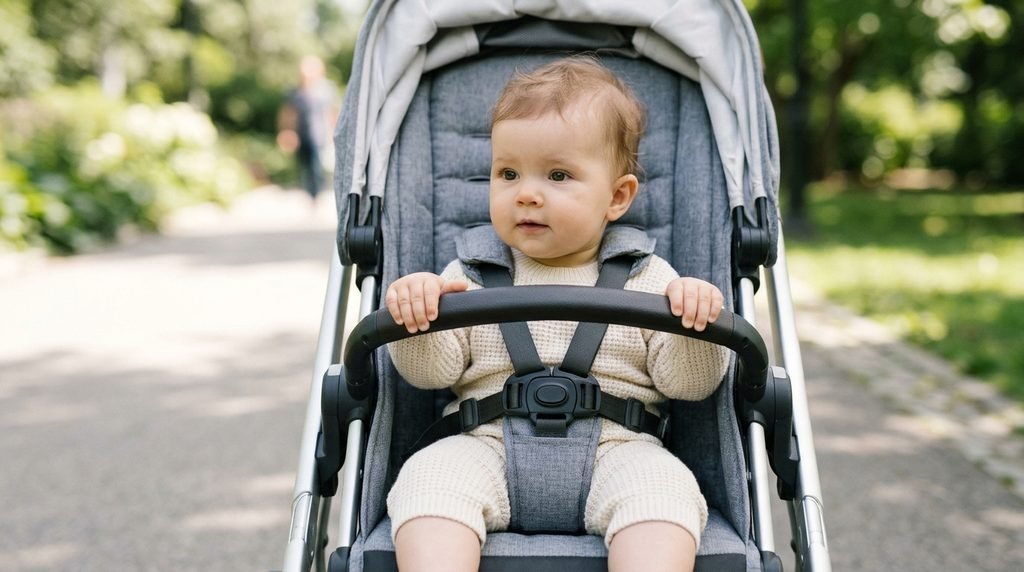
A regular upright seat usually works at about 6 months. That’s when most makers say a baby has enough head, neck, and core control to sit tall without slumping. Some brands give a range of 6 to 9 months, and others say independent sitting often arrives closer to 6 to 8 months.
It helps to picture three positions. Lying flat suits the youngest babies. Semi-reclined bridges the gap, and upright is for babies with solid trunk control. So when can baby sit in stroller in each position? That’s the quick version above and the full breakdown below.
There’s also a middle step. A few makers say a deeply reclined seat can start around 3 to 4 months if your baby has strong head control. That’s a manufacturer allowance, not a medical rule, so your manual has the final say.
Why does readiness beat the birthday? Babies develop at different speeds, and a stroller seat only helps if your baby can stay in a safe position. A 6-month-old who still wobbles needs more time. An early bloomer may be ready sooner, though the manual still sets the limits. Our sitting up milestone post shows the typical timeline.
Two rules hold at every age. Read the age and weight limits in your stroller’s manual, and ask your pediatrician if you’re unsure.
Why the Age Answers Don’t Match
When can baby sit in stroller? That depends on whom you ask, because each source answers a slightly different question. Here’s how the main voices compare.
| Source | What it says | Why it differs |
| Stroller makers | Deep recline from about 3 to 4 months with strong head control, an upright seat at about 6 months, and some say 6 to 9 | They design seats and recline angles for a range of babies and focus on head and neck control |
| CDC milestones | Head control by about 4 months, leaning on hands to sit around 6 months, sitting without support by 9 months | These are developmental checkpoints, not stroller rules |
| American Academy of Pediatrics | Use the five-point harness every ride, follow weight and age limits, and never let babies sleep in strollers | The focus is restraint, tipping, and suffocation risk |
| Federal safety standards | Strollers carry children sitting or semi-reclined, while carriages carry infants lying down | They separate products by body position |
So 6 months and 9 months can both be right. A stroller seat with a reclining back and a harness asks for head control and enough trunk strength to stay put. It doesn’t ask for the fully independent sitting that the CDC tracks at 9 months. In other words, your baby can be ready for the seat before they can sit alone on the floor.
The CDC’s 9-month milestone page shows babies sitting without support at that age. Because a stroller only needs a supported, harnessed position, many babies are ready earlier. Still, a baby who can’t hold the head steady or keeps folding forward isn’t ready yet.
Federal rules also draw a line. The stroller standard describes strollers as normally used from infancy to 36 months. It also separates them from carriages, which carry infants lying down.
The takeaway is simple. Age ranges are a starting point, and your baby’s abilities and your stroller’s instructions decide the rest.
5 Safe Signs Your Baby Is Ready for a Stroller Seat
So when can baby sit in stroller for an upright ride? When these five signs show up together.
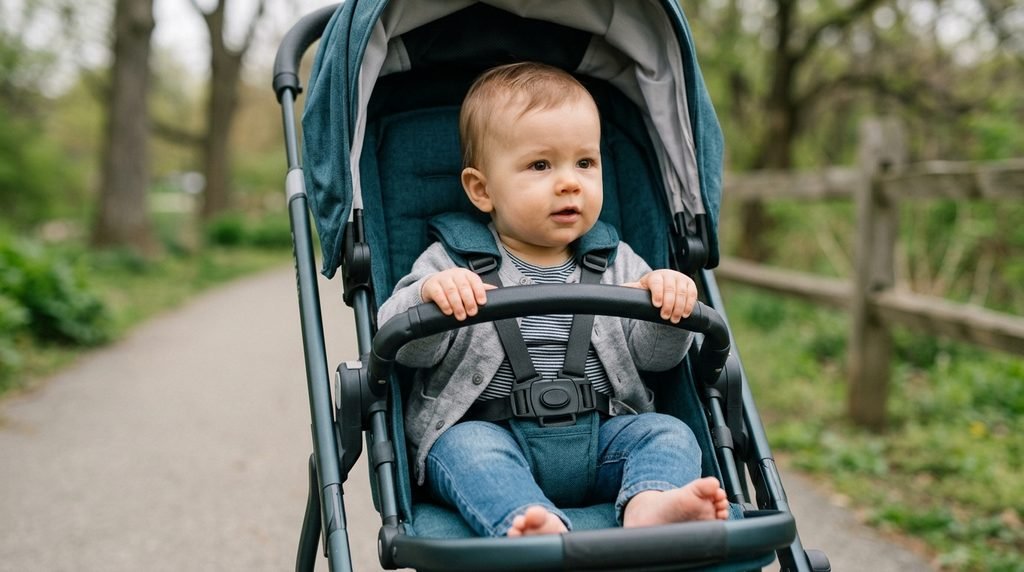
1. Steady head control
Your baby keeps the head centered when held upright, even when excited or when you roll over a bump. The wobble is gone, and they can turn to look around smoothly. If the head still bobs or drops, wait. Our head control milestones guide explains what to look for.
2. Upright trunk strength
Neck strength alone isn’t enough. Your baby also needs a back and core that keep them tall when supported, without folding forward or leaning to one side. One major maker notes that babies should stay upright so they don’t fall forward in the seat. Independent sitting comes later, and it isn’t required for a reclined, harnessed seat.
3. A chin that stays off the chest
In a stroller, slumping can push the chin toward the chest and narrow the airway. Another maker points out that good head control keeps a baby’s airway clear. Check the chin at the start of every ride and again every few minutes.
4. A good fit in the stroller
The harness should sit snugly over both shoulders, across the hips, and between the legs. Your baby should also fall within the stroller’s stated age and weight limits, and the seat should recline enough to support them. If your baby slides down or the straps don’t fit well, the stroller isn’t right for this stage yet.
5. Calm in a short trial
Try a short ride first, such as a slow lap around the block. A ready baby stays comfortable, looks around, and holds a steady posture. A baby who slumps, cries, or struggles isn’t ready today, and that’s fine. Stop and try again in a few weeks.
Before your first trial, try this quick at-home check. It isn’t a medical test, so ask your pediatrician if you’re unsure. First, sit your baby on your lap with your hands supporting the hips only. Does the head stay steady and level for a full minute while they look around? Second, does the back stay fairly upright without folding forward or tipping sideways? Third, does the chin stay off the chest?
Three yes answers mean a short trial makes sense. Any no means wait a few weeks and check again.
When you do try the first ride, pick a calm time when your baby is rested. Keep it to about 10 minutes, and pause halfway to check posture, chin, and mood. Stop right away if your baby slumps or gets upset. If any sign is missing, the answer to “when can baby sit in stroller” is simply “not yet.”
Watch for signs that your baby needs more time. Some babies feel very floppy or very stiff, or they always lean to one side. Others can’t sit with support at all. Talk to your pediatrician if you notice any of these. Premature babies also reach milestones later by calendar age, so ask whether to go by corrected age.
What to Use at Each Stage: Newborn to Toddler
Parents who search “when can baby sit in stroller” often need a plan for each stage, not just one age. The right setup changes as your baby grows, so here’s what fits each stage.
For newborns and young babies, choose a setup that lets them lie flat or nearly flat. A bassinet or carriage works well. So does a fully reclining stroller seat that the maker approves for birth. Another option is an infant car seat clicked onto a compatible frame. Our stroller buying guide explains how these setups differ, and our newborn essentials list covers the rest of the gear.
Car seats on a stroller frame are convenient, but they aren’t meant for long stretches. A semi-reclined position can affect breathing in very young or premature babies. Car seat makers commonly advise limiting time in the seat, so check your manual for the exact guidance. When you arrive, take your baby out. Also watch the car seat’s own height and weight limits. A baby who outgrows the seat needs a different setup, even if head control is strong.
Next comes the in-between stage. Some makers allow a deeply reclined seat from about 3 to 4 months if head control is strong. Keep those rides short and supervised, and follow your manual exactly. If you’re unsure, stay with the bassinet or car seat setup a little longer.
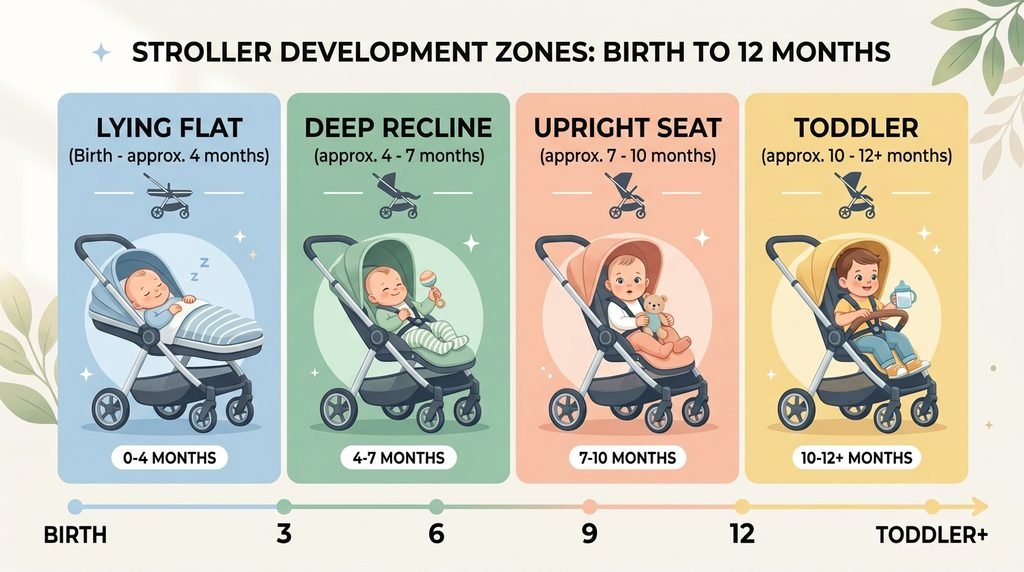
An upright seat usually comes at about 6 months, once head and trunk control are solid. Umbrella and other lightweight strollers deserve extra care here. Consumer Reports says they aren’t recommended until a baby can sit up alone. The exception is a stroller that reclines fully or accepts a car seat.
Jogging strollers need a longer wait. One pediatric practice says the AAP doesn’t recommend running with a baby before 6 months. A pediatrician quoted by Healthline puts the safe window at 6 to 8 months. Car seat adapters on jogging frames are generally meant for walking only, so check your manual. Start on smooth ground, and get your pediatrician’s OK first.
Here’s a simple way to match the setup to age. Treat it as a guide, since babies vary and your manual comes first.
| Baby’s age | Best setup | What to know |
| Birth to about 3 months | Bassinet or carriage, a newborn-approved fully reclining seat, or an infant car seat on a compatible frame | Head control isn’t ready, so keep the airway open and watch the chin |
| About 3 to 5 months | The same setups, or a deeply reclined seat if the maker allows it | Keep rides short and supervised, and follow the manual |
| About 6 to 8 months | A regular upright seat, if head and trunk control are solid | Most makers point here, though every baby differs |
| About 9 to 12 months | An upright seat with the harness | Most babies now sit without support, so watch weight limits |
| 12 months and up | Any suitable stroller, up to its limits | The federal standard covers strollers up to 36 months |
A Safety Checklist Before Every Ride
Knowing “when can baby sit in stroller” is only half the job. A few habits make every ride safer. Run through these steps before you buckle your baby in.
- Set the brake. Use it whenever you stop, and make sure your baby can’t reach the release. A brake that locks two wheels adds extra safety.
- Lock the frame open. Keep your baby away from the hinges when you unfold the stroller, and lock it fully before placing your baby inside.
- Set the recline. Use a deeper recline for younger or wobblier babies, within what your manual allows.
- Buckle the harness. Use the five-point harness every time, even for short rides. The Consumer Product Safety Commission warns that an unrestrained infant can slip through openings and become trapped by the head and neck.
- Check the load. Stay within the age and weight limits. Keep bags in the basket, since bags hanging from the handles can tip the stroller backward.
- Clear the seat. Remove toys strung across the stroller once your baby can sit or rise on hands and knees. Skip pillows, loose blankets, and other add-ons unless the maker approves them.
- Watch your baby. Never leave a child unattended in a stroller, and check posture and chin every few minutes.
The American Academy of Pediatrics’ stroller safety guidance covers these points and more. It also lists the wide-base and easy-brake features to look for when you shop.
Make this a ten-second habit. Brake, harness, recline, chin. After a few days, it becomes automatic, and it catches most of the problems that lead to falls.
If you’re using a hand-me-down, check it carefully. The AAP suggests looking up strollers made before 2014 on the CPSC recall list, since rules were updated that year. Test the brakes, inspect the harness, and make sure the frame lock clicks firmly.
Can Baby Sleep in a Stroller?
Short naps happen, but a stroller isn’t a safe place to sleep. The AAP advises against putting children to sleep in strollers, especially babies under 4 months, because they can move into positions that cause suffocation.

If your baby dozes off, don’t panic. Keep them in sight, and check that the face is clear and the chin is off the chest. Then move them to a firm, flat surface as soon as you can. That guidance comes from the AAP’s safe sleep advice. Our safe sleep guide explains the details.
Small choices help during a supervised stroller nap. Keep the harness snug, and keep the seat free of pillows, soft toys, and loose blankets. Avoid draping a blanket over the stroller, since it hides your baby and can trap heat. Plan for a proper crib or bassinet for longer sleep.
Older babies may doze during a walk, and that’s usually fine. The same rules apply, though. Watch them, keep the harness on, and move them to a flat surface when you get home.
Frequently Asked Questions About Baby Strollers
Here are quick answers to the questions parents ask right after “when can baby sit in stroller.”
Can a newborn go in a stroller?
Yes, with the right setup. Use a bassinet or carriage, a fully reclining seat approved from birth, or an infant car seat on a compatible frame. A regular upright seat has to wait, and first outings should stay short.
Can a 3-month-old sit in a stroller seat?
Only in a deep recline, and only if the maker allows it. Some makers say a reclined seat can start around 3 to 4 months with strong head control. Most upright seats wait until about 6 months. When in doubt, stay with a bassinet or car seat setup.
Does my baby need to sit up on their own first?
Not for a deeply reclined seat. For an upright seat, your baby needs steady head control and enough trunk strength not to slump. Fully independent sitting is a 9-month CDC milestone, so it often comes later. Ask your pediatrician if you’re unsure.
How long can a baby stay in a car seat on a stroller frame?
No single number fits every seat. Car seat makers commonly advise limiting time in the seat, and a semi-reclined position can affect breathing in very young or premature babies. Check your manual, and take your baby out when you arrive.
When can baby ride in a jogging stroller?
Not for running before about 6 months, and many families wait until 6 to 8 months. Check the maker’s minimum age, ask your pediatrician, and remember that car seat adapters are usually for walking only.
Can my baby sleep in a stroller?
Not as a regular sleep space. The AAP advises against it, especially for babies under 4 months. If your baby dozes off, keep them in view and move them to a flat, firm surface as soon as you can.
What if my baby slumps or leans in the seat?
Stop and adjust the recline and harness, and make sure the chin is off the chest. If slumping keeps happening, your baby likely needs more time. Call your pediatrician if your baby feels very floppy, very stiff, or always leans to one side.
Conclusion: What to Remember About Baby and Strollers
So, when can baby sit in stroller? Newborns can ride from birth with the right setup, and an upright seat usually works around 6 months. Readiness matters more than the calendar. Your baby needs steady head control, upright trunk strength, and a chin that stays off the chest.
Use the harness on every ride, follow your manual, and never treat the stroller as a sleep space. Check with your pediatrician if you’re unsure, and revisit the readiness signs every few weeks. For more calm, practical baby gear guidance, explore our other guides on Zayapol.
When did your baby first sit up in the stroller, and how did it go? Tell us in the comments.
This article is for general information and doesn’t replace advice from your child’s doctor.
Related Post:
When Can Baby Face Forward in Carrier? 5 Essential Signs
How to Choose a Baby Stroller: A Complete Guide
When Can Babies Have Blankets? The Safe Sleep Timeline
Can Babies Have Allergies? 7 Essential Signs and Safe Steps
Why Do Babies Grunt in Their Sleep? A Complete Parent’s Guide

2 thoughts on “When Can Baby Sit in Stroller? 5 Safe, Essential Signs”