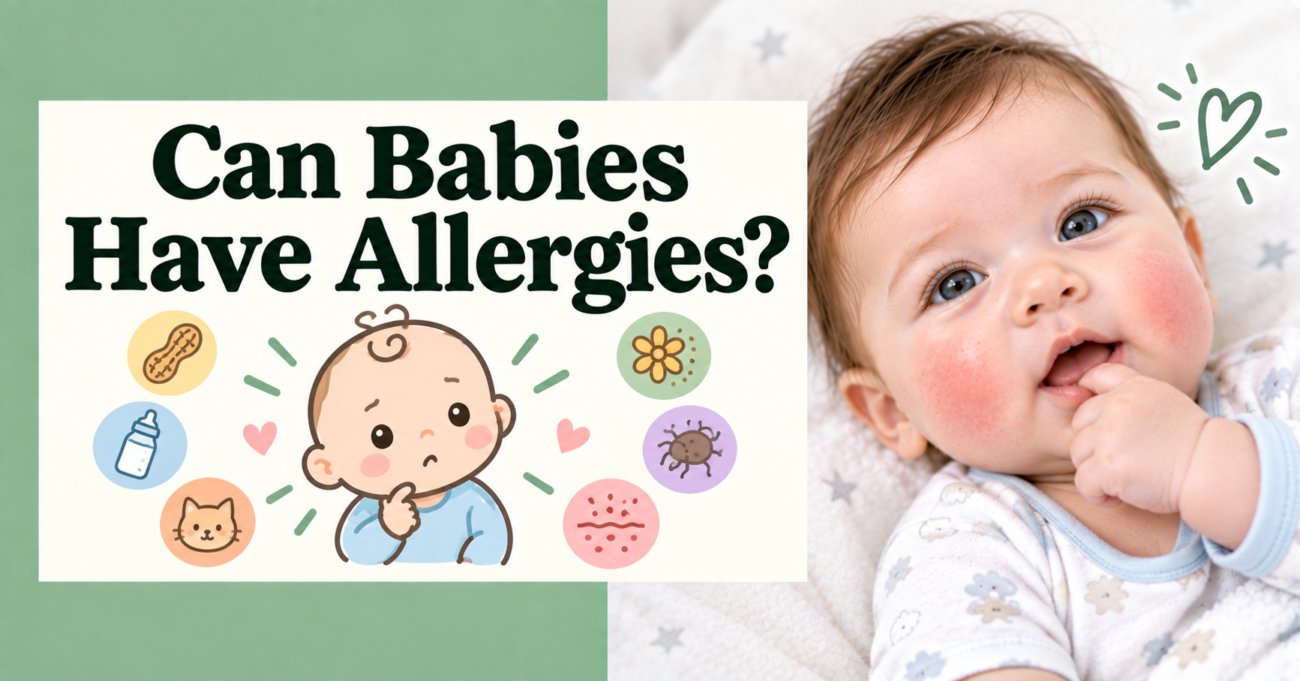
Can babies have allergies? Yes, they can, and food allergies are the most common kind in the first year. Most babies never develop one, but the months when you start solid foods are exactly when problems tend to surface.
Here’s what makes it hard. A red patch on the cheek, a sneezing fit, or a spit-up after a new food could be an allergy. It could just as easily be dry skin, a cold, or ordinary baby digestion. So you end up standing in the kitchen at 2 a.m. with your phone, trying to decide whether to worry.
This guide helps you sort it out. You’ll learn which allergies babies actually get, seven signs worth watching, and how to tell an allergy from a cold or eczema. You’ll also see what current US guidance says about introducing peanut and egg, and what to do if a reaction starts.
One quick note first. This article is general education, not a diagnosis, and your pediatrician knows your baby best.
Quick takeaways
- Can babies have allergies? Yes. Food allergies are the most common type in the first year.
- Babies aren’t born allergic, but they can inherit a higher risk.
- Hives, repeated vomiting, or facial swelling after eating point toward allergy. Trouble breathing is an emergency.
- Pollen allergy is rare before age 2.
- Early, regular introduction of common allergens can lower risk. Ask your pediatrician about timing, especially if your baby has severe eczema.
Can Babies Have Allergies? The Short Answer
Yes, babies can have allergies. An allergy happens when the immune system treats a harmless substance, such as milk protein or pollen, as a threat and reacts to it. In babies, food is the usual culprit.
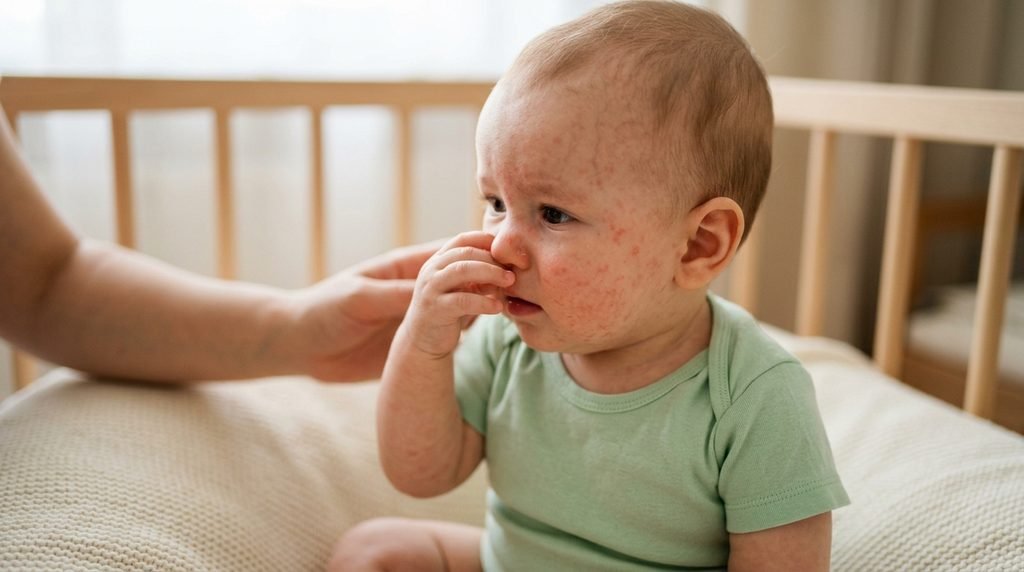
Babies aren’t born allergic, though. What they inherit is a tendency toward allergic disease, and the allergy itself develops after the immune system meets a trigger. Once a baby is “sensitized” to a food protein, the body builds antibodies aimed at it. The next exposure can release histamine, the chemical behind hives, vomiting, and wheezing.
This can happen the first time a baby eats a food, or later. That’s one reason food allergies are more common in infancy than at other ages. A baby’s gut is still developing, and much of the immune system lives there.
How common is it? One 2021 estimate found that 5.8 percent of US children under 18 had a food allergy. Numbers shift with age group and study method, but the pattern holds. Most babies won’t have an allergy, and some will.
Which Allergies Babies Actually Get
Babies get food allergies first, indoor and contact allergies next, and pollen allergies last. Knowing that order helps you guess what’s more likely behind a symptom.
Food allergies
Cow’s milk is the most common food allergy in babies. It hides in many foods and in most standard formulas, and small traces can pass into breast milk when a nursing parent eats dairy. Egg, peanut, wheat, and soy round out the usual list.
Nine foods cause most allergic reactions in the US: milk, egg, peanut, tree nuts, soy, wheat, fish, shellfish, and sesame. Peanut is the leading trigger across childhood overall. Can babies have allergies to several foods at once? Yes. A baby can be allergic to one food or many, and the reactions don’t always look alike.
Indoor and seasonal triggers
Babies spend most of their first year indoors, so dust mites and pet dander tend to come before pollen. That raises a common question. Can babies have allergies to pollen? Rarely before age 2, because true pollen allergy usually needs exposure across two or more seasons. Seasonal allergies most often begin between ages 3 and 5.
If a baby under 2 has a stubborn stuffy nose, allergy isn’t the only suspect. Repeated colds, enlarged adenoids, and cow’s milk allergy can all cause the same picture.
Skin, medication, and latex reactions
Some reactions have nothing to do with food or air. Contact dermatitis is a rash that appears where skin touches an irritant, and common culprits are shampoo, soap, and laundry detergent. A gentler baby skin care routine often solves it.
Medicines can trigger reactions too. Penicillin-type antibiotics, including amoxicillin, are among the best-known drug triggers. Babies with a known latex allergy also need latex-free gloves and medical supplies. Tell every clinician about any reaction you’ve seen.
Signs of Allergies in Babies, Body System by Body System
Can babies have allergies that show up in more than one place at once? Yes. Allergy signs in babies appear on the skin, in the gut, in the nose and eyes, or in the airways. Most start within minutes to about two hours after contact with the trigger. Hives and vomiting are the two most common signs in infants.
The seven signs at a glance
| # | Sign | What you might see | Worth knowing |
| 1 | Hives | Smooth, raised, itchy bumps that move around and fade within hours | Widespread hives plus other symptoms need prompt medical advice |
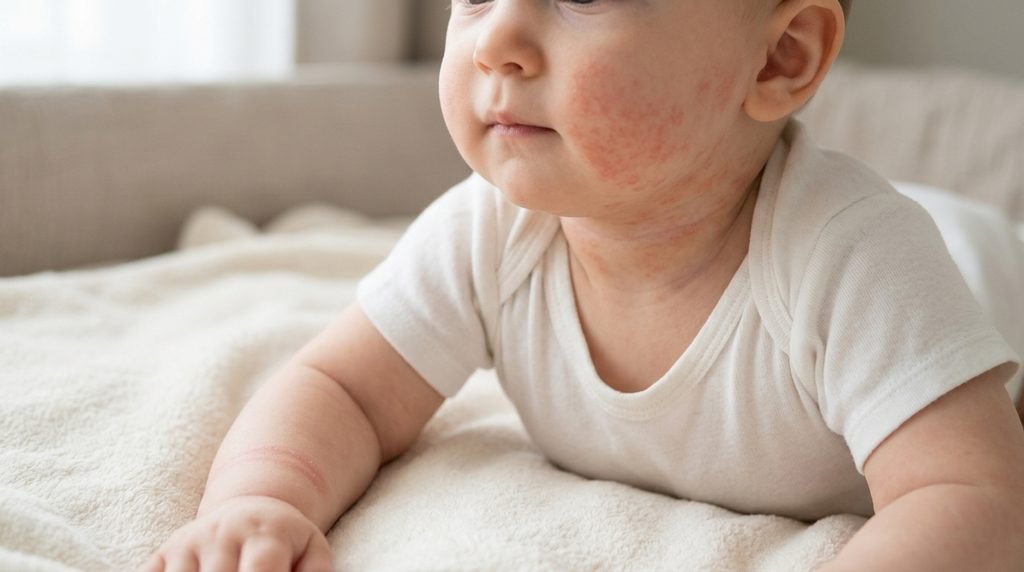
| 2 | Itchy, dry rash | Red, scaly patches on cheeks, neck, or skin creases | Eczema isn’t proof of allergy, but it raises the odds |
| 3 | Vomiting | Repeated vomiting soon after a feed or new food | Vomiting with hives is a classic pairing |
| 4 | Belly and stool changes | Diarrhea, extra gas, blood in the stool, unusual fussiness | Slower reactions often show up in the gut |
| 5 | Nose symptoms | Sneezing, clear runny nose, congestion | More likely from indoor triggers or milk than from pollen |
| 6 | Eye symptoms | Red, itchy, watery eyes and frequent rubbing | Crusty discharge can signal infection, so ask a doctor |
| 7 | Breathing trouble | Coughing, wheezing, swelling of the lips or face | Emergency. Call 911 |
None of these proves an allergy alone. A cluster that appears right after a new food tells you far more. Doctors judge severity by how many symptoms show up and how intense they are, so note everything you see, not just the loudest symptom.
Hives or eczema flare? How to tell
Hives arrive fast. They look like smooth, raised, itchy bumps or puffy patches that can move around the body and fade within hours. Eczema builds slowly instead. It looks dry, rough, or scaly. It favors the cheeks, neck, wrists, ankles, and the creases of elbows and knees, and it can last days or weeks. Flares often follow dry air, sweat, illness, or harsh soaps rather than one meal.
Location gives another clue. Eczema turns up in predictable spots, while food-related hives can appear anywhere and change places from one reaction to the next. A widespread rash across the torso, arms, and legs leans toward allergy, especially with other symptoms. If you’re unsure, get medical advice rather than waiting.
Allergy, Intolerance, Cold, or Eczema? How to Tell the Difference
Can babies have allergies and a cold at the same time? Absolutely, which is why sorting them out feels so hard. The quickest clues are timing, fever, and what’s coming out of the nose or showing on the skin. Use the table as a starting point, then let your pediatrician confirm.
| Condition | Timing | Typical signs | Fever? |
| Immediate food allergy (IgE) | Minutes to about 2 hours after eating | Hives, vomiting, swelling, wheeze | No |
| Delayed food allergy (non-IgE) | Hours to days | Gut symptoms, loose or bloody stools, fussiness, eczema flares | No |
| Food intolerance or sensitivity | Varies | Gas, discomfort, rashes, fussiness | No |
| Cold | Builds gradually, lasts 1 to 2 weeks | Cough, mucus that may turn thick or green | Sometimes |
| Eczema | Slow, flares last days to weeks | Dry, itchy, scaly patches | No |
| Indoor or seasonal allergy | Recurs with the trigger | Clear watery discharge, sneezing, itchy eyes | No |
Two terms in that table deserve a plain-English note. IgE-mediated allergies involve a specific antibody and tend to act fast. Non-IgE reactions work more slowly and often involve the gut. An intolerance or sensitivity, on the other hand, doesn’t produce that antibody, though it can still cause real discomfort.
Sneezing and a snuffly nose need context too. In newborns, they usually come from colds or dry air, not allergy. A cold clears in a week or two, and then your baby feels fine until the next one. Allergy symptoms stick around as long as the trigger does. If your baby is worse at home around a furry pet, that pattern is worth mentioning.
Before you cut any food from your baby’s diet, talk with the pediatrician. Removing foods without a clear reaction can backfire. It may raise the chance of developing an allergy and can leave nutritional gaps.
Why Some Babies Are More at Risk
Can babies have allergies without any risk factors at all? Yes, but eczema and family history raise the odds, and eczema carries more weight. Risk isn’t destiny, though. Plenty of babies with risk factors never develop an allergy.
Eczema
A large population study compared infants with and without eczema. By 12 months, those with eczema were about six times more likely to have egg allergy and 11 times more likely to have peanut allergy. You can read the details in this PubMed cohort study on eczema and food allergy risk. Early, severe eczema raises the risk the most. Roughly 1 in 3 babies with eczema go on to develop a food allergy.
Why the link? Broken skin may let food proteins slip in. Small, unnoticed exposures, like food residue on a caregiver’s hands, can also prime the immune system over time. Good baby eczema care matters for that reason.
Family history
Allergies run in families. Studies suggest the odds of allergic disease rise to about 30 to 50 percent when one parent has allergies. When both parents do, the odds climb to 50 to 80 percent. A sibling with allergies, asthma, or eczema also counts.
Delivery, antibiotics, and the gut
Some research links C-section birth and early antibiotic use, especially penicillin, to a higher chance of food allergy. The findings aren’t consistent, so treat them as a signal to watch, not a reason to avoid needed antibiotics or a medically necessary C-section.
Breast milk and formula
Breast milk can carry traces of the foods a nursing parent eats. Even so, cow’s milk protein allergy in exclusively breastfed infants is uncommon, about 0.5 to 1 percent by one review, and it’s sometimes over-diagnosed. A nursing parent’s elimination diet hasn’t been shown to prevent eczema or food allergy.
Cow’s milk formula is a common trigger for babies who do have milk allergy. If you suspect a link, don’t overhaul your own diet or switch formulas on a hunch. Bring your notes to the pediatrician first.
When Allergies Start: A First-Year Timeline
Can babies have allergies at any point in the first year? Yes, but the type changes with age. Think of this as a rough map, not a schedule, because every baby moves at their own pace.
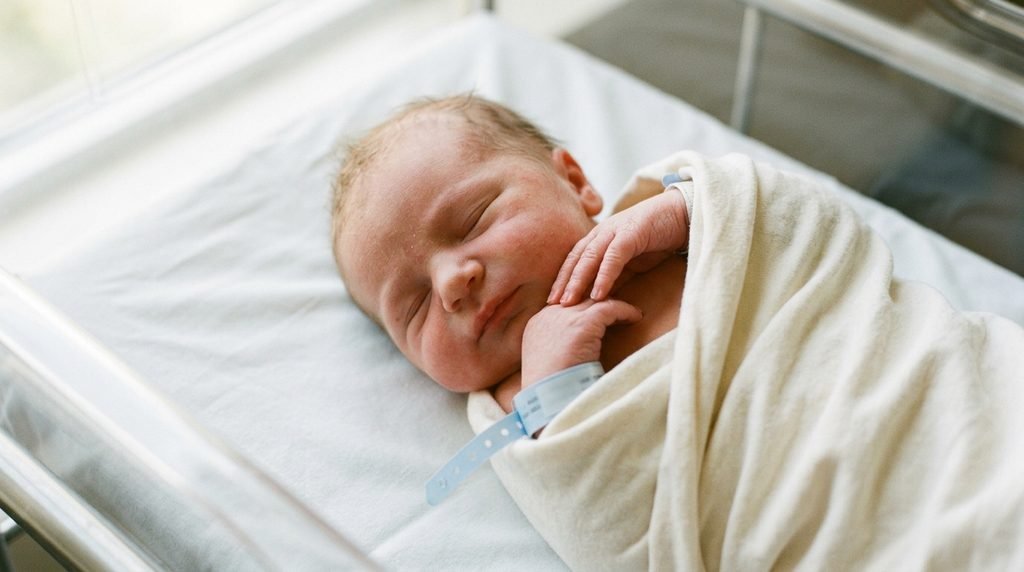
- Birth to 3 months: Skin and gut signs lead. Newborn rashes often fade around 2 to 3 months, and that’s roughly when allergic rashes and eczema can begin. Cow’s milk reactions can show up here.
- 4 to 11 months: First foods arrive, and so do most first food reactions. Researchers call this a critical window for teaching the immune system to tolerate common allergens.
- 12 to 24 months: The menu widens, and indoor triggers like dust mites and pet dander can join in. Pollen allergy is still unlikely.
- Ages 3 to 5: Seasonal allergies typically start once the immune system has met several pollen seasons.
Tracking your baby’s growth and milestones alongside new foods makes patterns easier to spot later.
Early Allergen Introduction: What US Guidance Says
Current US guidance says to introduce peanut and other common allergens early, around 4 to 6 months for high-risk infants, instead of delaying them. Parents were once told to wait until age 3. That advice is gone.
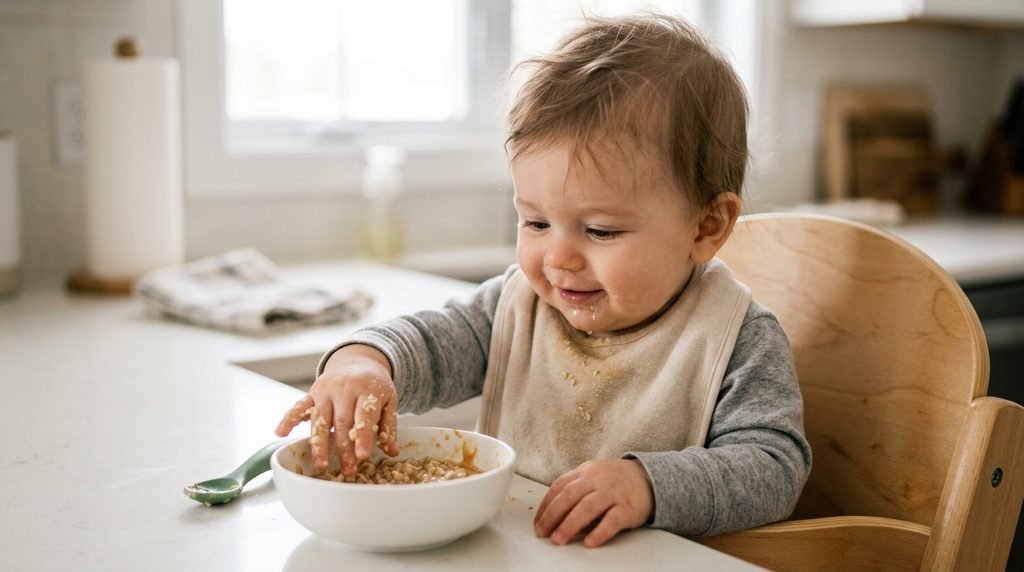
The turning point was the LEAP trial. Infants with severe eczema or egg allergy who ate peanut regularly had an 81 percent lower risk of peanut allergy by age 5. The benefit lasted into adolescence. Rates of peanut allergy have since dropped in the years after early-introduction guidelines appeared.
The NIAID Addendum Guidelines for the Prevention of Peanut Allergy sort infants into three groups:
- Severe eczema, egg allergy, or both: Consider testing first, then introduce peanut-containing foods at 4 to 6 months.
- Mild to moderate eczema: Introduce peanut foods around 6 months.
- No eczema or food allergy: Introduce peanut foods when your baby is developmentally ready, in line with your family’s preferences.
Peanut shouldn’t be the first solid food. Other solids come first, to show your baby is ready. The guidelines suggest about 6 to 7 grams of peanut protein per week, spread over three or more feedings.
A later consensus approach suggests introducing peanut and egg around 6 months, but not before 4, and puts less emphasis on pre-testing. Some experts say most infants can start at home without tests. Even so, if your baby has severe eczema, call the pediatrician first.
If your baby has already had a reaction to a food, don’t retry it at home. Ask an allergist how to proceed. Safe preparation matters for everything else. Use smooth nut butter thinned with water or breast milk, never whole nuts or chunky spreads. Mash hard-boiled egg, and soften bread in liquid. Then keep those foods in the diet regularly. Ready to begin? Our guide to starting solid foods walks through the first weeks.
Can babies have allergies to peanut even after early introduction? Yes. Early introduction lowers risk but doesn’t eliminate it, and that’s one of a few honest caveats. The FDA has also noted that the evidence behind its peanut health claim rests on a single major study. And a severe reaction to the very first taste is unlikely, since the immune system must meet a food before it reacts strongly. But a mild first reaction doesn’t guarantee later ones will stay mild.
How Doctors Diagnose and Treat Baby Allergies
Diagnosis starts with your story. Your pediatrician asks what your baby ate, what happened, and how fast it happened. Then an allergist may add a skin prick test, which pricks the arm or back to watch for a small hive. A blood test can also measure allergy antibodies. Some cases need a supervised food challenge.
Timing depends on the reason for testing. One children’s hospital notes that testing usually waits until around 6 months. NIAID guidance, on the other hand, says to consider testing high-risk infants before introducing peanut at 4 to 6 months. Your doctor weighs your baby’s situation.
Treatment mostly means avoiding the trigger. There’s no cure, though many children outgrow some allergies. For cow’s milk allergy, extensively hydrolyzed formulas work for many babies, and a smaller group needs amino acid-based formulas. Change one thing at a time and allow 2 to 3 weeks to judge, unless symptoms are severe. If you’re comparing options, see our notes on choosing a baby formula.
Medicine has limits at this age. One children’s hospital says no effective allergy medication exists for babies under 6 months, and that cetirizine is appropriate from 6 months. Always check any product and dose with your pediatrician first.
The long game is hopeful. About half of children with milk allergy outgrow it by age 5, and nearly 3 in 4 do by adolescence. Peanut and tree nut allergies are less likely to fade.
What to Do During a Reaction
Stop the food, stay with your baby, and call 911 for trouble breathing or swelling that affects the airway. Anaphylaxis is a severe, whole-body allergic reaction, and it needs emergency care right away.
Treat these as emergencies:
- Difficulty breathing, wheezing, or a hoarse cry
- Swelling of the lips, tongue, or face
- Repeated vomiting along with hives
- A limp, pale, or unusually drowsy baby
If your doctor has prescribed epinephrine, use it as instructed and still call 911. For milder signs, like a few hives and no other symptoms, stop the food and call your pediatrician the same day. Widespread hives plus any other symptom deserve urgent care.
Once your baby is safe, start a reaction log. It takes five minutes and helps the doctor far more than memory does. Record the time of the last bite, the amount eaten, the brand and ingredient list, and what else your baby had that day. Snap a timestamped photo of the rash or swelling, since hives can fade before the appointment. Note how long symptoms lasted and what helped.
Frequently Asked Questions
Can babies have allergies from birth?
Not exactly. Babies aren’t born with allergies, but they can be born with a genetic tendency toward them. The allergy itself develops after the immune system is exposed to a trigger, which can happen through formula, breast milk, or first foods.
Can babies have allergies to pollen in their first year?
It’s rare. True pollen allergy usually needs exposure over two or more seasons, so it typically starts between ages 3 and 5. Indoor triggers like dust mites and pet dander are more likely in the first year.
Can babies have allergies from breast milk?
Breast milk itself isn’t the problem, but traces of foods a nursing parent eats can pass into it. Cow’s milk protein allergy in exclusively breastfed babies is uncommon, roughly 0.5 to 1 percent by one review. Talk with your pediatrician before cutting foods from your own diet.
How can I tell if my baby has allergies or a cold?
Check for fever, nasal discharge, and timing. Colds can bring a fever and thick or green mucus, and they clear in one to two weeks. Allergies don’t cause fever, usually bring clear watery discharge, and last as long as the trigger is around.
At what age can babies be tested for allergies?
It depends on why you’re testing. Some children’s hospitals say testing usually starts around 6 months. US guidelines say to consider testing before peanut introduction for infants with severe eczema or egg allergy at 4 to 6 months. Your pediatrician or allergist decides.
What is the most common allergy in babies?
Cow’s milk allergy is the most common food allergy in babies. Eczema is the most common allergy-related sign. Egg, peanut, wheat, and soy follow.
Do babies outgrow allergies?
Many do, but it depends on the food. About half of children with cow’s milk allergy outgrow it by age 5, and nearly 3 in 4 by adolescence. Peanut and tree nut allergies are less likely to go away.
Conclusion
So, can babies have allergies? Yes, and now you know what to look for. Three things matter most. Watch how your baby reacts in the first two hours after new foods. Keep eczema well managed. And don’t put off talking with your pediatrician about introducing peanut and egg.
Worry is normal here. Food allergy clinics see plenty of parent anxiety, and a plan is the best remedy. Save this guide, bring your reaction log to the next checkup, and ask about your baby’s personal risk.
Have you ever wondered whether a rash was an allergy or just baby skin? Share what confused you in the comments, and we’ll cover it next.
What to Write in a Baby Shower Card: Ideas & Etiquette
When Do Babies Start Smiling? The Real Timeline
Baby’s Skin Is Mottled: Causes and When to Worry
When Can You Find Out Baby Gender? Reveal Party Timing
Why Do Babies Grunt in Their Sleep? A Complete Parent’s Guide

One thought on “Can Babies Have Allergies? 7 Essential Signs and Safe Steps”