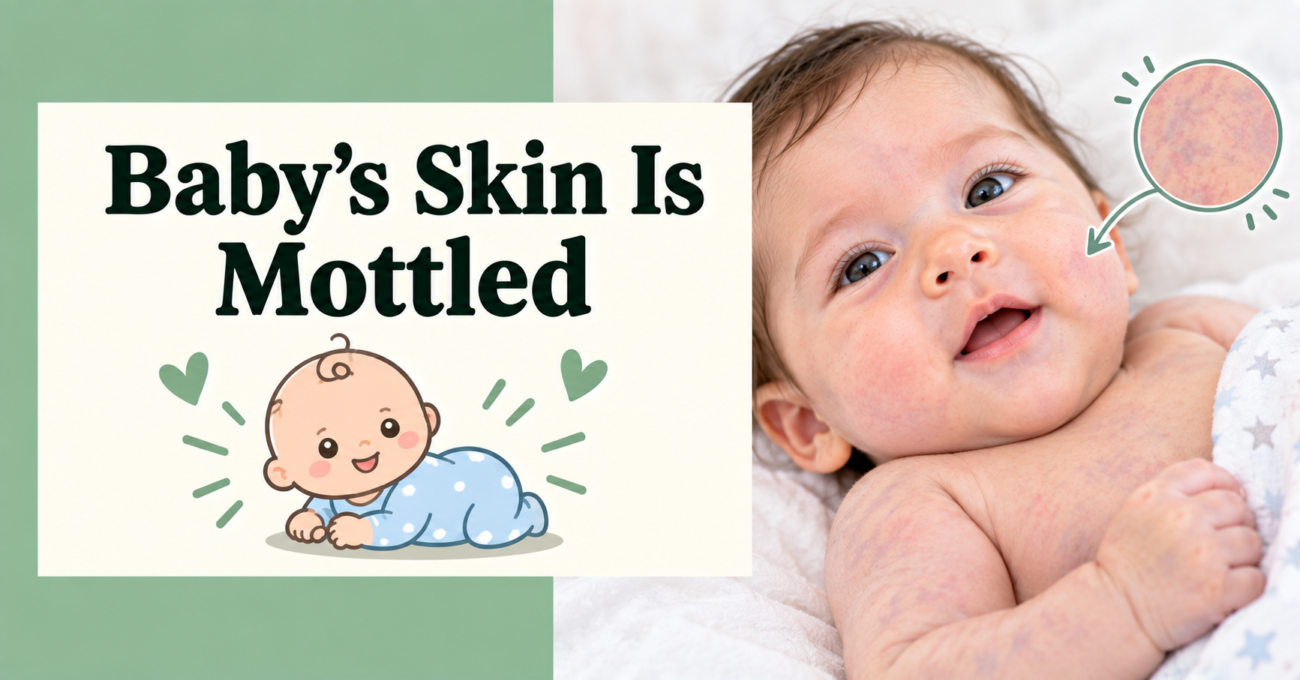
You’re halfway through a diaper change when you notice it a lacy, marbled pattern of blue and purple spreading across your baby’s legs, like a faint web just under the skin. For a second, your stomach drops. If your baby’s skin is mottled, here’s the reassuring news first: in the vast majority of cases, this is one of the most common and least concerning things a newborn’s skin does.
Quick answer:
Mottled skin, medically called cutis marmorata, is usually a normal response to cold temperatures caused by a newborn’s still-developing circulation. It typically fades once your baby warms up and resolves on its own over the following months. The exception is mottling that shows up alongside fever, extreme sleepiness, poor feeding, or breathing trouble that combination is worth urgent medical attention rather than a wait-and-see approach.
What It Means When Baby’s Skin Is Mottled
Mottling gets its lacy, marbled look from something happening just beneath the skin’s surface: the small blood vessels there are constricting and dilating unevenly, which changes how visible they are in different patches. Doctors call the common newborn version cutis marmorata, literally “marbled skin,” and it’s not a rash, an infection, or anything happening on the surface of the skin itself it’s simply a visible reflection of how blood is moving through the vessels underneath.
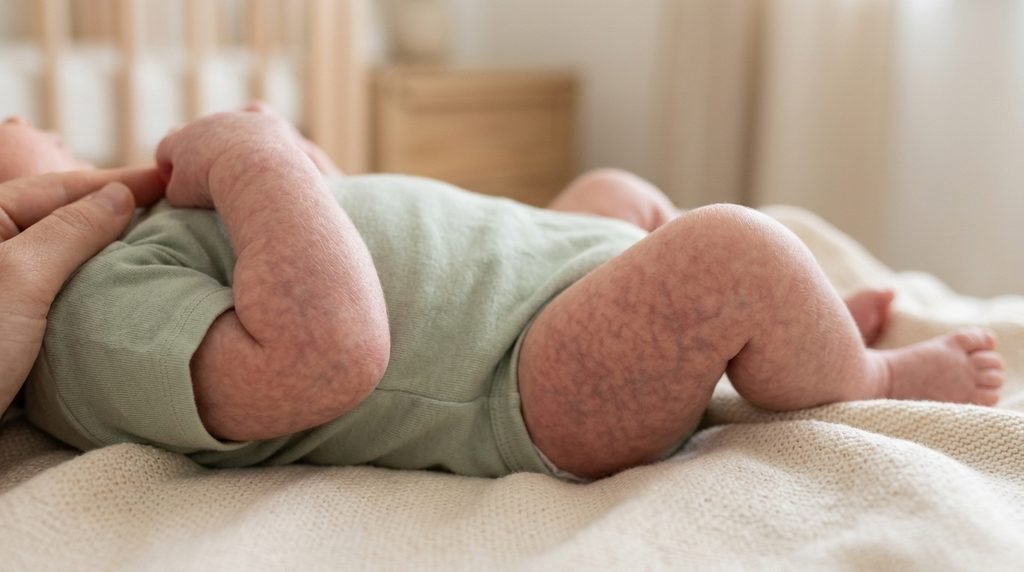
The reason it shows up so often in young babies comes down to development. A newborn’s nervous system hasn’t fully matured yet, including the part responsible for evenly regulating blood vessels near the skin. Until that system catches up, temperature changes and other triggers can cause blood flow to shift unevenly, producing that characteristic web-like pattern.
Common, Everyday Triggers
Cold is by far the most common trigger, and it’s often the very reason parents first notice mottling: right after a bath, during a diaper change in a cool room, or after removing a layer of clothing. Crying, feeding, and general fussiness can occasionally bring it on too, and premature infants tend to show more pronounced mottling than full-term babies, simply because their circulatory and nervous systems have had less time to mature.
None of these triggers are cause for concern on their own. If you notice the mottling fades once your baby is re-dressed, wrapped in a blanket, or held skin-to-skin for a few minutes, that’s a strong sign this is the ordinary, temperature-related kind.
The Three Levels of Mottling — Normal, Worth Mentioning, Emergency
Rather than treating this as a simple “fine” or “call 911” situation, it helps to think in three tiers.
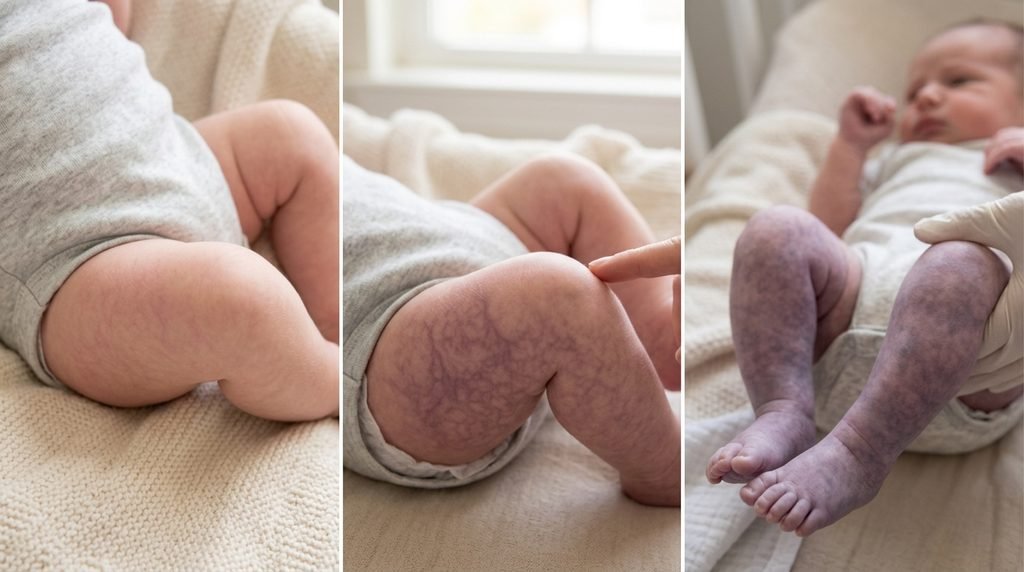
Level 1 — Normal, no action needed. Mottling that appears after cold exposure, fades with warming, and happens in a baby who’s otherwise feeding well, gaining weight, and acting like themselves. This covers the large majority of cases.
Level 2 — Worth mentioning at your next checkup. Mottling that keeps recurring well past the newborn stage say, still showing up regularly after 3 months of age or that seems unusually intense compared to what you’d expect from the room temperature. This isn’t an emergency, but it’s a reasonable thing to flag for your pediatrician so they can take a look and rule out anything else going on.
Level 3 — Seek medical care promptly. Mottling that shows up alongside fever or an unusually low temperature, extreme sleepiness or difficulty waking, poor feeding, rapid or labored breathing, or a bluish tint around the lips. This combination is different from ordinary cutis marmorata and deserves prompt medical attention rather than waiting it out at home.
When It’s an Emergency — Sepsis and Circulatory Warning Signs
This is the part worth taking seriously, even though it applies to a small minority of cases. Mottled or discolored skin is a recognized warning sign of sepsis in infants a serious, rapidly progressing complication of infection where blood flow gets diverted away from the skin toward the body’s vital organs. According to Miller Children’s & Women’s Hospital, warning signs of sepsis in babies include poor feeding, fewer wet diapers, trouble breathing, unusual sleepiness, fever or a lower-than-normal temperature, pale or mottled skin, and a baby who simply doesn’t seem like themselves.
The key distinguishing factor is that sepsis-related mottling doesn’t show up in isolation it comes bundled with other signs that your baby is genuinely unwell, not just cold. A baby with ordinary cutis marmorata is otherwise acting completely normal: alert, feeding fine, comfortable once warmed up. A baby with concerning mottling tends to look and act sick alongside it.
Certain congenital heart conditions can also cause a mottled, pale, or bluish skin tone due to circulation or oxygenation problems, which is why blue lips or noticeable breathing difficulty paired with mottling should always be treated as urgent, regardless of the cause. If you ever see mottling combined with any of these signs, don’t wait to see if it improves seek medical care right away.
When Mottling Doesn’t Fade — Could It Be CMTC?
There’s a second, much rarer condition worth knowing about, precisely because it looks similar at first glance but behaves differently. It’s called cutis marmorata telangiectatica congenita, or CMTC, and the key distinguishing feature is right in the name: it’s congenital, meaning present from birth, and unlike ordinary cutis marmorata, it doesn’t fade when your baby warms up.
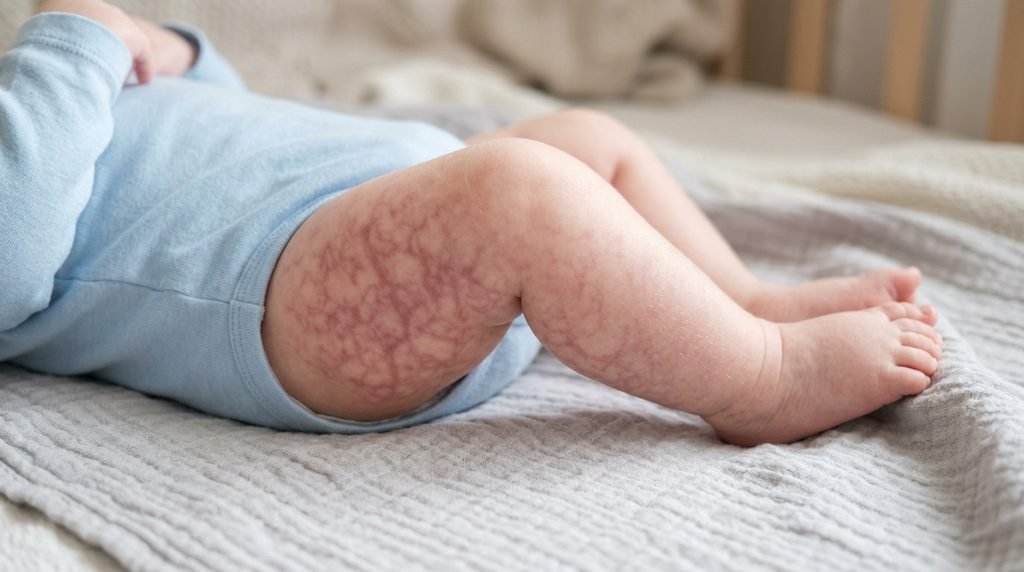
CMTC tends to look more pronounced and more fixed than the common form often described as a deeper violet or purple, sometimes localized to one area of the body rather than spread evenly, and sometimes affecting just one limb or side. According to clinical reference literature on CMTC, it’s considered a rare, generally benign vascular condition, and most babies with it go on to develop normally, with the skin pattern gradually fading over the first year or so of life. That said, because CMTC has occasionally been associated with other developmental considerations, a pediatrician or pediatric dermatologist evaluation is the right next step if you notice mottling that simply won’t resolve with warming, especially if it was there from the very start.
The takeaway isn’t to worry CMTC is uncommon, and most persistent-looking mottling still turns out to be a more pronounced version of the ordinary kind. It’s simply worth knowing that “doesn’t go away with warming” is the one detail that separates a routine observation from something your pediatrician should actually look at.
What You Can Do at Home
For the everyday, cold-triggered version, there’s genuinely not much to do beyond the obvious:
- Add a layer or wrap your baby in a warm blanket if you notice mottling after a bath or diaper change.
- Try skin-to-skin contact, which warms your baby quickly and comfortably while also being a nice bonding moment.
- Keep the nursery in a comfortable range, generally around 68–72°F, to reduce how often the temperature-related version shows up in the first place. Our guide on how to dress your baby for sleep covers this room-by-room if you want more detail.
- Watch, don’t panic. If the mottling fades within a few minutes of warming and your baby seems otherwise completely fine, there’s nothing further you need to do.
Frequently Asked Questions
Is mottled skin common in newborns?
Yes, extremely common. Most babies show at least occasional mottling in their first few months, especially right after a bath or during a cool diaper change, and it typically becomes less noticeable as their nervous system matures.
Does mottled skin always mean my baby is cold?
Usually, yes cold is the most common trigger by far. But crying, feeding, and general fussiness can occasionally bring it on too, so it’s not an absolute sign your baby needs another layer if the room is already warm.
Can premature babies have more mottling than full-term babies?
Yes. Premature infants tend to show more pronounced mottling since their circulatory and nervous systems have had less time to develop, and it often becomes less frequent as they catch up developmentally over the following weeks and months.
Should I worry if it keeps coming back after a few months?
Not necessarily an emergency, but recurring mottling well past the newborn stage especially after 3 months of age is worth mentioning at your baby’s next checkup so your pediatrician can take a look and rule out anything else going on.
Conclusion
For the overwhelming majority of babies, mottled skin is simply cutis marmorata a completely normal, temporary side effect of a circulatory system that’s still learning to regulate itself, triggered by cold and resolved with warming. Keep an eye out for the combination that actually matters: mottling alongside fever, extreme sleepiness, poor feeding, or breathing trouble, which is worth prompt medical attention rather than waiting it out. And if the mottling simply never fades no matter how warm your baby gets, that’s worth a mention to your pediatrician too, just to have it looked at properly.
Have you noticed mottling show up at a predictable moment right after bath time, or during a diaper change in a chilly room? That pattern alone is often the clearest sign you’re looking at the completely ordinary kind.
Related Post:
What to Write in a Baby Shower Card: Ideas & Etiquette
Does Baby Oil Help You Tan? What Dermatologists Say
Do Babies Open Their Eyes in the Womb?
When Can You Find Out Baby Gender? Reveal Party Timing
Why Do Babies Grunt in Their Sleep? A Complete Parent’s Guide
