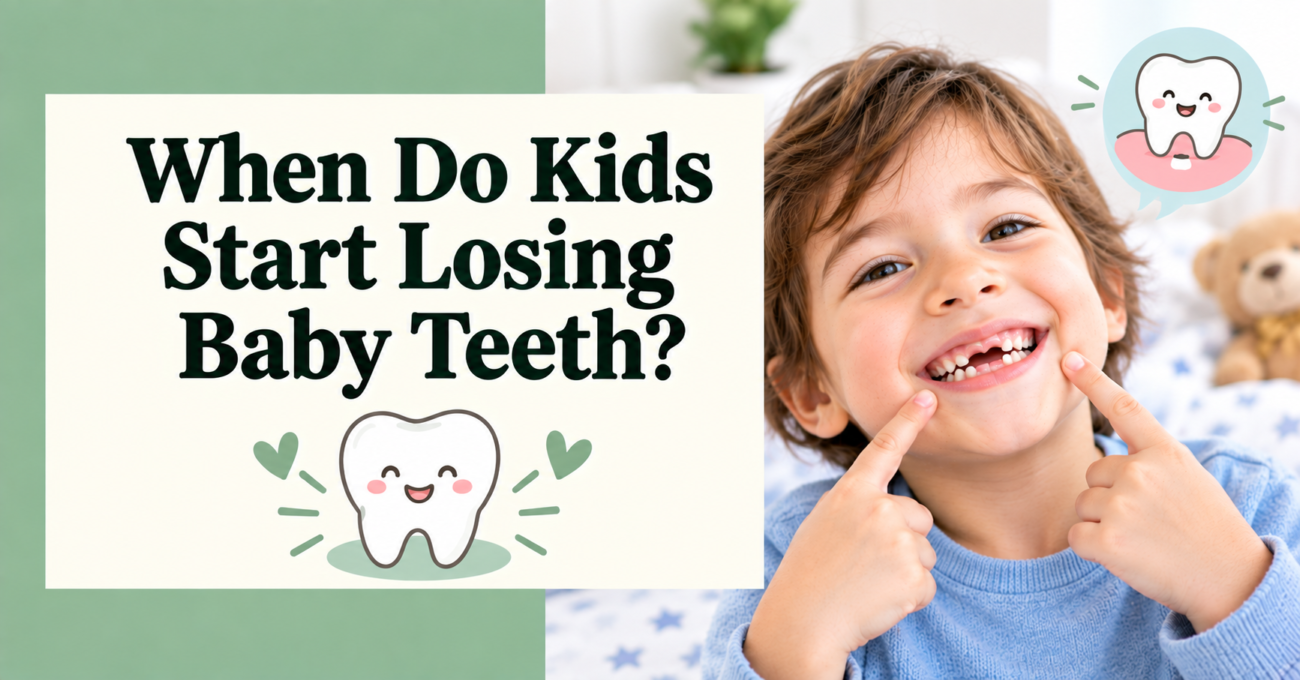
One day your kid is grinning their full, gummy-toothed smile, and the next they’re wiggling a front tooth at the dinner table with the kind of intensity usually reserved for video games. If you’re wondering when do kids start losing baby teeth, that wiggly-tooth phase is your answer arriving right on schedule and it’s a lot more predictable than it feels in the moment.
Quick answer:
Most kids lose their first baby tooth around age 5 or 6, though anywhere from 4 to 7 is considered completely normal. The process usually wraps up by age 12 or 13, and teeth tend to fall out in roughly the same order they first came in.
The Real Age Range — When Do Kids Start Losing Baby Teeth?
Age 6 is the number you’ll see most often, and it’s a genuinely solid average to keep in mind. But “average” is doing a lot of work in that sentence plenty of kids lose their first tooth at 4 or 5, and plenty more don’t lose one until 7, all without anything being wrong. If your child’s baby teeth came in early as an infant, there’s a decent chance they’ll lose them a bit early too; the same goes for kids whose teeth came in later than typical.
There’s also a small, well-documented pattern worth knowing: girls tend to lose their first tooth slightly earlier than boys, on average. It’s not a huge gap, and it’s certainly not a rule for every individual kid, but it’s common enough that dentists mention it regularly.
By around age 12 to 13, most kids have lost all 20 of their baby teeth and have a full set of permanent ones (minus wisdom teeth, which show up much later). So the whole process start to finish typically spans about six or seven years.
The Order Teeth Usually Fall Out
Here’s the part parents find genuinely useful: baby teeth almost always fall out in the same order they erupted, which makes the whole process fairly predictable.
- Lower central incisors (bottom front two teeth) usually first, around age 6
- Upper central incisors (top front two teeth) close behind, often within the same year
- Lateral incisors (the teeth just beside the front ones, top and bottom) around ages 7-8
- First molars and canines (the pointy teeth) typically ages 9-11
- Second molars (the very back baby teeth) usually last, around ages 10-12
Front teeth first, back teeth last that’s the pattern to remember, and it holds true for the vast majority of kids. If your child’s teeth erupted in the typical order as a toddler, there’s a good chance they’ll follow that same order on the way out.
Why This Matters — What Baby Teeth Are Actually Doing
It’s tempting to think of baby teeth as temporary placeholders that don’t matter much, but they’re doing real structural work while they’re in there. Every baby tooth is holding open a specific amount of space for the permanent tooth developing underneath it, and it’s also guiding the jaw as it grows to eventually accommodate a full adult-sized smile.
That’s exactly why early tooth loss from decay or an injury, rather than natural shedding is worth paying attention to. When a baby tooth disappears too soon, the teeth next to that gap can drift inward and crowd the space meant for the permanent tooth, sometimes leading to alignment problems down the road. It’s not a guaranteed outcome, but it’s common enough that dentists often recommend a small device called a space maintainer to hold the gap open until the permanent tooth is ready to come in.
Wait, My Kid Is Gaining Teeth AND Losing Them?
Here’s a detail that surprises a lot of parents the first time they hear it: around age 6, right when the front baby teeth start wiggling loose, a completely new set of permanent teeth is also showing up and they’re not replacing anything.
The first permanent molars, often called “6-year molars,” erupt in the empty space at the very back of the jaw, behind all the existing baby teeth. There’s no baby tooth in that spot to fall out first; these are brand-new additions to your child’s mouth. So for a while, your kid is simultaneously losing old teeth up front and gaining new ones in the back which explains why a 6- or 7-year-old’s mouth can look like a genuinely chaotic mix of gaps, baby teeth, and new permanent teeth all at once. It’s not a sign anything’s off; it’s just what this stage actually looks like.
Signs It’s Starting
Most kids notice something feels “off” with a tooth before it’s visibly loose a slight wobble when they bite into food, or a strange sensation when they run their tongue over it. From there, it typically becomes noticeably loose over a period of days to a couple of weeks, sometimes with a little tenderness or mild gum swelling right around the tooth as it prepares to come out. That swelling is normal and usually resolves quickly once the tooth is gone; children’s ibuprofen can help if it’s bothering your child in the meantime.
How to Handle a Loose Tooth
The honest answer here is: mostly, just let it happen. A loose baby tooth is being pushed out from underneath by the permanent tooth beneath it, and forcing the process before the tooth is genuinely ready can cause unnecessary pain or bleeding.
If your child wants to help it along, gentle wiggling with clean fingers or the tongue is generally fine it won’t hurt anything as long as it’s not aggressive. A simple way to test if a tooth is truly ready is the tissue test: have your child gently squeeze the loose tooth between a piece of tissue or soft cloth. If it comes out easily with minimal resistance, it was ready. If it doesn’t budge, that’s your cue to back off and give it a few more days.
Most loose teeth end up coming out on their own during totally ordinary moments — eating, playing, brushing with far less drama than parents expect.
When to Check In With a Dentist
Most of this process needs zero intervention from you. But there are a few specific situations worth a call to the dentist rather than waiting it out:

- Loss before age 4, especially of the back molars or canines, since Mayo Clinic notes that a permanent tooth may not erupt in proper alignment if the baby tooth is lost this early.
- No teeth lost at all by age 7-8, which is outside the typical window and worth a checkup, even though it’s rarely a true emergency.
- A tooth lost to injury or trauma, rather than natural shedding this is different from routine tooth loss and deserves a dental evaluation to check for damage to the surrounding gum or the permanent tooth underneath.
- Pain, swelling, or bleeding that doesn’t settle down quickly, which can signal infection rather than normal, expected tenderness.
One important distinction: a knocked-out baby tooth is generally not a dental emergency you typically don’t need to try to save or reinsert it, since doing so can actually interfere with the permanent tooth developing underneath. A knocked-out permanent tooth is a completely different situation and does need urgent dental attention, ideally within the hour, so it’s worth knowing which kind of tooth you’re dealing with before deciding how urgently to act.
Helping an Anxious Kid Through It
Some kids treat a loose tooth like a trophy and can’t wait for it to fall out. Others find the whole thing genuinely unsettling a body part coming loose is a strange concept when you’re 6. Both reactions are completely normal, and a little reassurance goes a long way: remind your child that this happens to every kid, that it doesn’t hurt the way they might expect, and that a strong new tooth is already on its way to take its place.
Leaning into the tradition around it a visit from the tooth fairy, a special little box to keep the tooth in, whatever your family’s version of that celebration looks like tends to turn a mildly nerve-wracking moment into something kids actually look forward to.
Frequently Asked Questions
Is it bad if my kid hasn’t lost any teeth by age 7?
Not necessarily an emergency, but it’s outside the typical range and worth mentioning at their next dental checkup. Sometimes it’s simply genetics kids whose teeth came in late as toddlers often lose them late too.
Can I pull a loose tooth myself?
If it’s genuinely ready meaning it comes out easily with the gentle tissue-squeeze test yes, that’s fine. If it resists or your child is in pain, don’t force it; give it more time.
What if a permanent tooth comes in before the baby tooth falls out?
This is sometimes called “shark teeth,” where a new tooth erupts behind a baby tooth that hasn’t loosened yet, creating a temporary double row. It’s fairly common and usually resolves on its own within a few months as the baby tooth loosens and falls out, but it’s worth a quick mention to your dentist if it doesn’t shift within that window.
Does losing teeth early or late affect the adult teeth?
Timing itself usually isn’t the issue it’s the reason behind unusually early or late loss that matters. Early loss from decay or injury can affect spacing, while very late loss is worth checking simply to rule out an underlying cause. Losing teeth a bit earlier or later than average, on its own, is rarely something to worry about.
Conclusion
If you’re still wondering when do kids start losing baby teeth, the real answer is: somewhere in that wide, normal window between ages 4 and 7, most commonly right around 6, following a predictable front-to-back order that wraps up by around age 12 or 13. Let the process happen at its own pace, keep an eye out for injury or unusually early or late loss, and don’t be surprised if your kid is gaining brand-new molars in the back while losing baby teeth up front that’s genuinely normal, not a coincidence worth worrying about.
Related Post:
When Can Babies Breathe Through Their Mouth? A Parent’s Timeline
Does Baby Oil Help You Tan? What Dermatologists Say
When Can Babies Have Blankets? The Safe Sleep Timeline
When Can You Find Out Baby Gender? Reveal Party Timing
Why Do Babies Grunt in Their Sleep? A Complete Parent’s Guide

One thought on “When Do Kids Start Losing Baby Teeth? Age & Order Guide”