You’ve got the book picked out, it’s wrapped and ready, and you’re standing there with a pen, staring at that blank inside cover like it owes you an explanation. Everyone else seems to know exactly what to write in baby shower book pages funny, heartfelt, not too long, not too short and you’re stuck somewhere between “Congratulations!” and full writer’s block.
Good news: this is a lot less complicated than it feels in the moment. Here’s everything you need to write something genuine in the next five minutes.
Quick answer:
A short, sincere message beats a clever one every time. Two to three sentences a welcome to the baby, a wish for the family, and your name and the year covers it completely. If you want to go further, personal beats generic: a small detail about your relationship to the parents will always land better than a quote pulled from somewhere online.
Two Kinds of “Baby Shower Book”
Quick pause before we go further, because this phrase actually means two different things depending on the shower. Most often, “baby shower book” refers to a children’s picture book you’re gifting instead of a card, where you write a personal note on the inside cover that’s the version most people are asking about, and it’s what the rest of this guide focuses on.
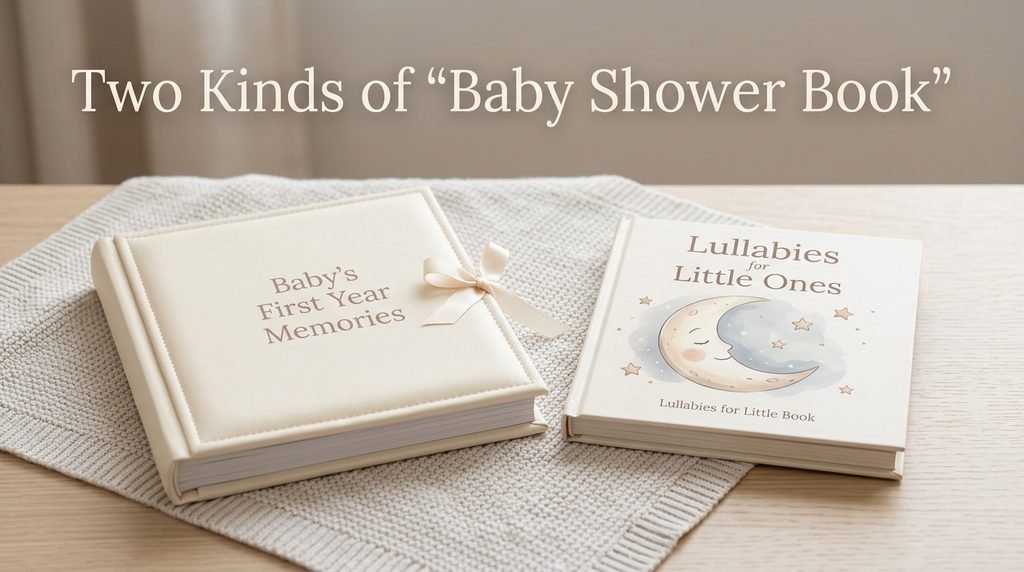
The other version is a baby shower guest book, a keepsake journal passed around at the party where every guest leaves advice, well-wishes, or a prediction about the baby. If that’s what you’re holding, skip down to the guest book section near the end the etiquette is a little different.
The Basics Before You Write
A few small logistics make the actual writing part much easier.
You probably don’t know the baby’s name yet. That’s completely normal for a shower. Address your message to “Baby [Last Name],” or sidestep the issue entirely with something like “Welcome, little one” or “To our newest favorite person.”
Where to write it matters. In a hardcover book, the inside front cover is usually your best bet — it’s blank, sturdy, and won’t smudge. If there’s a dedication page, even better; that’s exactly what it’s there for. Board books are trickier since they have less space, so don’t be afraid to keep it to one short line if that’s all that fits.
Watch for smudging. Glossy or laminated pages don’t play nice with regular pens. A fine-tip permanent marker holds up better on slippery surfaces, and either way, give the ink a minute to dry before you close the book.
Sign your name and the year — skip the full date. “With love, Priya, 2026” tells the child exactly who gave them this and roughly when, without cluttering the page. If you’re gifting the book somewhere other than the parents’ hometown say, at a destination shower adding the city is a nice touch.
Draft it first. Jot your message on a scrap of paper or in your phone’s notes app before committing pen to page. It’s a lot easier to fix a wonky sentence there than to cross something out in a book someone’s going to keep for twenty years.
How Long Should Your Message Be?
Short is genuinely fine better than fine, actually. Two to three sentences, somewhere in the neighborhood of 20 to 40 words, is enough to say something real without running out of room or veering into essay territory. If you’re someone who tends to overthink these things, that’s your permission to stop drafting and just write.
What to Write in a Baby Shower Book, By Relationship
The right message usually has less to do with being clever and more to do with how well you actually know the parents. Here’s a starting point for each situation, with room to make it your own.
If you’re a close friend: Lean into what you actually know and feel. A little humor is welcome here, and specificity beats generality every time.
- “I’ve watched you become the person who’s about to be somebody’s whole world. This kid has no idea how lucky they are yet.”
- “Consider this book your permission slip to read the same page four hundred times without complaint. Love you both.”
If you’re family: This is where a small memory or a nod to the family history goes a long way.
- “You were read to on this exact couch thirty years ago now it’s your turn to pass it on. Welcome to the family, little one.”
- “Every kid in our family gets one of these from me. Welcome to the tradition, and welcome to the world.”
If you’re a coworker or casual acquaintance: Keep it warm but not overly personal a genuine well-wish is more than enough, and there’s no need to manufacture closeness that isn’t there.
- “So excited for this next chapter for you. Wishing your family so much joy ahead.”
- “Couldn’t be happier for you both. This felt like the perfect first book for the newest member of the team’s extended family.”
If you don’t know the parents well: A simple, timeless message works better than trying too hard. Keeping it about the baby, rather than the parents, sidesteps the awkwardness of not knowing them personally.
- “Welcome to the world. May your life be full of stories worth telling.”
- “Wishing you a childhood full of good books and better memories.”
Fun Formats to Try
If a straightforward message feels flat, a few formats make it easier and more memorable.
Fill-in-the-blank prompts work well if you’re not sure where to start:
- “This was one of my favorite books as a kid because ___________.”
- “When I picture you all grown up, I hope you’re ___________.”
A personal memory about the book itself is one of the most genuinely touching options. If this title mattered to you growing up someone read it to you, or you read it to your own kids say so. That context turns a generic gift into a story. You don’t need a dramatic memory either; “I read this to my daughter every single night for a year and she still asks for it” says just as much as a bigger, more sentimental story would.
A little humor can be the right call for the right audience. Something like referencing a rough night of newborn sleep, or joking that this book is “step one of raising a reader,” works especially well for close friends who’ll appreciate the tone. The test is simple: if you’d say it to their face and they’d laugh, it’ll probably land the same way on paper.
A “someday” note is another option worth considering a message written less for the parents right now and more for the child years down the line. Something like “By the time you’re old enough to read this yourself, I hope you already know how loved you were before you could even talk” plants a message that only really lands once the child is old enough to understand it, which is its own kind of special.
Using a Favorite Quote Without Copy-Pasting One
A lot of guides point you toward long lists of famous lines from children’s books and it’s tempting, because plenty of them are genuinely beautiful. But here’s a better approach: instead of copying someone else’s words verbatim, think about why a particular book or line mattered to you, and write that in your own words instead.
Say your favorite childhood book taught you something about courage, or comfort, or curiosity. Write about that feeling directly: “This book taught me that being scared and being brave can happen at the same time. I hope it does the same for you.” That’s more personal than any quote you could look up, it can’t accidentally misquote the original author, and it says something about you, not just the book.
If you really do want to reference a specific line, a light paraphrase with credit “there’s a line near the end about home always being wherever the people you love are, and I think about it constantly” respects the original while keeping your message your own.
If You’re Writing in a Guest Book Instead
For the keepsake-style guest book passed around at the party itself, the etiquette shifts slightly. These are usually addressed to the parents rather than the baby, and often include a prompt like “advice for new parents” or “a wish for the family.” A few reliable go-tos:
- “Advice: sleep when you can, and don’t be afraid to ask for help. You’ve got this.”
- “Wish: a lifetime of easy bedtimes and even easier mornings.”
- “My prediction: this baby is going to have your sense of humor. Good luck.”
Keep it to a sentence or two guest books usually have a small box per entry, and thirty other people are waiting for the pen.
Frequently Asked Questions
What if I still don’t know the baby’s name when I’m writing?
Address it to “Baby [Last Name]” if you know the surname, or use something universal like “Welcome, little one” if you don’t. Neither reads as awkward it’s expected at a shower.
Is it weird to write something funny instead of sentimental?
Not at all, especially with close friends who’ll appreciate your actual sense of humor. Save the more sentimental route for people who don’t know you as well, since tone lands best when it matches the relationship.
Should I address the message to the baby or the parents?
Either works. Writing to the baby creates a sweet keepsake they’ll read later; writing to the parents feels more like a warm note in the moment. There’s no wrong choice go with whichever feels more natural to you.
What if I make a mistake while writing?
Cross it out neatly with a single line and keep going, or use a small sticker or washi tape to cover it if you have one handy. A tiny imperfection in a heartfelt note is rarely the thing anyone remembers.
Can I write in a book even if I’m also giving a card?
Absolutely there’s no rule against both. Some guests like giving a card for the parents’ immediate reaction at the shower and a book inscription as a slower-burn keepsake the child grows into. If anything, it’s a nice way to cover both moments at once.
Conclusion
You really did overthink this. What to write in baby shower book pages usually comes down to picking a message that’s short, genuine, and matches how well you know the parents everything else is optional decoration. Whether you go warm, funny, or quietly sentimental, the fact that you took a minute to write something at all is what makes it a keepsake in the first place.
Have you been to a shower where the book note stuck with you more than the gift itself? That’s usually a pretty good sign you’re on the right track with your own.
Related Post:
How Long Is a Baby Shower? Typical Length & Timeline
Does Baby Oil Help You Tan? What Dermatologists Say
Do Babies Open Their Eyes in the Womb?
When to Take Baby to Dentist? Complete Guide for New Parents
Why Do Babies Grunt in Their Sleep? A Complete Parent’s Guide
