
Who pays for a baby shower? Traditionally, the host does. Whoever throws the party covers the food, decorations, venue, and games. That might be a friend, a relative, a coworker, or a small group sharing the load. The parents-to-be aren’t supposed to pay for their own shower, and guests shouldn’t be charged for attending.
That is the classic rule, and it’s still the safest default. But modern etiquette has loosened up. Co-hosts split bills, families pitch in, and sometimes a generous friend’s budget needs a little help. The harder question isn’t just who pays, but how to handle money without making anyone uncomfortable.
This guide covers the traditional rule, what has changed, who pays for each expense, how to divide costs among co-hosts, and what to do when the budget is tight.
Who Pays for a Baby Shower? The Short Answer
The host pays. If one person hosts, that person covers the costs. If several people co-host, they share them. The honoree, meaning the parent-to-be, doesn’t pay. Guests don’t pay for the party either. Their contribution is the gift.
The Traditional Rule
Etiquette sources agree on the basics. Traditionally, the host pays for the shower, and the host is most often a friend or family member, such as a best friend, an aunt, a cousin, or a coworker. A host can also ask a few close friends or family members to co-host, which spreads out the expense.
The same thinking shows up in forum discussions where readers ask what “hosting” really means. In one parenting forum thread, several replies simply said that whoever is hosting is paying, while others described relatives chipping in on costs. Those are opinions from readers, not official rules, but they match the standard etiquette advice.
Why the Parents-to-Be Stay Out of the Bill
The reasoning is about gifts. A baby shower exists so friends and family can give the parents things the baby will need. If the parents throw it themselves, it can look like inviting people to a party in order to receive presents.
An etiquette spokesperson from the Emily Post Institute has described a self-thrown shower as too direct an ask for presents. Shutterfly’s guide goes further and says you should never ask the mom-to-be to help pay.
Think of it this way. When a friend throws you a party, you receive hospitality. When you throw yourself a party where guests are expected to bring gifts, the dynamic flips. That’s the line etiquette is protecting.
Does the Old Rule Still Apply Today?
Mostly, yes. The “host pays” rule is still the default. What has changed is who is allowed to host and how flexible people are about sharing costs.
Evite’s etiquette guide says the standard used to be that the host paid and guests brought gifts, but expectations have shifted, and it’s now reasonable to discuss guest or family contributions. In practice, expect more variety than your grandmother’s generation saw.
Who Should Host a Baby Shower Today?
Before you can answer who pays, you need to know who’s hosting. The rules here have changed more than most people realize.

Family Members Can Host Now
For decades, immediate family didn’t host showers. Because gifts are central to showers, having the honoree’s or her partner’s close family host looked self-serving.
That has changed. The Emily Post Institute now says it’s appropriate for anyone to host, as long as there’s a legitimate reason. For example, parents-to-be who live far from their hometown may have mothers and siblings who want to host so long-time friends can attend. Lizzie Post, co-president of the institute, has said that truly anyone can host a baby shower these days.
So if you’re a grandmother-to-be, a sister, or a mother-in-law offering to host, you can do it without worrying about breaking etiquette. Your cost responsibility is the same as any other host.
Friends, Coworkers, and Group Hosts
Close friends remain the classic hosts. Coworkers often host office showers, and groups of friends or relatives frequently co-host. Group hosting is popular because it spreads the cost and the workload.
One caution from etiquette experts: it’s unreasonable to expect the same people to host several showers for the same person. If someone has already hosted a bridal shower for you, consider who else might take the lead this time.
What If You Are Throwing Your Own Shower?
Sometimes there’s no one else. A parent-to-be may have no nearby family, or friends may be busy. Is it a crime to host your own?
No, but it’s not ideal. One etiquette columnist notes that hosting your own baby shower is not really the best look, because the “no gifts please” line that works on a birthday invitation can’t work for a shower. The same columnist suggests keeping the guest list small to avoid looking grabby.
If you must host, consider asking a friend to be the official host, with their name on the invitation, even if you quietly handle some planning. Or hold a casual get-together instead of a gift-centered event.
Who Pays for What at a Baby Shower
“The host pays” is simple, but readers often want to know about specific items. This table shows the typical split under traditional etiquette. It’s a practical summary, not a universal rule, so adjust it for your group.
| Expense | Usually Paid By | Notes |
| Venue or rental fee | Host or co-hosts | Hosting at home avoids this cost entirely |
| Food and drinks | Host or co-hosts | Potlucks are a common cost-saver |
| Decorations | Host or co-hosts | Cost varies widely by theme and DIY level |
| Invitations and postage | Host or co-hosts | Digital invitations reduce costs |
| Games and prizes | Host or co-hosts | Small prizes keep it manageable |
| Cake or desserts | Host or co-hosts | A bakery cake can be a big line item |
| Party favors | Host or co-hosts | Optional |
| Photographer (if any) | Host or co-hosts | Most guests take their own photos |
| Gifts | Guests | Their contribution to the celebration |
| Thank-you notes | Parents-to-be | Standard practice, a small cost |
Notice that the parents-to-be typically cover only thank-you notes and their own time. That’s intentional. The shower is a gift to them.
Who Pays for a Baby Shower With Co-Hosts? How to Split the Bill
Co-hosting is where most real-world confusion starts. If three friends are hosting, who pays for what, and how do you keep it fair?
Three Fair Ways to Split Costs
1. Split the total evenly. Add up all costs and divide by the number of co-hosts. This is the simplest method and works well when everyone has similar budgets.
2. Split by category. One person covers food, another covers decorations, another covers invitations and games. This is easy to manage and lets each host stick to what they’re comfortable with.
3. Split by ability. Hosts contribute different amounts based on what they can afford. This works if everyone is transparent and nobody feels judged. It’s the most flexible but needs the most trust.
Pick a method before you buy anything. Most disputes come from vague assumptions, not bad intentions.
A Simple Example
Say three co-hosts plan a shower for 25 guests with a $600 total budget. This is an illustration, not real data.
- Even split: $200 each.
- By category: One covers food and cake (280),onecoversdecorationsandgames(170), one covers invitations, favors, and extras ($150). The totals aren’t equal, but each host works within a clear lane.
- By ability: One host with a bigger budget pays $300, and the other two pay $150 each.
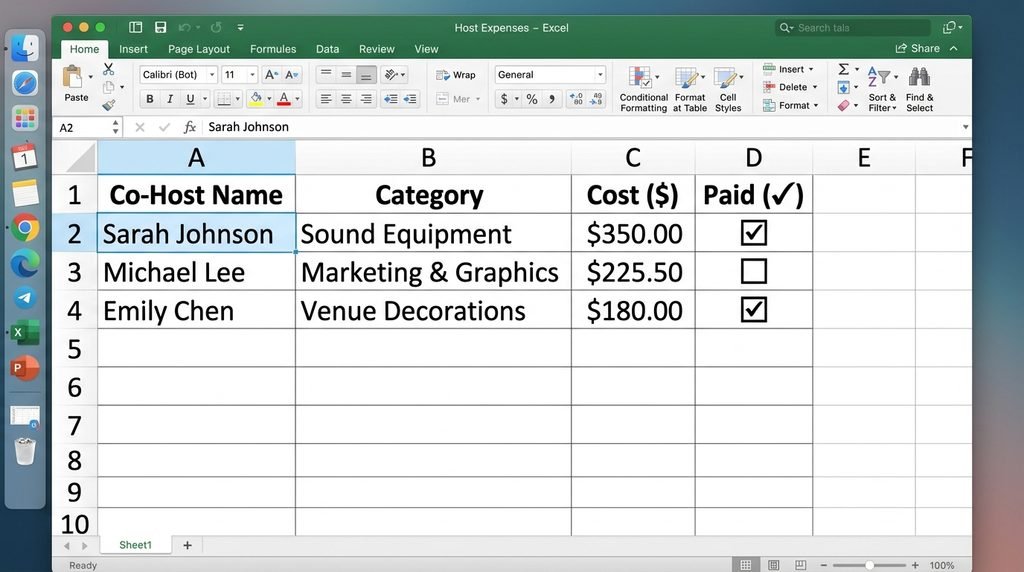
A shared spreadsheet or group chat note keeps everyone on the same page. Save receipts, and settle up soon after the party.
How to Ask Someone to Co-Host
Money talk feels awkward, so keep it simple and give people an easy out. Here are two template wordings you can adapt:
“I’d love to throw [Name] a baby shower. I’m thinking a budget around $[amount]. Would you be open to co-hosting and sharing costs? No pressure if it’s not a good time.”
“I’m planning the shower and want to keep it low-stress. Could you take care of the cake and I’ll handle food and decorations?”
Be specific about the money and the task. Don’t assume a friend can afford an even split. A task-based request, like “could you bring the cake?”, is often easier to say yes to than a dollar amount.
Can Guests Contribute Money?
Guests already contribute by buying a gift. Asking them to pay for the party on top of that is where etiquette gets sensitive.
Group Funds and Potlucks
There are low-pressure ways to involve guests. One option is a private online fund for friends and family who would rather contribute money than co-host. Another is a potluck. Finder’s budget tips for hosts include holding the shower at home and having each guest bring a dish.
The key is that participation stays optional. A guest who can’t contribute shouldn’t feel excluded from the event.
Why Charging Guests Is Risky
Some people ask guests to pay a “cover” or to cover their own meal at a restaurant shower. Etiquette guidance generally discourages billing guests for a party they were invited to. That’s an editorial reading of the standard rules rather than a quote from one source, but it’s the common view.
Evite does acknowledge that, with prices up, asking for guest contributions is now considered fair game by some. If you go that route, be upfront in the invitation, keep amounts small, and offer an alternative like a potluck. If a venue requires a per-person minimum, consider choosing a cheaper location instead.
Can the Parents-to-Be Help Pay?
Etiquette says the host shouldn’t ask them to. That’s different from whether they can quietly help in real life.
Evite advises that if a host offers to cover the shower, the parents-to-be can simply accept. If the host’s budget is tight, parents-to-be can help in ways that don’t turn the shower into a payment request:
- Keep the guest list reasonable to hold costs down.
- Suggest a simpler venue or menu.
- Offer to handle items that aren’t “party” expenses, like thank-you notes.
If you’re a host who needs money from the parents, the safest approach is a private, honest conversation. But the stronger etiquette move is to scale the shower to your budget instead.
How Much Does a Baby Shower Cost?
Costs vary enormously, and the numbers online conflict. Be careful with any single “average.”

What the Data Says
Several vendor and blog sources give different ranges. One virtual-shower company puts an in-person shower anywhere from $100 to $1,000. Another site estimates a typical shower totaling about $550. A retail blog suggests hosts spend $300 to $800 on food, decorations, and incidentals. These are commercial websites rather than independent research, so treat them as rough ballparks.
For something closer to research, a 2018 survey of Australian parents by finder.com.au found an average cost of A$672 per shower. Of parents who had one, 27% paid for it themselves, 45% split costs with family, and 28% had family and friends pay entirely. That’s Australian data from 2018, so it doesn’t prove what happens in your country today. It does show that, in practice, many parents end up contributing even though etiquette says they shouldn’t.
How to Set a Realistic Budget
Skip the national average. Use a simple formula instead:
Total budget = number of guests × comfortable cost per guest
If you invite 20 people and are comfortable spending $20 per person, your budget is $400. Then divide that across food, decorations, invitations, and games. Food usually takes the biggest share, so cut the guest list or simplify the menu first if you need to trim.
Decide the budget before you pick a venue or theme. It’s much easier to build a shower around a number than to cut an elaborate plan down later.
Special Situations
Virtual and Long-Distance Showers
Online showers change the money question. One virtual shower company notes that old rules assume in-person events at a restaurant or home, so who pays matters less online, though who runs it may still matter in your social group. Virtual showers usually have lower costs, such as an invitation, a video platform, and perhaps a few mailed items. The host typically covers those too.
Office Showers
Coworker showers are usually small and casual, with a cake and a card. Typically a colleague organizes it and covers the basics, with an optional group card or gift collection. Keep contributions voluntary and low-pressure, since coworkers have different budgets. This reflects general workplace etiquette rather than a specific source.
Second Baby Showers and “Sprinkles”
Etiquette allows it. Hosts of a second shower can choose themes around restocking basics or treats for mom and dad, such as babysitting or take-out coupons. The host-pays rule applies the same way. A smaller “sprinkle” is also easier on the host’s wallet.
Showers After the Birth
In some places and families, showers or celebrations happen after the baby arrives. A UK guide notes that many people feel it tempts fate to receive gifts before a birth, so a shower can be held afterward. The payment rule doesn’t change. The host still pays, and the parents-to-be, now new parents, are still guests of honor.
7 Baby Shower Money Rules to Remember
- The host pays. One host covers everything. Co-hosts share.
- Parents-to-be don’t pay. The shower is a gift to them.
- Guests don’t pay for the party. Their gift is their contribution.
- Agree on the split early. Co-hosts should decide before buying anything.
- Set the budget first. Choose a number, then plan the shower around it.
- Make contributions optional. Funds and potlucks should never feel like obligations.
- Scale to the budget. A smaller, simpler shower beats an expensive one that strains the host.
How Hosts Can Keep Costs Down
You don’t need a big budget to throw a lovely shower. Finder’s tips include hosting at home, making it a potluck, and restricting the party to one room so your decorating budget stretches further.

A few more ideas:
- Choose a brunch or tea. Lighter menus cost less than full dinners.
- Use digital invitations. They save printing and postage.
- DIY decorations. Balloons and paper decor go a long way.
- Keep the guest list tight. Costs rise with every guest.
- Limit the games. One or two with small prizes is plenty.
- Skip favors. They’re optional.
For history and background on the tradition, see the encyclopedia entries below.
FAQ
Is it rude for the mom-to-be to pay for her own baby shower?
It’s not rude exactly, but it’s not ideal. One etiquette columnist calls hosting your own shower “not really the best look.” A better route is to ask a friend to host officially.
Can a grandmother or mother-in-law host?
Yes. Current Emily Post guidance says anyone can host if there’s a legitimate reason. The same payment rule applies to them as to any host.
Do guests have to pay anything?
No. Guests bring a gift. If the host sets up an optional group fund or a potluck, joining in is voluntary.
What if the host can’t afford the shower?
Scale it down. Move it to someone’s home, switch to a potluck, shorten the guest list, or bring in co-hosts. These steps solve most budget problems without involving the parents.
Who pays for the venue?
The host or co-hosts. If a venue fee is too high, consider hosting at home or in a free community space instead.
Do the parents-to-be have to contribute anything?
Not under traditional etiquette. They usually cover thank-you notes and little else. If they offer help, hosts can accept graciously, but hosts shouldn’t ask.
Should the host pay again for a second baby’s shower?
There’s no rule against it, and a smaller “sprinkle” is common. The host-pays rule is the same, though a simpler event is easier on the budget.
Final Takeaway
The answer to who pays for a baby shower is simple. The host does, and co-hosts share the cost, while the parents-to-be and guests stay out of the bill. Everything else is about flexibility. Agree on a budget early, split costs openly, make any contributions optional, and keep the shower sized to what the hosts can comfortably afford. A warm, modest party beats a lavish one that leaves someone stressed about money.
Related Post:
When to Send Out Baby Shower Invites: 6 Easy Timelines
Does a Surrogate Share DNA With the Baby? 7 Clear Facts
When to Move Baby Out of Bassinet: 6 Must-Know Signs

One thought on “Who Pays for a Baby Shower? 7 Essential Etiquette Rules”