You spot short, fine hairs along your hairline and your stomach drops. Is this the start of baldness?
Usually, baby hairs on their own do not answer that question. Are baby hairs a sign of balding? Sometimes, but only when they appear where thicker hairs used to be, keep getting thinner, or come with a hairline that is steadily moving back. In other cases they are normal hairline hairs, new growth after shedding, or broken hairs.
This guide shows you how to tell the difference, what to track over the next few months, and when to see a dermatologist.
Are Baby Hairs a Sign of Balding? The Short Answer
Not by themselves. What matters is where they are, how many there are, how thick they are, and whether they are changing.
| What you might be seeing | What it means | Usually worrying? |
| Short, soft hairs that have always been at your hairline or temples | Fine hairline hairs that never became thick scalp hairs | No |
| Short hairs appearing a few months after a stressful event, illness or childbirth | Regrowth after shedding (telogen effluvium) | No, if they lengthen and thicken |
| Short, snapped-off hairs where you tie, part or slick your hair | Breakage or traction damage | Can become permanent if the pulling continues |
| More short, thinner hairs where thick hairs used to be, often at the temples or crown | Miniaturization, the hallmark of pattern hair loss | Yes, worth a dermatologist visit |
Notice the pattern: the same word, “baby hair,” covers very different things.
“Baby Hair” Is Not a Medical Term
Dr. Jeff Donovan, a board-certified dermatologist who specializes in hair loss, points out that “baby hair” is a public term, not a medical one. It describes any hair that is not as big as it could be. Depending on the case, it can be a good sign of regrowth, a neutral sign, or a sign that hair growth is going wrong.
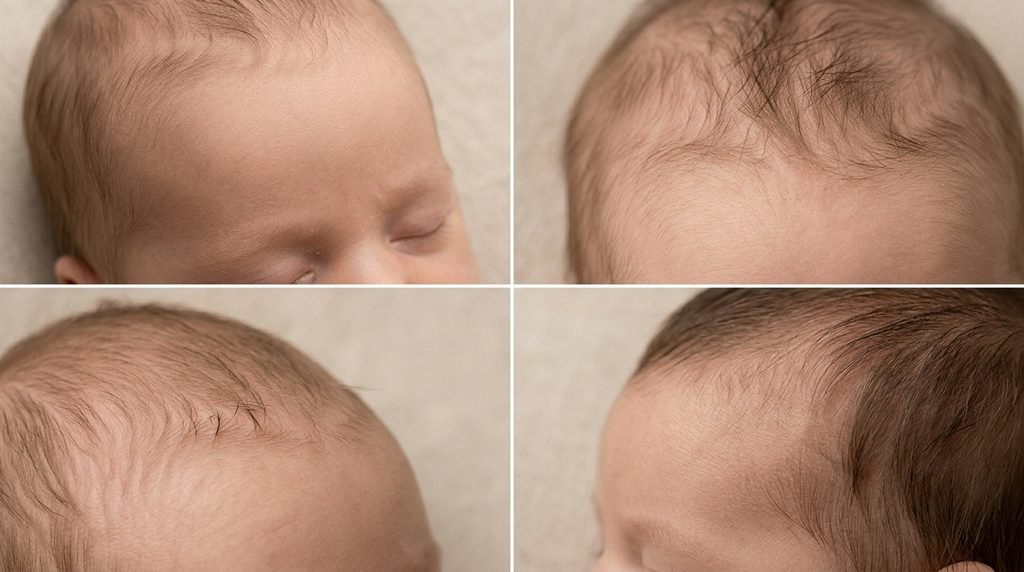
That is why one forum reply says “short strands never indicate balding,” while another says “lots of vellus hairs on the temples are a sign of male pattern baldness.” Both are opinions. The truth depends on the details, which is what the rest of this article covers.
What Baby Hairs Actually Are: Terminal, Vellus and Miniaturized
Scalp hairs come in three broad types.
- Terminal hairs are the thick, long hairs that make up most of your scalp hair. Dermatologists often call a hair terminal when it is about 60 to 70 micrometers (µm) thick or more. A micrometer is one-thousandth of a millimeter.
- Vellus hairs are short, thin, pale “peach fuzz” hairs, usually under about 30 µm.
- Miniaturized (intermediate) hairs sit in between. They used to be terminal hairs and have been shrinking.
Dr. Donovan notes that most scalp hairs in teenagers measure around 70 to 90 µm. In pattern hair loss, follicles shrink over time to 50, then 20, then 10 µm and finally stop producing a hair that reaches the surface.
The key difference: some people have vellus-like hairs at the front hairline from the start. In others, a terminal hair turns into a vellus hair over time. The first is normal. The second is balding in progress.
| Hair type | Typical thickness | Typical look |
| Terminal | About 60 to 70 µm or more | Long, thick, pigmented |
| Miniaturized | Between terminal and vellus | Shorter, thinner, lighter than neighbors |
| Vellus | Under about 30 µm | Very short, wispy, pale |
When Baby Hairs Are Normal
Many people have them. Common normal cases include:
- A juvenile or mature hairline. One hair-transplant clinic notes that many men see the hairline settle back half an inch to an inch between ages 17 and 30. This is a commercial source, so treat the exact figures as a rough guide. A maturing hairline moves back evenly and then stops.
- Fine edge hairs you have always had. If you remember them from years ago and they look the same in old photos, they are probably just part of your hairline. A forum poster put it this way: they were never full-sized hairs in the first place, so they are not “shrinking.”
- Hairs at the temples and around the face, especially in people with a full head of hair.
Signs that point to “normal”:
- The baby hairs have been there for years
- The hairline sits in about the same place in photos taken a year apart
- Hair density behind the hairline looks the same
- Family members have the same hairline pattern without major hair loss
When Baby Hairs Can Signal Balding
The cause that worries people is androgenetic alopecia, also called pattern hair loss. A 2025 review in a Brazilian dermatology journal explains that male androgenetic alopecia begins with follicular miniaturization. A miniaturized hair looks very similar to a vellus hair, with a thickness under 0.03 mm.
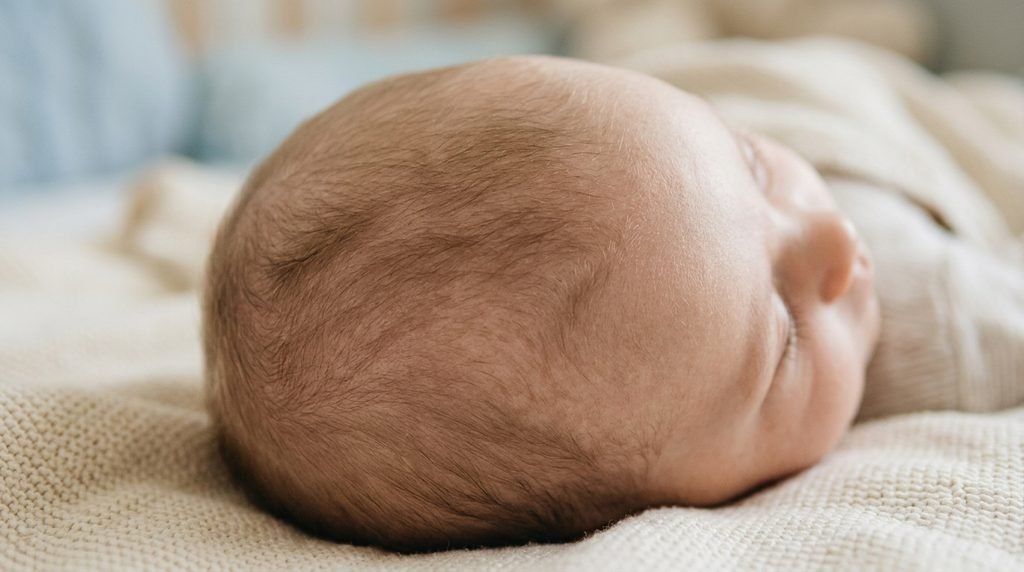
It is common. Dr. Donovan writes that by age 50, around half of men and 30% of women show some evidence of it. The early signs in men usually involve the temples and crown, and in women the central scalp.
How Miniaturization Works
In pattern hair loss, certain follicles respond to hormones (DHT is the one most often named) and shrink with each hair cycle. Each new hair is thinner, shorter and lighter than the last. Eventually the follicle may stop producing a visible hair.
A City Skin Clinic article describes a diagnostic clue called anisotrichosis, meaning a large variation in hair thickness in the same area. A diameter variation of more than 20% is a key sign of androgenetic alopecia. Dr. Donovan also names it as typical of the condition.
In plain words: if you have thick hairs sitting next to many very thin ones in the same patch, that is a warning sign.
Here is how to tell the “worrying” pattern from a harmless one.
| Clue | Often harmless | More worrying |
| Where | Along the whole edge, same as always | Mainly at the temples or crown, getting worse |
| How many | A thin band at the very front | More and more short thin hairs behind the front edge |
| Change over time | Stable for a year or more | Finer and shorter each month |
| Neighbors | Normal thick hair right behind them | Thick hairs mixed with many thin ones |
| Hairline | Steady | Moving back unevenly, often in an M shape |
| Family | No pattern hair loss | Close relatives with hair loss |
Six Questions That Help Sort Out a Short Hair
Dr. Donovan suggests asking six questions about a short hair:
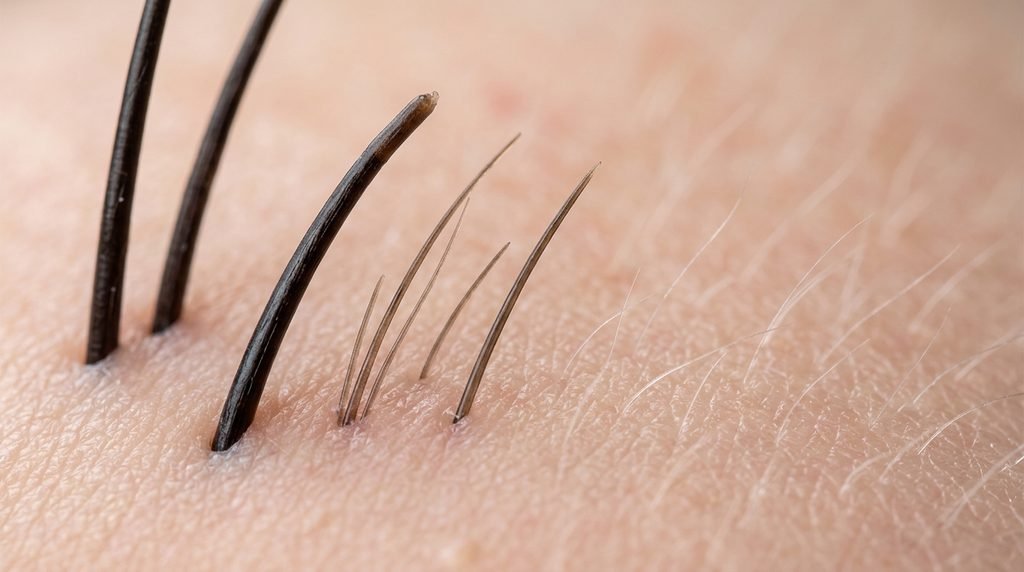
- Is it reasonably thick (about 40 to 50 µm or more) or very thin (under 30 µm)?
- Are the tips pointed (new growth) or blunt (cut or broken)?
- Are the short hairs everywhere or in one area?
- Are there just a few or lots of them?
- Are they growing straight up, or twisting and curling?
- Is there redness, scale or pus around them?
You cannot measure thickness at home. But you can look at tips, location, number and the state of the skin. Redness, scale or pus deserves a doctor’s visit.
Baby Hairs After Pregnancy, Illness or Stress
Sometimes baby hairs mean your hair is growing back.
Telogen effluvium (TE) is a common, temporary form of shedding in which many hairs shift into the resting phase at the same time Triggers include childbirth, high fever, major illness, surgery and crash dieting. Mass General Brigham’s dermatology handout explains that shedding appears about three months after the trigger, can reach up to 300 hairs a day, and that regrowth is slow but visible as short hairs on top of the scalp.
After childbirth, estrogen drops sharply. One dermatologist quoted by Parenteam says new baby hairs typically show around 6 to 12 months after delivery, and that healthy regrowth starts out shorter, tapered and a little finer than the original hair.
Signs this is regrowth rather than balding:
- Shedding was widespread, not just at the temples
- Hairs of different lengths appear in several areas
- The short hairs have pointed tips and slowly lengthen
- It follows a clear trigger, with timing that fits
When to worry: the Mass General handout advises seeing a dermatologist if shedding has not returned to normal after about six months, or if hair on top of the scalp is not recovering. A doctor can also check for iron deficiency or thyroid problems, which can slow regrowth. I did not verify this in the sources reviewed, so treat that as a question to ask rather than a diagnosis.
Baby Hairs From Breakage and Tight Styles
Not every short hair is new. Some are broken pieces.
Ponytails, buns, braids, extensions and other styles that pull on the hairline can cause traction alopecia. One hair-science article explains that the short hairs from traction do not grow long and thick the way regrowth does. Another useful tip from the same article: short hairs spread evenly across your scalp suggest regrowth, while short hairs concentrated where you tie, part or apply heat suggest breakage.
Other clues of breakage:
- Hairs look frayed, split or blunt at the tip
- They stick up right at the ponytail line or part
- Your hairline feels sore or tight after styling
Repeatedly slicking down and brushing the edges with strong pressure can also hurt the follicles over time. Traction can also make other types of hair loss worse. Looser styles and breaks from tight ones give the hairline time to recover. If the hairline has been under tension for years, hair may not come back, so ask a dermatologist early.
A Simple At-Home Check You Can Do This Month
You can learn a lot with your phone camera and some patience.
- Take baseline photos today. Use the same bright, even light, with your hair dry and combed back. Shoot the front hairline, both temples, the part and the crown.
- Add a reference. Place a small ruler or coin near the hairline to compare distance later.
- Look at the tips. Pointed tips suggest new growth. Blunt, frayed tips suggest breakage.
- Repeat every 4 weeks for 3 to 6 months, on the same day of the month, with the same lighting.
- Compare. Are the short hairs getting longer and thicker, staying the same, or getting thinner? Is the hairline holding or moving back?
- Check old photos. Look at pictures from 2 to 5 years ago to see whether your hairline is truly different.
Illustrative example, not a real case: A person photographs their temples each month. After three months, most short hairs have grown a few millimeters and match the thickness of neighboring hairs. That fits regrowth. Another person sees the same hairs get thinner and the area behind the hairline becomes more see-through. That is a reason to book an appointment.
Are Baby Hairs a Sign of Balding in Women?
Are baby hairs a sign of balding in women? Less often than people fear, but it can happen.
Female pattern hair loss tends to look different from the male version. One hair-care source notes that in women, it more often shows up as overall thinning that starts at the top of the scalp, not a receding hairline. Dr. Donovan describes the early area as the central scalp in women.
For women, baby hairs are more often one of these:
- Postpartum regrowth around the temples and forehead
- Regrowth after illness, stress or dieting
- Traction from tight ponytails, braids or extensions
- Normal fine edge hairs, which many women with a full head of hair have
See a dermatologist if your part is widening, you see more scalp through the hair on top, or the short hairs are thin and not thickening.
When to See a Dermatologist
Book an appointment if:
- Your hairline is clearly moving back, especially unevenly
- Short, thin hairs are increasing and not lengthening
- You have thinning at the crown or widening part
- A parent or sibling has pattern hair loss
- Shedding has not normalized after about six months
- Hair loss is patchy
- You notice redness, scaling, pus, pain or itching
- You are worried and want an expert answer
Dermatologists can use trichoscopy, a magnified scalp exam. A City Skin Clinic article describes it as the gold standard for diagnosing miniaturisation early. They may also order blood tests if shedding is the issue.
Seeing a dermatologist early is useful because, in pattern hair loss, time matters (see the next section).
Can You Stop or Reverse Miniaturization?
It depends on how far it has gone.
A paper in the Journal of the American Academy of Dermatology argued that miniaturization may happen in abrupt steps and can be reversed within one hair cycle in patients who respond to finasteride. The paper notes it was supported by a pharmaceutical grant and that its author served as a consultant to the company, so it is one view among others.
The City Skin Clinic article makes a more cautious point: treatments rarely convert fully miniaturized vellus follicles back into terminal ones. My interpretation: treatment tends to work best before follicles are fully shrunk, so earlier evaluation helps.
Also keep in mind:
- In alopecia areata, miniaturized hairs are often temporary, whereas in pattern hair loss they tend to become permanent without treatment, according to the Wimpole article.
- Treatments and doses differ for men and women, and some are not safe in pregnancy or while breastfeeding. Ask a dermatologist rather than self-prescribing.
- If you suspect breakage or traction, the first step is to stop the pulling.
Myths and Mistakes
- “Any baby hair means I’m balding.” No. It can be regrowth, breakage or normal.
- “Baby hairs always mean healthy regrowth.” Also no. Sometimes the same hairs are thinning follicles.
- “I can pluck or shave them to make them grow thicker.” There is no good evidence for this. Over-handling the hairline can cause irritation.
- “The pull test at home tells me everything.” Forum posters swap rules like this, but a casual pull test is not a diagnosis.
- “Waiting a few years will make it clear.” Waiting is fine for a stable, lifelong pattern, but not if the hairline is changing fast.
- “A product will fix it.” Be careful with serums that promise to unlock baby hairs. Some pages hype baby hairs with dramatic claims and little evidence.
- “Mature hairline and receding hairline are the same.” A maturing hairline moves back evenly and stops. A receding one keeps going, often in an M shape.
FAQ
Are baby hairs a sign of balding in men?
Not always. Baby hairs at the temples are common and can be normal. They are more concerning when they replace thicker hairs, multiply, and come with a hairline that keeps receding.
Do baby hairs mean my hair is growing back?
Sometimes. After a shedding episode, short tapered hairs scattered across the scalp are a good sign. If they stay thin and short, or appear only at one thinning spot, ask a dermatologist.
Are baby hairs at the hairline normal?
Yes, many people have them, including people with a full head of hair. Stable ones that have been there for years are usually normal.
Are baby hairs a sign of balding in women?
They can be, but more often they are postpartum regrowth, traction damage or normal edge hairs. Female pattern hair loss usually shows as thinning on top and a widening part.
How can I tell vellus hairs from miniaturized hairs?
You can’t tell reliably by eye. A dermatologist can measure hair thickness and look at the pattern with trichoscopy.
Do baby hairs after pregnancy go away?
They are regrowth and usually lengthen over months. A dermatologist quoted by Parenteam says they typically appear around 6 to 12 months after delivery.
Can tight hairstyles cause baby hairs?
They can cause broken hairs that look like baby hairs, and long-term pulling can lead to traction alopecia. Loosen your style and see a doctor if the hairline is thinning.
When should I see a doctor about my baby hairs?
When your hairline is receding, short thin hairs are multiplying, shedding hasn’t normalized after about six months, or you notice patches, redness, scale or pain.
Final Takeaway
So, are baby hairs a sign of balding? Not on their own. Check where they are, whether they are getting thicker or thinner, and whether your hairline is moving. Take monthly photos for three to six months, loosen tight styles, and book a dermatologist if the pattern looks like thinning or you are worried. Early evaluation gives you the most options.
Related Post:
When to Send Out Baby Shower Invites: 6 Easy Timelines
Does a Surrogate Share DNA With the Baby? 7 Clear Facts
When to Move Baby Out of Bassinet: 6 Must-Know Signs

One thought on “Are Baby Hairs a Sign of Balding? 5 Clear Ways to Tell”