
Does a surrogate share DNA with the baby? In gestational surrogacy, the most common type, the answer is no. The baby’s DNA comes from the egg and sperm that formed the embryo, and the surrogate only carries the pregnancy. In traditional surrogacy, the answer is yes, because the surrogate supplies her own egg and is the baby’s genetic mother.
That settles the main question, but it usually raises others. Can the baby look like her? Do they share blood? What about epigenetics and the cells that cross the placenta? And does DNA decide who the legal parents are? This guide answers each one, points to the sources behind the science, and says plainly where research is limited.
Does a Surrogate Share DNA With the Baby? The Short Answer
The answer depends on one thing: whose egg was used to create the embryo.
- Gestational surrogacy: The embryo is made through IVF using an egg and sperm from the intended parents or donors. The surrogate becomes pregnant through IVF and is not genetically related to the child.
- Traditional surrogacy: The surrogate’s own egg is used, so she is the genetic mother and shares about half of the baby’s DNA.
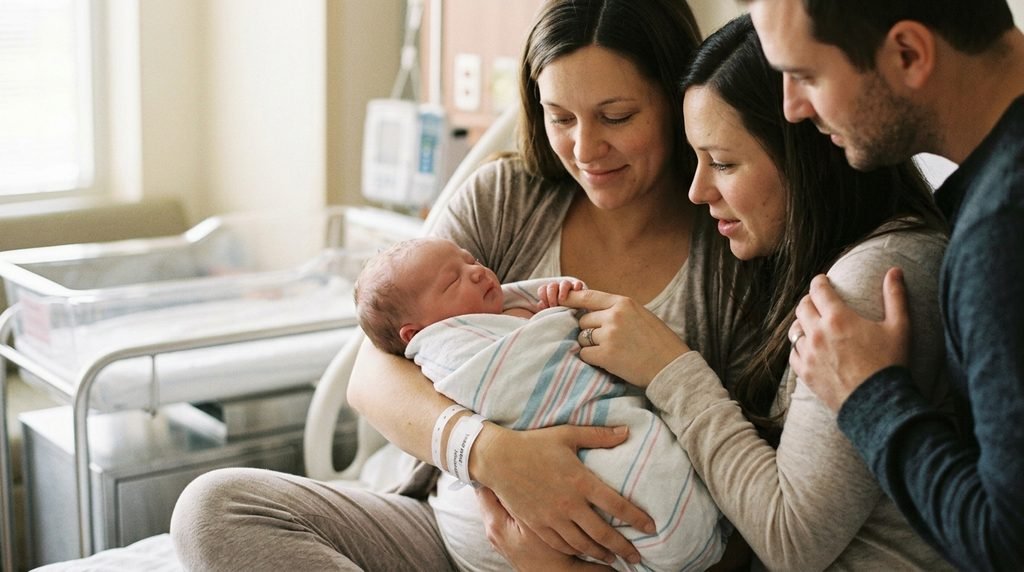
Seven facts worth remembering:
- In gestational surrogacy, the carrier shares no DNA with the baby.
- In traditional surrogacy, she shares roughly half.
- The baby’s genes come from the egg provider and the sperm provider, who may be the intended parents, donors, or a mix.
- Looks come from genes, so a baby born through gestational surrogacy does not inherit the carrier’s features.
- Carrier and baby have separate blood supplies, linked by the placenta.
- The carrier’s health can influence how the baby’s genes are used (epigenetics), but it does not rewrite the DNA code.
- Legal parenthood follows local law and legal steps, not just DNA or who gave birth.
Gestational surrogacy is the most common form used by agencies such as American Surrogacy. For most people asking this question today, the practical answer is no.
Gestational vs. Traditional Surrogacy: Where the DNA Comes From
The word “surrogacy” covers two different arrangements, and mixing them up causes most of the confusion online. One agency notes that many people assume all surrogacy is the traditional kind, which is why the DNA question comes up so often.
Does a Surrogate Share DNA With the Baby in Gestational Surrogacy?
No. In gestational surrogacy, doctors create an embryo in a lab with IVF. The egg may come from the intended mother or an egg donor. The sperm may come from the intended father or a sperm donor. The embryo is then transferred into the carrier’s uterus. She provided no egg, so she has no genetic link to the baby.
Here is a hypothetical example. Priya and Dan use Priya’s eggs and Dan’s sperm. One embryo is transferred to a carrier named Sarah. The baby shares DNA with Priya and Dan. Sarah’s DNA was never part of the embryo, so it is not in the baby’s genome.
Gestational arrangements are also generally simpler legally. One agency says gestational surrogacy involves fewer legal complications because the surrogate has no genetic tie. Legal rules still differ by location.
Does a Surrogate Share DNA With the Baby in Traditional Surrogacy?
Yes. In traditional surrogacy, the surrogate’s egg is fertilized, usually through insemination with the intended father’s sperm or donor sperm. In that case the child has half of the surrogate’s DNA.
Because the surrogate is also the genetic mother, traditional surrogacy raises harder legal and emotional questions. Legal status varies widely, and some clinics, agencies, and jurisdictions don’t support it. If someone proposes a traditional arrangement, get the local legal position in writing from a qualified lawyer.
Side-by-Side Comparison
| Feature | Gestational surrogacy | Traditional surrogacy |
| Who provides the egg | Intended mother or egg donor | The surrogate |
| How pregnancy starts | IVF and embryo transfer | Insemination (or similar) |
| Surrogate’s genetic link | None | About half of the baby’s nuclear DNA |
| Can the baby inherit her looks? | No | Yes |
| Legal complexity | Generally lower | Generally higher |
| Common today | The more common form | Less common |
Image Suggestion: A clean comparison chart with the same rows as the table, using icons for egg, sperm, and uterus. Placement: Beside the comparison table. Alt Text: Comparison chart of gestational and traditional surrogacy showing who contributes the egg and DNA.
Whose DNA Does a Surrogate Baby Actually Have?
The baby’s DNA comes from two people: whoever supplied the egg and whoever supplied the sperm. Neither has to be an intended parent. So, does a surrogate share DNA with the baby when donors are involved? In gestational surrogacy, still no. Donors change who the genetic parents are, not what the carrier contributes.
Scenarios at a Glance
| Scenario | Egg from | Sperm from | Baby shares DNA with | Surrogate shares DNA? |
| Gestational, both intended parents | Intended mother | Intended father | Both intended parents | No |
| Gestational, donor egg | Egg donor | Intended father | Intended father and egg donor | No |
| Gestational, donor sperm | Intended mother | Sperm donor | Intended mother and sperm donor | No |
| Gestational, donor egg and donor sperm | Egg donor | Sperm donor | Both donors | No |
| Traditional | Surrogate | Intended father or donor | Surrogate and the sperm provider | Yes (about half) |
Why a Baby May Not Match Both Intended Parents
A baby may not share DNA with both intended parents, depending on whether donor eggs, donor sperm, or both are used. People turn to donors for many reasons, including age-related fertility changes, medical conditions, same-sex couples, and single parents. Single parents also pursue surrogacy, working with donors and a surrogate.
A different genetic route doesn’t change who the intended parents are. It matters mainly for medical history, family storytelling, and legal paperwork.
Do Surrogate Babies Have “Three DNAs”?
A third-party page showed this as a PAA-style question: “Do surrogate babies have 3 DNAs?” The surrogate is not a third DNA source. The baby’s nuclear DNA comes from egg and sperm.
The confusion may come from mitochondrial donation, a separate IVF technique used in a few countries, where a small amount of mitochondrial DNA comes from a donor egg. That is unrelated to surrogacy and is not done through the carrier.
Will the Baby Look Like the Surrogate?
Eye color, hair type, freckles, and height potential are inherited through genes. A gestational carrier contributes none, so none can come from her. Agency resources state that the surrogate’s genes do not influence traits like eye color, hair type, or height potential.
If a baby seems to resemble the carrier, the usual explanations are chance, shared ancestry (people from the same region often share features), or simple pattern-spotting. Newborns also change quickly, so early resemblance can fade.
The womb does influence some things. Pregnancy health affects growth and health at birth, but it doesn’t determine the shape of a nose or the color of eyes. For traits like that, look to the egg and sperm providers.
Do a Surrogate and the Baby Share Blood?
No. Their blood supplies stay separate. In 1754, John Hunter demonstrated that maternal and fetal circulations are separated during pregnancy. Oxygen, nutrients, and waste cross the placenta. Blood does not mix.
The placenta isn’t a perfect wall, though. Antibodies pass across it, and, as the next section explains, a small number of cells can slip through.
Blood type follows the same logic. The baby’s blood type is set by the baby’s own genes, not the carrier’s. They can be different. Differences in Rh factor are something prenatal teams monitor in any pregnancy, including surrogate pregnancies.
The Gray Areas: Epigenetics and Microchimerism
This is where simple answers can mislead. “No shared DNA” is correct about inheritance. But pregnancy is still a biological relationship, and science describes two effects worth understanding. Neither makes the carrier a genetic parent.

Epigenetics: How the Womb Affects Gene Activity
DNA is the instruction text. Epigenetics is how those instructions get read. A geneticist at a science museum explains that chemical tags, such as methyl groups, can hide parts of the instructions from the cell, a bit like changing capitalization in a sentence. Diet and other environmental factors can affect these tags.
In pregnancy, the carrier is the baby’s environment. Her nutrition, stress, infections, medications, smoking, alcohol use, and medical conditions can shape development. Fertility resources say a surrogate’s health does not change the baby’s DNA but may affect gene expression. This is one reason carrier screening and good prenatal care matter.
How large are these effects? That is still being worked out. In one Reddit thread in a donor-conception community, people disagreed. These are personal opinions, not research. Some argued epigenetics makes a carrier “related” to a child. Others said the clinical significance is unclear and tiny compared with inherited DNA. A cautious reading of the evidence lands closer to the second view: the influence is real, its size is not fully measured, and it is different from heredity.
Microchimerism: A Small Two-Way Cell Exchange
Microchimerism means a person carries a small number of genetically different cells. The usual definition is a foreign cell population below roughly 1 in 100. In pregnancy, cells travel both directions between mother and fetus. Fetal cells can stay in the mother for several decades after delivery. Maternal cells have been found in fetal organs, including skin, thymus, spleen, liver, and thyroid.
What does this mean for surrogacy? The placenta works the same way in a surrogate pregnancy. So a carrier may hold a few of the baby’s cells, and the baby may hold a few of hers. I did not find studies that measure this specifically in gestational carriers, so treat that as a reasonable inference, not an established finding.
Researchers are still studying what these cells do. One review describes maternal microchimerism as probably double-edged, harmful in some cases and helpful in others.
What These Effects Do Not Mean
Neither epigenetics nor microchimerism means that:
- The baby inherits the carrier’s genes.
- The carrier is a genetic parent.
- The baby’s own genome has been rewritten.
- The child’s looks or personality “come from” the carrier.
Heredity travels through egg and sperm. One science explainer compares cell crossing to a few flies getting past a window screen: some get in, but the room isn’t full of flies. The baby is not filled with the carrier’s DNA.
Genetic, Gestational, Intended, and Legal Mother: What Each Term Means
Words like mother, surrogate, biological, legal, and gestational are often used interchangeably online, even though they describe different roles. Separating them removes much of the confusion.
| Term | Meaning | In gestational surrogacy | In traditional surrogacy |
| Genetic mother | Provides the egg | Intended mother or egg donor | The surrogate |
| Gestational mother | Carries and gives birth | The surrogate | The surrogate |
| Intended mother | Plans to raise the child | Intended mother | Intended mother |
| Legal mother | Recognized by law | Depends on local law and orders | Depends on local law; often more complex |
One intended-parent guide notes that legal parenthood is set by the law of the country where the baby is born, not by who carries the pregnancy. Because rules vary by state and country, check the local position with a surrogacy lawyer. This article is not legal advice.
DNA Testing in Surrogacy: What It Can and Cannot Show

Can DNA Be Tested During Pregnancy?
Sometimes. Small amounts of the baby’s DNA circulate in a pregnant woman’s bloodstream from around 7 weeks of pregnancy. This is the baby’s DNA found in the carrier’s blood, which is why some prenatal and parentage tests can work during pregnancy. It does not mean the carrier’s DNA is in the baby.
Can a Surrogate Refuse a DNA Test?
In UK guidance, yes. The surrogate’s consent is required unless a court has ordered the test. Rules differ in other countries, so ask your clinic or lawyer. Agree on testing expectations in the contract before the pregnancy begins.
Does DNA Decide Legal Parenthood?
Not by itself. UK guidance says a DNA test isn’t automatically required for a parental order, and that a DNA test cannot prove legal parenthood in surrogacy. In many places, legal parenthood depends on contracts, court orders, or birth registration steps. A DNA result can show genetic relationship but doesn’t replace those steps.
Common Myths About Surrogates and DNA
- “Bonding makes her genetically related.” Bonding is emotional. DNA is inherited through egg and sperm.
- “The baby takes the carrier’s blood type.” Blood type comes from the baby’s genes. It can differ from the carrier’s.
- “Epigenetics makes the carrier a biological parent.” Epigenetics changes gene activity, not the DNA code. Researchers still debate how large the effects are.
- “Cells crossing the placenta means shared DNA.” A few foreign cells are not inheritance. The baby’s own genome stays the same.
- “She can change her mind and is the real mother.” Her genetic status and her legal status are separate questions, and legal rules vary by location. One agency states that in gestational arrangements the surrogate has no legal rights to the baby. Confirm what applies where you live.
- “A surrogate baby has three sets of DNA.” The carrier is not a DNA source in gestational surrogacy.
Practical Steps for Intended Parents and Surrogates
Knowing the science is useful. Putting it into practice is better.
- Confirm the surrogacy type in writing. Make sure the agreement says gestational or traditional.
- Document the egg and sperm source. Keep records of donor identity, screening, and consent forms.
- Ask about testing. Ask your clinic what genetic and prenatal tests are offered and what each can and cannot tell you.
- Prioritize carrier health. Since the womb environment affects gene activity, nutrition, prenatal care, and avoiding harmful exposures matter.
- Talk to a surrogacy lawyer early. Legal parenthood, DNA testing, and consent differ by location.
- Plan the child’s story. Some agencies note that a child may someday ask about their surrogacy story. Decide in advance how you want to explain it, and consider counseling for everyone involved.
Frequently Asked Questions
Does a surrogate mother share blood with the baby?
No. Their circulations stay separate. The placenta passes oxygen, nutrients, and waste between them, but blood does not mix.
Can a surrogate baby have the surrogate’s DNA?
Only in traditional surrogacy, where she supplies the egg. In gestational surrogacy, the baby’s DNA comes only from the egg and sperm providers.
Can a surrogate decide to keep the baby?
Her genetic status and her legal status are separate. In gestational surrogacy she has no genetic link, and one agency says she has no legal rights to the baby. Legal rules vary by location, so confirm them with a lawyer.
Can a baby inherit personality or traits from a surrogate?
Inherited traits come from DNA, which the gestational carrier does not provide. Her health can influence development through epigenetics, but there is no evidence I found that this shapes inherited traits.
Does carrying a baby change the surrogate’s DNA?
Her own genome stays the same. She may carry a few of the baby’s cells afterward, a phenomenon called fetal microchimerism.
Does carrying a surrogate pregnancy affect the genetics of her own children?
No. Carrying a surrogate pregnancy does not change the genetic makeup of any future children the surrogate might have.
Is a DNA test needed for a surrogate baby?
Not always. In UK guidance, a DNA test isn’t automatically required for a parental order. Requirements differ elsewhere, so ask your clinic or lawyer.
Final Takeaway
So, does a surrogate share DNA with the baby? Only if she supplied the egg, which means traditional surrogacy. In gestational surrogacy, the baby’s DNA comes only from the egg and sperm providers, and the carrier gives the baby a place to grow, not a genetic blueprint. Her health still matters because the womb environment can affect how genes are used, and tiny numbers of cells can cross the placenta both ways. Neither effect makes her a genetic parent. Confirm the surrogacy type and the egg source in writing, and get local legal advice on parenthood.
Related Post:
When to Send Out Baby Shower Invites: 6 Easy Timelines
When Can You Take a Baby to the Beach? 7 Essential Steps
When to Move Baby Out of Bassinet: 6 Must-Know Signs

4 thoughts on “Does a Surrogate Share DNA With the Baby? 7 Clear Facts”