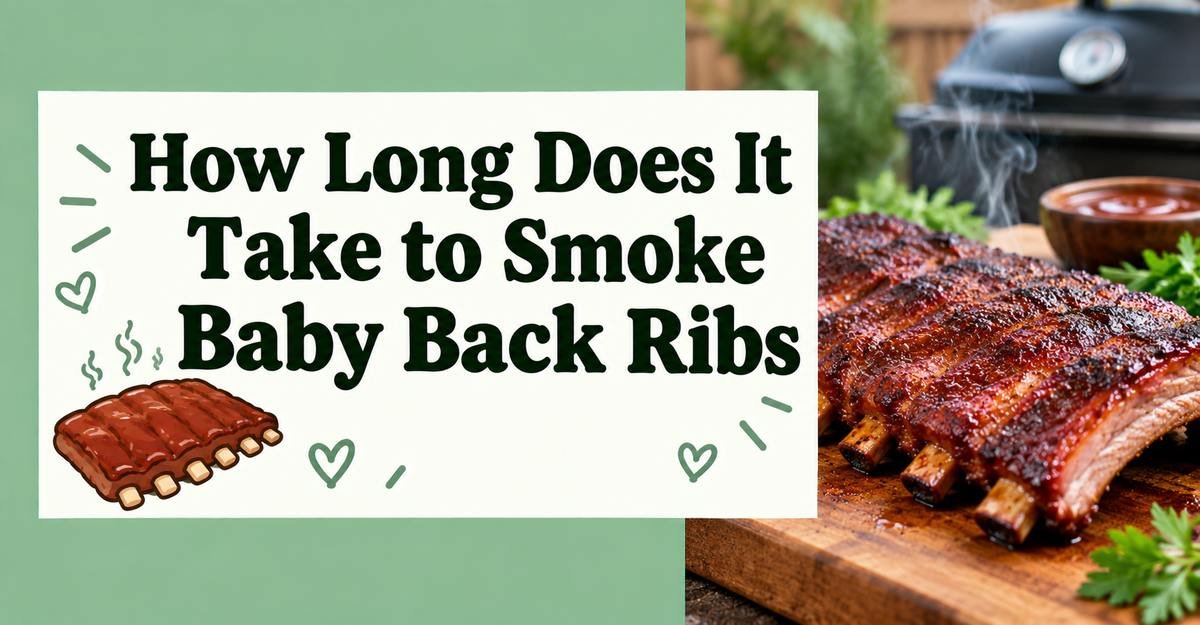
How long does it take to smoke baby back ribs? At 225°F, plan on about 4.5 to 6 hours. At 250°F, it’s closer to 4 to 5 hours, and at 275°F it drops to roughly 4 hours. Those are planning ranges, not promises, because every rack cooks a little differently.
Here’s the catch most recipes skip. The clock gets you to the right neighborhood, but tenderness tells you when to stop. A thin rack can finish an hour before a meaty one, and a smoker that reads 225°F on its dial may be running noticeably hotter or cooler at the grate.
This guide gives you a time chart for four temperatures and explains why times vary. You’ll also learn four ways to check doneness, build a backward-planning schedule so dinner lands on time, and fix ribs that turn out tough or mushy.
Quick takeaways
- At 225°F, baby backs take about 4.5 to 6 hours. At 250°F, about 4 to 5 hours.
- Wrapping saves roughly an hour at 225°F and keeps the meat moist.
- Baby backs are leaner than spare ribs, so the classic 3-2-1 schedule often runs too long.
- Judge doneness by the bend test, a toothpick probe, and bone pullback, not the clock alone.
- Pork is safe at 145°F, but ribs only turn tender well above that.
How Long Does It Take to Smoke Baby Back Ribs? Time Chart by Temperature
Baby back ribs take about 4 to 6 hours to smoke between 225°F and 275°F, and the exact time depends on your temperature and whether you wrap. Use the chart below to answer how long does it take to smoke baby back ribs on your own smoker.
| Smoker temperature | Typical total time | Common method |
| 225°F | 4.5 to 5 hours wrapped, 5.5 to 6 hours unwrapped | 2-2-1 or no wrap |
| 250°F | 4 to 5 hours | Shortened 2-2-1 or 3-1-1 |
| 275°F | About 4 to 4.5 hours | 2-1-1 with a short wrap |
| 300°F | About 3.5 hours | Hot and fast, short wrap |
These numbers come from barbecue sites and cook reports, and they overlap but don’t agree perfectly. One barbecue blog that tested two racks side by side at 225°F reported about 4.5 hours when wrapped and 5.5 hours when left bare. Several cooks also say 250°F finishes somewhere between 30 minutes and an hour sooner than 225°F.
So what should you do with a range? Start checking about an hour before the low end. If your plan is 4.5 hours, poke your first rack at the 3.5 hour mark. You’ll catch a fast rack before it dries out, and a slow rack simply gets another check later.
Why Smoke Times for Baby Back Ribs Vary
How long it takes to smoke baby back ribs varies mostly because of rack thickness, true smoker temperature, and wrapping. Weight matters less than you’d think.
That’s why two cooks using the same recipe can end up hours apart, and why the honest answer to how long does it take to smoke baby back ribs is always a range. Here are the factors that move your number.
Rack size and thickness. “Baby back” describes a cut, not a size. According to Wikipedia’s overview of pork ribs, a rack can hold anywhere from 8 to 13 ribs, and the bones run roughly 3 to 6 inches long. Racks with fewer than 10 bones are sometimes called “cheater racks.” Cooks on barbecue forums also note that store racks are often smaller than restaurant racks, and one experienced poster points out that thickness and marbling matter more than weight.
Your real smoker temperature. Dial thermometers can mislead. On one forum, a cook noted that a reading of 250°F at the dome was closer to 235°F at the grate. Another said a particular electric smoker ran hot by about 10 to 15 degrees. A cheap oven thermometer clipped to the grate settles the question in minutes.
Wrapping. Foil or butcher paper traps steam and speeds up the middle stretch of the cook. Skip it, and you’ll add roughly an hour at 225°F.
Opening the lid. Every peek lets heat escape and stretches the cook. Experienced cooks on forums repeatedly tell newer ones to leave the lid closed until the ribs are close to done.
Mistakes that add time. A few habits stretch the cook without anyone noticing. Leaving the membrane on slows smoke and seasoning. Pulling the ribs early, then putting them back, loses heat each time. Some cooks also pat the rack dry before seasoning so the bark starts sooner, though that’s common cook wisdom, not a tested rule.
Baby Back Ribs vs Spare Ribs: Why Baby Backs Finish Faster
Baby backs cook faster than spare ribs because they’re shorter, leaner, and less laden with connective tissue. That changes which schedule fits.
Baby backs come from the top of the rib cage, under the loin. That position shapes their timing, so the answer to how long does it take to smoke baby back ribs differs from the answer for spare ribs. Spare ribs come from the belly side. They’re flatter, carry more bone than meat, and have more fat. That extra fat can make spare ribs more forgiving, and it explains why they need more time.
The famous 3-2-1 method (3 hours bare, 2 wrapped, 1 finishing) was built with spare ribs in mind. On baby backs, it often overshoots. Several barbecue sources recommend 2-2-1 or 3-1-1 instead, and one brand says two hours wrapped is often too long for smaller baby backs. For comparison, St. Louis style racks at 225°F run about 5 to 6 hours in one current guide.
The membrane matters too. Wikipedia notes that the tissue lining the inside of the rack is tough to cook tender, and it’s usually removed before cooking. Peel it off the back of the ribs first, and your smoke and rub can reach the meat.
Smoking Timelines by Method
Pick a method before you light the smoker, because each one changes both the total time and the texture. Here are three popular options at 225 to 275°F.
2-2-1 Method (Most Popular)
Smoke the ribs bone-side down for 2 hours at 225°F. Wrap them in foil or paper with a splash of apple juice and cook 2 more hours. Unwrap, sauce lightly, and return them to the grate for about 1 hour to firm up the bark. Total time is about 5 hours, and the ribs come out very tender.
If you run 250°F, shorten the wrapped stretch. One barbecue writer suggests 2 hours bare, about 1.5 hours wrapped, then about 30 minutes uncovered with sauce.
3-1-1 Method (More Smoke, Firmer Bite)
Smoke for 3 hours unwrapped, wrap for 1 hour, and finish unwrapped for 1 hour. You get more smoke flavor and less time steaming in foil, so the meat keeps more bite. Total time is about 5 hours at 225°F.
No-Wrap Method (Simplest)
Leave the ribs bare the whole way. At 225°F, expect about 5.5 to 6 hours. At 250°F, plan on roughly 4 to 5. The bark is crustier and the bite is firmer, but it’s easier to dry out a thin rack, so watch your checks.
A Faster Option at 275°F
Smoke 2 hours bare at 275°F, wrap for 1 hour, and unwrap to set the sauce for about 1 hour. That’s roughly 4 hours, and it suits a day when you can’t wait for 5 or more.
A Sample 225°F Schedule, Hour by Hour
Wondering how long does it take to smoke baby back ribs when you’re standing at the smoker with a watch? Here’s a realistic walk through a 2-2-1 cook, with the checks that matter at each stage.
| Time into cook | What’s happening | What to do |
| 0:00 | Ribs go on bone-side down, smoke rolling | Close the lid and leave it |
| 2:00 | Bark has set, color is deep mahogany | Wrap with a little apple juice, return to smoker |
| 3:30 | Wrapped ribs are steaming and softening | Peek once through the wrap, check the bend |
| 4:00 | Meat is pulling back from the bones | Unwrap, brush on a thin layer of sauce |
| 4:30 to 5:00 | Sauce is tacky, bark is firming | Run the toothpick test, pull when it glides |
| 5:00 and after | Ribs come off the heat | Rest 10 to 15 minutes, then slice |
If your ribs aren’t ready at the 5 hour mark, don’t panic. A thick rack can easily need another 30 to 45 minutes, and a rack that’s ready early can simply wait in foil.
For any method, add sauce near the end. Most sources say 15 to 30 minutes before the ribs come off is plenty, which keeps sugar from burning.
How to Know Baby Back Ribs Are Done
Baby back ribs are done when they pass the bend, probe, and pullback checks, and the clock is only a guide. Use at least two of these checks before you pull them.
- The bend test. Pick up the rack near its center with tongs. When it sags into a loose arch, with the bark cracking a little, it’s close to done. If it snaps apart, it’s overdone.
- The toothpick test. Slide a toothpick or probe between the bones. It should go in with little resistance, like pushing into soft butter.
- Bone pullback. The meat should shrink back from the ends of the bones by about a quarter inch.
- Internal temperature. Use this as a supporting check, not the main one.
Temperature needs a careful explanation. The USDA safe temperature chart lists fresh pork at 145°F with a rest of at least 3 minutes. The chart names chops and roasts, but ribs are a whole cut of fresh pork. USDA also says consumers can choose to cook to higher temperatures for preference.
That’s the safety floor, not the tenderness target. Ribs held at 145°F stay tough because their connective tissue hasn’t broken down. Pitmasters commonly pull baby backs somewhere around 190 to 203°F. That range is barbecue convention rather than an official number, so treat it as a rough guide and let the bend and probe tests decide.
One more caution. Ribs are thin, and a probe can hit bone or a thin spot and read wrong. One grill maker notes that a meat thermometer isn’t always the best choice for ribs for exactly that reason. So feel beats numbers here.
After you pull them, rest the ribs for 10 to 15 minutes. That’s longer than USDA’s 3 minute minimum, and it lets the juices settle so the slices don’t run dry.
Plan Your Cook Backward: When to Start the Smoker
To serve ribs on time, work backward from dinner and add a buffer, because ribs can’t be rushed but they can be held. Here’s a worked example.
Say you want to eat at 6:00 p.m. and you’re smoking at 250°F without much wrapping. Your cook window is 4 to 5 hours. Add a 30 minute rest and a 1 hour buffer, and you need about 6 to 6.5 hours in total. That puts ribs on the smoker between 11:30 a.m. and noon.
Now add prep. Trimming the membrane, applying the rub, and preheating can take 30 to 45 minutes, so start prepping around 10:45 a.m.
If the ribs finish early, don’t crank the heat to rush the last stretch, and don’t let them cool. Wrap them in foil and keep them hot. Some cooks use an insulated cooler as a warming box. The USDA advises keeping hot food at or above 140°F, and it says food shouldn’t sit in the danger zone between 40°F and 140°F for more than two hours. Check with a thermometer, and don’t hold ribs longer than that.
Buffer is the real secret. A rack that finishes 45 minutes early is easy to hold. A rack that needs 45 more minutes while guests sit down hungry is a problem.
Tough, Mushy or Dry? Troubleshooting Your Ribs
Tough ribs usually mean the ribs aren’t done yet, while mushy ribs usually mean they spent too long wrapped. If you followed a guide on how long does it take to smoke baby back ribs and they still missed, match the symptom to the fix.
| Symptom | Likely cause | What to do |
| Tough and chewy at 4 hours | Not done; connective tissue hasn’t broken down | Keep smoking and recheck every 20 to 30 minutes |
| Still tough after 5 hours | Smoker running cooler than its dial | Check grate temperature, raise heat slightly |
| Falling apart, no bite | Wrapped too long, too much liquid | Shorten the wrap next time, unwrap and set the bark |
| Dry and stringy | Thin rack, too hot, or too long | Wrap earlier, pull sooner, rest covered |
| Soft bark after wrapping | Steam in the foil | Finish unwrapped for 30 to 45 minutes |
On forums, the most common “my ribs are tough” story ends the same way. The cook pulled them at 170 to 180°F or after a fixed time, and the fix was more time. So trust the tests over the clock.
What If the Temperature Stalls?
Brisket fans know the stall, a long plateau where the meat’s temperature barely moves. Ribs are smaller, so it’s less talked about, but it does get mentioned. One cook on a barbecue forum reported a rack at 225°F sitting near 180°F for about an hour before it started climbing again.
Responses to that post varied, and some cooks say they’ve never seen ribs stall, so treat it as an occasional quirk rather than a rule. What helps is patience and a second thermometer. Don’t crank the fire. A short wrap, or an extra 30 minutes, usually gets the rack moving again. And remember that a slow rise at a steady 225°F doesn’t mean a bad cook. The answer to how long does it take to smoke baby back ribs depends on the rack more than the recipe.
How Long Does It Take to Smoke Baby Back Ribs on a Pellet Grill or Offset?
Smoker type changes the time mainly through how steadily it holds temperature, not through the ribs themselves. What counts is the actual heat at the grate.
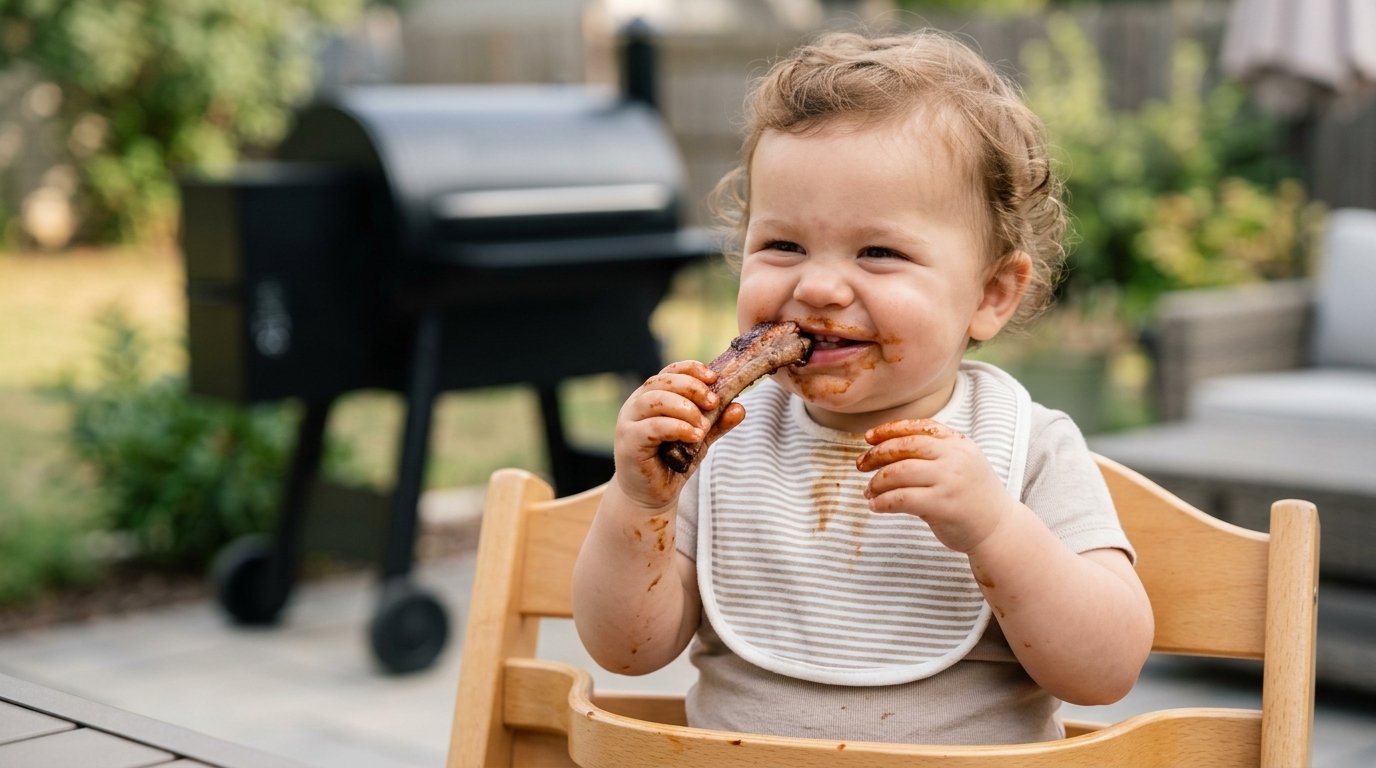
A pellet grill or electric smoker tends to hold a steady temperature, so the time chart above works well. An offset or charcoal smoker swings more as the fire rises and falls, so times drift and you need more checks. That’s an interpretation based on how these cookers behave, not a measured rule.
A few practical tips apply everywhere. Put a second thermometer at grate level. Keep the lid shut until your first check. And use the same tests (bend, probe, pullback) regardless of smoker, because they work on every cooker.
Frequently Asked Questions
Is 3 hours enough to smoke baby back ribs?
Usually not at 225°F. Three hours gets you good color, but the meat is typically still firm. At 275°F with a wrap, 3.5 to 4 hours can work, so use the bend and probe tests.
Do I have to wrap baby back ribs?
No. Wrapping speeds the cook and adds softness, but unwrapped ribs work fine. Expect about an extra hour at 225°F and a crustier bark.
Can I smoke baby back ribs at 275°F or higher?
Yes. At 275°F, plan on about 4 to 4.5 hours, and at 300°F about 3.5. The bark sets faster, but there’s less smoke flavor and less room for error.
Why are my ribs still tough after 5 hours?
They’re likely not done, or your smoker is running cooler than its dial. Check the grate temperature with a second thermometer, then keep cooking and retest every 20 to 30 minutes.
What internal temperature are baby back ribs done?
USDA’s safe minimum for fresh pork is 145°F with a 3 minute rest. Most pitmasters pull baby backs near 190 to 203°F for tenderness. Use the bend and probe tests to confirm.
How long should ribs rest?
Rest them 10 to 15 minutes. USDA requires at least 3 minutes for pork, but a longer rest helps the juices settle and the slices hold together.
Can I hold cooked ribs in a cooler?
Yes, for a limited time. Wrap them in foil and keep them hot. USDA advises holding hot food at 140°F or above and limiting time in the 40 to 140°F danger zone to two hours.
Key Takeaway: Cook to Feel, Plan to the Clock
So, how long does it take to smoke baby back ribs? About 4.5 to 6 hours at 225°F, 4 to 5 at 250°F, and around 4 at 275°F. Use those numbers to plan your day, then let the bend test, the toothpick probe, and bone pullback decide when to pull.
Start checking an hour before the low end of your range, add a one hour buffer, and keep the lid closed. Ready to try it? Pick a temperature from the chart, set your start time backward from dinner, and tell us in the comments how your rack finished.
Related Post:
Moses Basket for Baby: 7 Essential Checks Before You Buy
When Can You Take a Baby to the Beach? 7 Essential Steps
Why Do Some Babies Wear Helmets? 7 Simple, Essential Facts

2 thoughts on “How Long Does It Take to Smoke Baby Back Ribs? 3 Key Times”