A Moses basket for baby is a lightweight basket with handles and a small mattress, made for a newborn’s first few months. It can be a safe sleep space, but only if that exact product is designed and sold for infant sleep, has a firm, flat mattress that fits snugly, and is used the way the maker instructs.
That condition catches many buyers out. Online, “Moses basket” covers everything from tested infant sleep products to diaper-changing baskets and nursery props. The name alone tells you nothing about safety.
This guide explains what a Moses basket is, what US and UK safety guidance says, seven checks to run before you buy, how to set one up, and when to stop using it. It is general information, not medical advice. Your pediatrician, midwife or health visitor can answer questions about your own baby.
Quick answer
- Safe for sleep? Yes, if the product is sold as an infant sleep product, meets the bassinet standard where you live, and you follow the instructions.
- How long? Roughly birth to 3 or 4 months, but the label decides. Stop sooner if your baby pushes up, rolls or nears the weight limit.
- What goes inside? A firm, flat, fitted mattress and a fitted sheet. Nothing else.
- What to avoid? Changing baskets, decorative baskets, extra padding, and any basket used without the stand or base it was designed for.
What Is a Moses Basket?
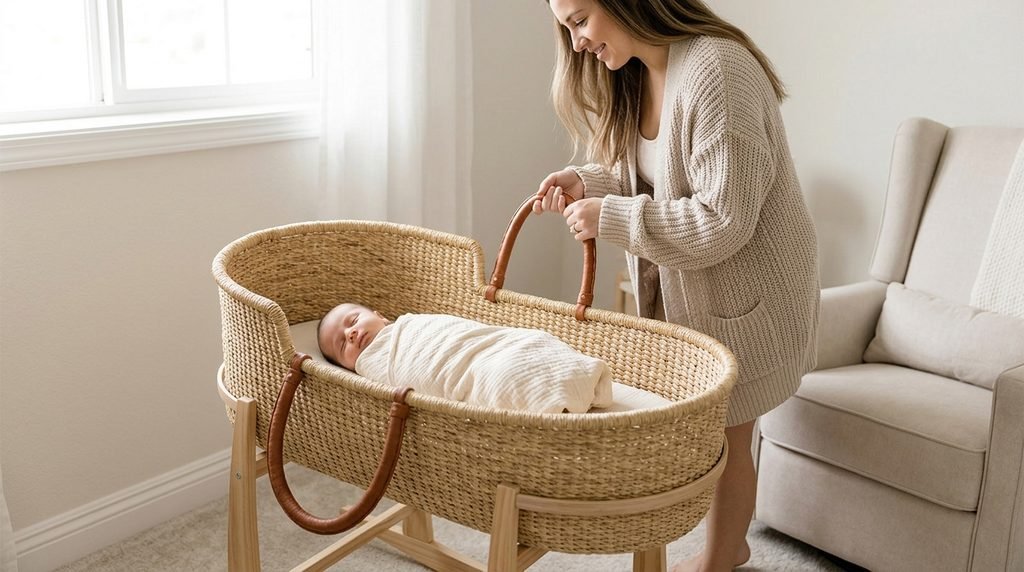
A Moses basket is a portable infant bed with two handles, traditionally woven from palm leaf, wicker or grass. It holds a small, firm mattress and sits on a stand, the floor or another stable surface, depending on the design. The name comes from the story of baby Moses hidden in a basket of reeds.
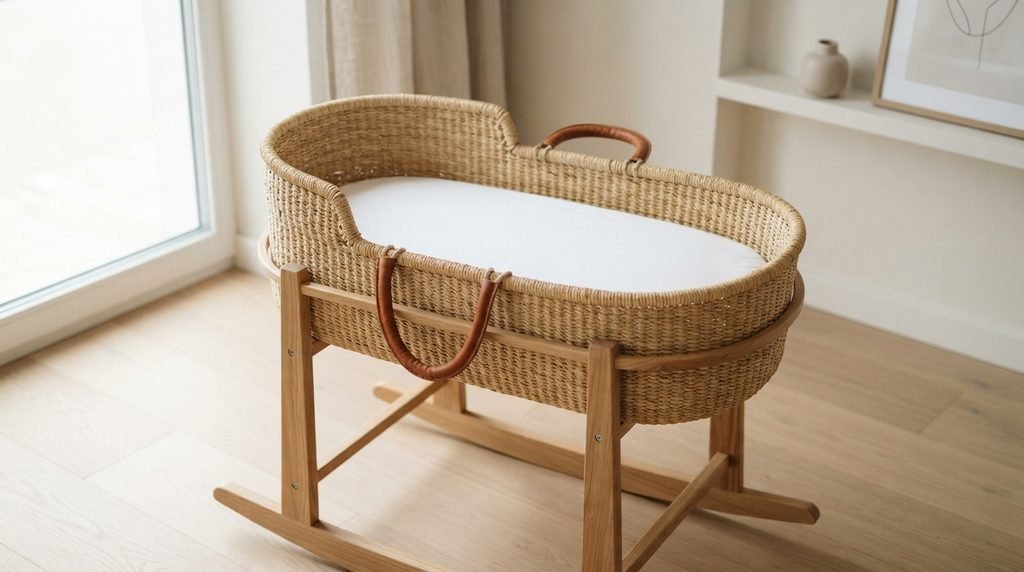
Wikipedia’s entry on bassinets groups Moses baskets and carry cots as beds built to be carried, in contrast with bassinets that stand on legs or a frame. Both are meant for roughly the first four months of life.
Modern versions come in woven grass, crochet, cotton rope, felt and quilted fabric. Some have a hood, some come with a rocking stand, and some fold flat for travel. Those differences affect safety, which is why the checks later in this guide matter.
Moses Basket vs. Changing Basket: A Costly Mix-Up
Search a US retail site for “Moses basket” and many results are titled “baby changing basket.” Listings that appeared in my search results on Amazon and Walmart combine both terms, often alongside a foam pad, a waterproof cover and a diaper caddy.
A changing basket is meant to sit on a dresser as a diapering station. Unless the maker states that it is an infant sleep product and meets the applicable bassinet standard, treat it as a changing accessory, not a bed.
Read the description, not the photo. Look for the intended use, the weight limit, the mattress details and a named safety standard.
Is a Moses Basket for Baby Safe for Sleep?
Yes, when the product meets the safety rules that apply where you live and you use it as directed. The woven basket itself is not the main risk. The risks come from soft surfaces, poor fit, unstable support and unsafe habits.
What US Guidance Says
The American Academy of Pediatrics (AAP) updated its safe sleep policy in 2022. It recommends a firm, flat, noninclined sleep surface, back sleeping for every sleep, and room-sharing without bed-sharing. It also states that products which do not meet the federal safety standard are likely not safe for infant sleep. Room-sharing is advised ideally for at least the first six months.
AAP Policy Statement, Sleep-Related Infant Deaths: Updated 2022 Recommendations
The federal rule for bassinets and cradles is 16 CFR part 1218, enforced by the Consumer Product Safety Commission (CPSC). It describes a bassinet as a small bed for infant sleep supported by free-standing legs, a stationary base or frame, a wheeled base or a rocking base. The sleep surface must be within 10 degrees of flat.
CPSC’s infant sleep product guidance adds that a product whose name implies sleep, such as “bed,” “bassinet” or “crib,” falls under its infant sleep rules. In December 2025, CPSC published a direct final rule adopting the updated ASTM F2194-25 bassinet standard, scheduled to take effect on February 21, 2026. Check CPSC’s site for the current status.
One nuance is worth knowing. The AAP says that in a true emergency, a basket or dresser drawer with a firm, flat surface and thin, firm padding may serve temporarily. That is a stopgap, not permission to use a decorative basket as a regular bed.
What UK Guidance Says
The Lullaby Trust, the UK charity focused on safer sleep, names a cot or Moses basket as a suitable separate sleep space in the same room as you. It advises a firm, flat, waterproof mattress, placing your baby on their back, and sleeping your baby in the “feet to foot” position with feet at the end of the basket. It also cautions against raised, soft or padded sides, because a baby’s face could press against them.
For product standards, the Lullaby Trust points UK buyers to BS EN 1466:2014 or BS EN 1466:2023 for Moses baskets and carry cots. A room temperature of 16 to 20°C is the range UK safer-sleep guidance commonly gives.
Other Countries
Rules differ by country. Red Nose, an Australian safe sleep organization, has said there is no mandatory Australian standard for bassinets. It points parents to Product Safety Australia’s buying tips instead: sides at least 300 mm above the mattress base, a wide stable base, and a firm mattress no thicker than 75 mm. If you live outside the US or UK, check your national consumer safety agency.
Why the Stand Matters
Consumer Reports notes that in the US, Moses baskets sold without a stand violate the bassinet safety standard. That fits the federal definition, which describes a bassinet as supported by a stand, frame or base.
A 2015 CPSC recall shows the practical risk. About 5,500 Tadpoles Baby and Kids baskets and 800 stands were recalled because the basket failed the hand-held carrier standard and the stand failed the bassinet standard. The basket could slide off an inclined surface and the stand could tip, creating a fall hazard. The lesson: a basket and its stand are tested and sold as a system. Do not mix and match.
7 Checks Before You Buy a Moses Basket for Baby
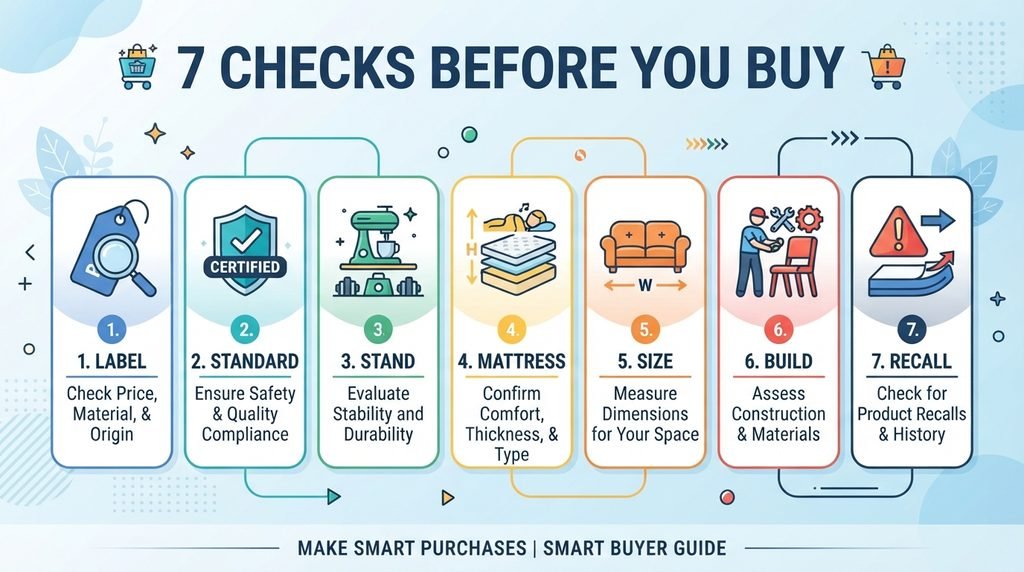
Run these seven checks before you pay. If a listing fails any of the first three, walk away.
1. Confirm It Is Sold for Sleep
The listing should say the product is a bassinet or infant sleep product, not just a “basket,” “prop,” or “changing station.” Check the description, the manual and the packaging. Titles that mention diaper caddies, changing pads or dresser use point to a changing basket.
2. Look for a Named Safety Standard
In the US, look for a statement that the product complies with the CPSC bassinet rule, 16 CFR part 1218. JPMA certification is a voluntary extra that some brands add. CPSC guidance shows makers of bassinets must certify compliance in a Children’s Product Certificate, so a serious seller should be able to tell you which standard the product was tested against.
In the UK, look for BS EN 1466. If a seller cannot name a standard, treat that as a warning sign.
3. Inspect the Stand or Base
Check that the stand is included, made for that specific basket, and stable when you push on it. Look for locking parts and a wide footprint. If the stand is sold separately, confirm the brand lists it as compatible. Do not put a basket on a stand from another maker.
4. Examine the Mattress and Sides
The mattress should be firm, flat and fit the basket snugly with no gaps at the edges. UK guidance also asks for a waterproof cover. Avoid baskets with thick padded liners or cushioned bumpers, because soft surfaces raise suffocation risk. Wikipedia’s bassinet entry notes that research links firm mattresses with lower SIDS risk.
5. Match Size and Weight Limits
Find the weight and age limit on the label or in the manual. Limits vary by brand. One hooded US basket lists use from birth up to 15 pounds or until the baby can push up or roll, whichever comes first. Another travel model featured by The Bump suits babies up to 20 pounds. A larger baby may outgrow a smaller basket within weeks.
6. Check the Build
Handles should be firmly attached and the weave smooth, with no snags, splinters or loose stitching. Sides should be high enough to help prevent falls, openings should be enclosed to avoid entrapment, and there should be no small parts or dangling cords. A sleep consultant quoted by The Bump lists these same points.
7. Search for Recalls
Search the exact brand and model in CPSC’s recall database before buying, especially for second-hand baskets. Register your product with the maker if a registration card is included, so you hear about any future notice.
Listing red flags at a glance
| If the listing says | What it may mean | What to do |
| “Baby changing basket” | Sold for diaper changing | Do not use for sleep unless the maker says otherwise |
| No standard named | No stated testing | Ask the seller or choose another product |
| Stand sold separately, brand not listed | Untested pairing | Buy only the maker’s matching stand |
| Thick quilted liner | Soft surface | Use only the firm mattress supplied |
| No weight or age limit | Missing safety instructions | Skip it |
| “Decorative” or “photo prop” | Not a sleep product | Use as decor only |
How to Set Up a Moses Basket Safely
Setup is where good products go wrong. Work through these steps before the first sleep.
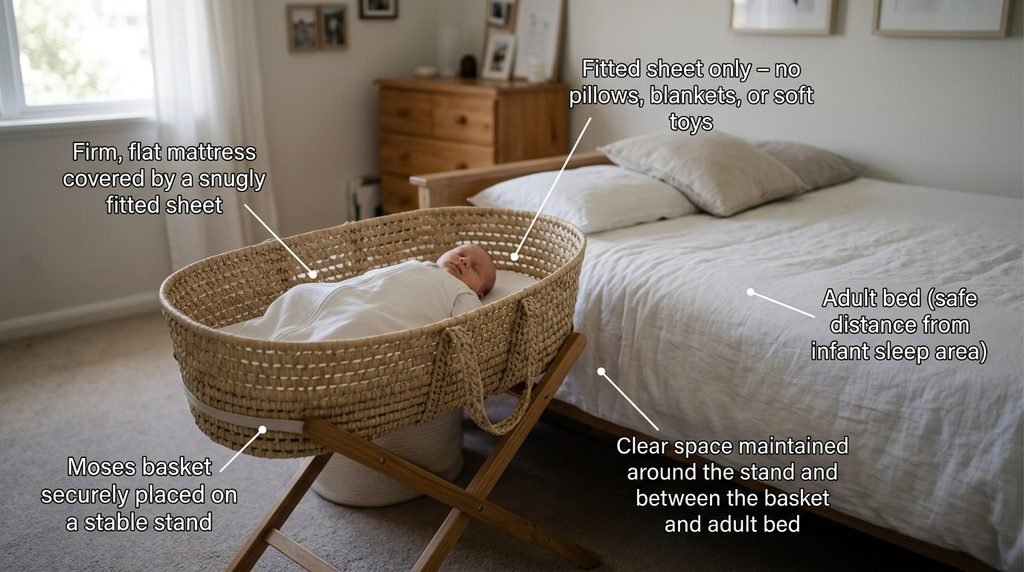
- Pick a stable spot. Use the stand it came with or a firm floor if the maker allows it. Never place it on a bed, sofa, table or counter.
- Keep it close. Place it within arm’s reach of your bed so your baby sleeps in your room. Keep it away from windows, blinds, cords, heaters and fireplaces.
- Use only the fitted mattress and sheet. No extra pads, pillows, toys, bumpers or loose blankets. If it is cold, dress your baby in a wearable blanket or sleep sack instead of adding bedding.
- Place your baby on their back for every sleep. In the UK, also place them feet to foot so they cannot slide under any covering.
- Leave hoods uncovered. If the basket has a hood, follow the maker’s directions. Do not drape blankets or fabric over the basket, because they can fall onto a baby.
- Move it empty. Never lift or carry the basket with your baby inside unless the maker explicitly states it is also a tested carrier.
- Control the room. Keep the room comfortably cool, avoid overheating, and keep the home smoke-free.
How Long Can a Baby Use a Moses Basket?
Most Moses baskets suit birth to about three or four months. Wikipedia notes that babies can roll over at around three to four months, which is when a light basket could tip.
The manufacturer sets the real limit. Some retailers claim four to six months, but treat that as brand-specific, not universal. Your label is the authority.
Stop using the basket when any of these happens, whichever comes first:
- Your baby pushes up on hands and knees, rolls, or tries to sit.
- Your baby reaches the weight limit on the label.
- Your baby’s head or feet reach the ends of the basket.
Plan the next bed early. The AAP advises room-sharing ideally for at least six months, which is longer than a basket lasts. The next sleep space should fit in your room and meet federal standards, such as a crib, bedside sleeper or play yard.
Moses Basket vs. Bassinet vs. Crib vs. Play Yard
| Feature | Moses basket | Bassinet | Crib | Play yard with bassinet |
| Typical use window | Birth to about 3-4 months | Birth to about 4-6 months | Birth to toddler years | Birth to toddler years |
| Portability | Very light, with handles | Movable, often wheels | Fixed | Folds |
| Space needed | Small | Small to medium | Large | Medium |
| Key check | Named sleep standard and correct stand | Federal standard and weight limit | Federal standard and mattress fit | Federal standard; use insert within limits |
| Best for | Room-sharing in small spaces | Bedside sleep | Long-term sleep | Travel and multi-use |
The time frames are typical ranges. Your product label overrides any general figure.
Is a Moses Basket for Baby Worth the Money?
Parents disagree. I could not access Reddit through my research tools, so this section draws on older parent forum threads, including The Bump community boards and Mumsnet. These are opinions, not evidence, and several threads are years old.
Three themes came up repeatedly:
- Short use window. Some parents felt a basket costs a lot for a few weeks of use, and preferred a play yard with a newborn bassinet insert.
- Small spaces and portability. Others valued the narrow footprint and the ability to keep the baby nearby for naps around the house.
- Trust. Some parents doubted baskets in general and asked whether a stand is necessary. The standard and label answer that better than forum opinion.
Prices vary widely. Listings in my searches ranged from about $40 for a basic hooded model to $475 for a premium travel basket.
A Moses basket is a reasonable fit if:
- You live in a small space and want a compact room-sharing bed.
- You can verify a named sleep standard and the correct stand.
- You want a light bed to keep nearby during the day.
Skip it if:
- You already own a play yard with a certified bassinet.
- You would buy it mainly for looks.
- You cannot confirm it is a tested sleep product.
Common Mistakes to Avoid
- Buying on looks. A pretty weave does not prove it is safe for sleep.
- Adding cushioning. Extra liners, toppers or pillows create soft surfaces. The AAP asks for a firm, flat surface with only a fitted sheet.
- Raising it on furniture. Use only the stand supplied. Consumer Reports advises against putting a portable bassinet on a raised or soft surface.
- Carrying it with the baby inside. Makers and safety experts consistently advise moving it empty.
- Covering the basket. Draped blankets can fall and cause smothering.
- Overstaying. Using it past the limits raises tipping and entrapment risk.
- Skipping the recall check. This matters most with hand-me-downs.
Cleaning, Storage and Second-Hand Baskets
Natural weave baskets often need spot cleaning only, so read the care label. Wash removable covers as directed and dry them fully before use.
The Lullaby Trust’s advice, as commonly summarized, is to use a new mattress for each baby where possible. If you reuse one, check that it is still firm, flat, clean and in good condition.
For a hand-me-down basket, inspect it before use:
- Look for broken weave, loose handles, splinters or a musty smell.
- Confirm you have the correct stand and all its parts.
- Find the manual, or download it from the maker’s website.
- Check the model against recall notices.
If you cannot confirm it is a compliant sleep product, use a different sleep space and keep the basket for storage or decor.
Frequently Asked Questions
Can a baby sleep in a Moses basket overnight?
Yes, if the basket is sold as an infant sleep product, meets the relevant standard, and you follow the maker’s instructions. Place it in your room, use a firm flat mattress, and keep it empty of soft items.
Are Moses baskets safe from SIDS?
No product can remove the risk of sudden infant death syndrome. Following safe sleep practices lowers it: back sleeping, a firm flat surface, a clear sleep space, room-sharing and a smoke-free home.
How long can a baby use a Moses basket?
Typically until about three or four months. Follow the age and weight limit on the label, and stop earlier if your baby pushes up or rolls.
Do I need a stand?
In the US, follow the maker’s instructions, because baskets sold for sleep are tested with a specific stand or base. UK Moses baskets often sit on the floor or a maker-approved stand. Never use an unmatched stand.
Can I use a changing basket for sleep?
Not unless the maker states it is an infant sleep product and meets the bassinet standard. Treat changing baskets as diapering accessories.
Is a hooded Moses basket safe?
Only if the maker designed the hood as part of the tested product. Keep your baby’s face uncovered and never drape extra fabric over the basket.
Can I use a blanket in a Moses basket?
Avoid loose blankets. If your baby is cold, use a wearable blanket or sleep sack and keep the room at a comfortable temperature.
What is the difference between a Moses basket and a bassinet?
A Moses basket is lighter and built to be carried when empty, while a bassinet usually stands on legs or a frame. Both are for the first few months, and both need to meet a sleep standard.
Final Takeaway
The right Moses basket for baby is a tested sleep product with a firm, flat, snug mattress, the correct stand and clear age and weight limits. Confirm the standard, check recalls, keep the basket bare, and plan the next sleep space before your baby outgrows this one.
Related Post:
When Do Babies Start Using High Chairs? 7 Essential Signs
Does a Surrogate Mother Share Blood With the Baby? 5 Truths
Why Do Some Babies Wear Helmets? 7 Simple, Essential Facts

6 thoughts on “Moses Basket for Baby: 7 Essential Checks Before You Buy”