Somewhere around the first birthday, a strange kind of dread sets in for a lot of parents. Not about the cake or the candle, but about the pantry shelf still stocked with formula cans. You start wondering if you are supposed to stop cold, whether your baby is even ready, and what on earth you are meant to serve instead. This guide walks through when to stop giving baby formula, the real signs of readiness on both sides, and a transition plan that will not turn bedtime into a battle.
Quick Takeaways
- Most pediatricians point to around 12 months as the general answer to when to stop giving baby formula, though it is a guideline rather than a hard cutoff.
- Readiness depends on more than age. Eating solids well, sitting with good control, and steady weight gain all matter too.
- A gradual, one-bottle-at-a-time switch to whole milk works better for almost every baby than stopping all at once.
- The one-year timing is not just about nutrition. Dental guidance and a baby’s natural shift toward solid foods point to the same window.
When to Stop Giving Baby Formula: The General Guideline
For the large majority of babies, the honest answer to when to stop giving baby formula is close to their first birthday, around 12 months old. By that point, a baby’s digestive system is typically ready to handle the proteins in cow’s milk, and solid foods should already be doing a growing share of the nutritional work that formula used to carry alone.
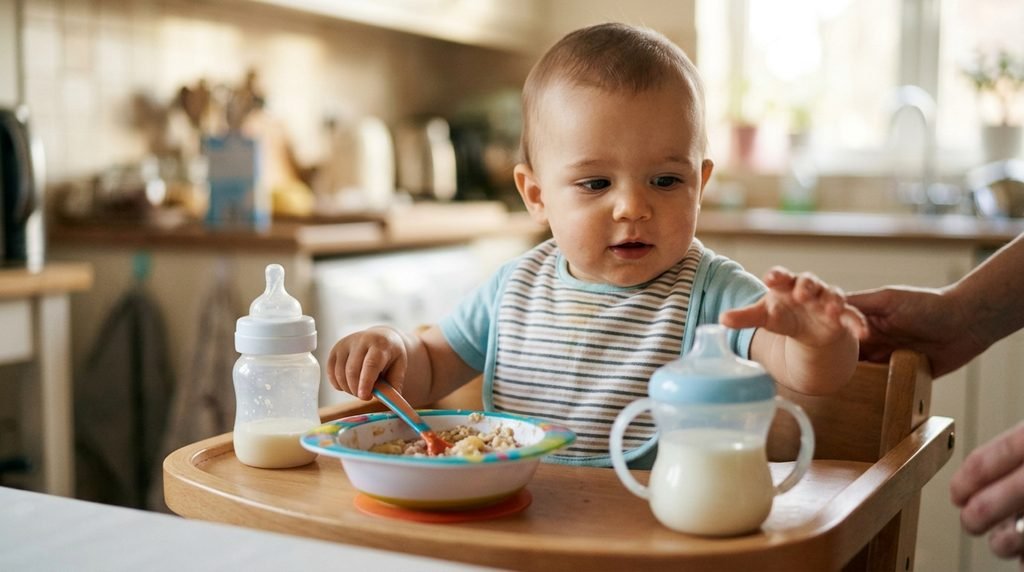
This is a guideline, not a deadline stamped on a calendar. A baby born prematurely should be judged by corrected age rather than actual age, since their digestive and developmental timeline runs on its own schedule. Some babies show real readiness signs as early as 9 months, but that call belongs with a pediatrician, not a parenting blog or a due date app.
What matters more than the exact week is why the guideline exists at all. Cow’s milk lacks the balance of iron and other nutrients a baby under 12 months needs, so pulling formula too early, before solids have taken over enough of that job, can leave a real gap in nutrition during a period of rapid growth. Parents searching for a single, universal answer to when to stop giving baby formula will not find one that fits every baby exactly, but the 12-month window remains the right place to start planning from.
Signs Your Baby Is Ready to Stop Formula
Age gives you a ballpark, but your baby’s actual eating behavior tells you more. A baby who is ready to leave formula behind is usually working through a real variety of solid foods, not just the same puree on repeat, and that includes some protein, vegetables, and grains rather than fruit alone.
Physical control matters too. Good head and trunk control, along with the coordination to manage a cup, are signs the digestive and motor systems are lining up together. Steady weight gain on the pediatrician’s growth chart is the quiet confirmation behind all of it, since a baby who is thriving on a mix of solids and formula is usually ready to shift that balance further toward food and milk.
One sign parents notice before anything else: baby starts losing interest in the bottle itself during the day, preferring to sit at the table and eat what everyone else is eating. That shift in attention is often the clearest early signal that the transition window has opened.
Signs Your Baby Isn’t Ready Yet
Not every baby hits these markers on the same week, and that is fine. The bigger flags to watch for are delayed feeding milestones, things like real difficulty chewing or swallowing solid textures, or head control that still lags behind where it should be for age.
Growth that has stalled or dropped off its usual curve is the other major signal. If your pediatrician has flagged a growth concern, or your baby seems to be genuinely struggling with new textures rather than just mildly resisting them, the right move is to keep formula in the rotation and let your pediatrician guide the pace instead of following a strict timeline.
It also helps to separate ordinary toddler pickiness from a real readiness problem. Plenty of one-year-olds throw food on the floor, refuse a vegetable they loved last week, or want the bottle back on a rough day, and none of that means they are behind. The signals worth taking seriously are the more consistent ones, like head control that still looks unsteady for age or a pattern of gagging on textures most babies that age handle fine, rather than a single bad mealtime.
Is It Okay to Continue Formula Past One Year?
Yes, and it does not automatically mean something is wrong. Formula past 12 months is not inherently harmful. The concern only shows up when a toddler starts relying on formula heavily enough that it crowds out solid food intake, since that can quietly work against the varied diet a growing toddler needs.
Some babies do need formula for longer, whether because of a slower growth pattern or a specific medical condition that calls for a specialty formula. That decision should be made with a pediatrician rather than treated as falling behind some invisible deadline. Every baby’s timeline looks a little different, and a few extra weeks or months of formula is not a parenting failure.
A practical way to tell if formula is starting to crowd out food is to look at mealtimes rather than the calendar. A toddler who consistently turns down solids after a big bottle, or who seems to be filling up on formula between meals instead of at meals, is showing the pattern worth mentioning to a pediatrician. A toddler still taking formula alongside three solid meals and snacks, with a healthy appetite at the table, is usually just on a slightly slower version of the same normal timeline.
How to Wean Your Baby Off Formula, Step by Step
Gradual weaning beats a sudden stop almost every time. The most reliable approach is to swap one bottle or feed at a time for a cup of whole milk, then give it about a week before touching the next one. That pacing lets your baby adjust to the new taste and texture without every feed changing at once.
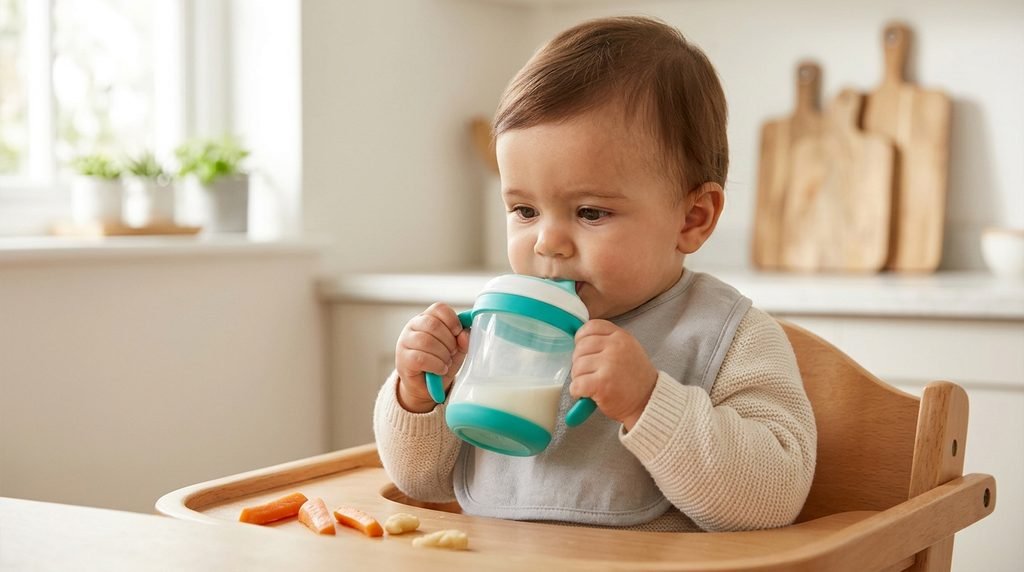
Some parents find it easier to bridge the gap by mixing formula and milk together in the same bottle first, slowly shifting the ratio toward more milk over a week or two. Either method works. What matters is picking one and sticking with it rather than bouncing between approaches, which tends to confuse both the baby and the routine.
A rough timeline helps make this concrete. In week one, replace the feed your baby cares about least, often a midday bottle, with a cup of whole milk, and leave every other feed as formula. In week two, once that swap feels normal, drop a second bottle the same way. By week three or four, most babies are down to just the bedtime feed, which usually needs a slower approach of its own. There is no penalty for stretching this out longer if a particular week goes rough, since the actual pace matters far less than the direction.
Why the Bedtime Bottle Is Always Last
If there is one feed that refuses to budge, it is almost always the one right before sleep, and that has less to do with hunger than with comfort. The bedtime bottle is usually woven into the whole wind-down routine, so simply swapping it for a cup of milk rarely works cleanly on its own.
What tends to work better is building a short replacement ritual around the swap itself. Keep the bottle for now, but add a book or a quiet song right after it, then once that new step feels normal, drop the bottle and let the book or song carry the comfort forward on its own. The goal is separating the emotional routine from the bottle itself before asking the bottle to disappear.
What to Give Your Baby Instead
Once formula steps back, whole cow’s milk usually steps in. Most guidance, including the U.S. Dietary Guidelines for Americans, points to roughly 16 to 24 ounces a day for a toddler between 1 and 2 years old, which works out to about 2 to 3 cups. Going noticeably higher than that can actually backfire, since too much milk fills a toddler up and can crowd out iron-rich solid foods, raising the risk of iron deficiency.
If cow’s milk is not an option, fortified alternatives like soy, pea protein, or oat milk can fill the gap, as long as they carry calcium, vitamin D, and calories close to whole milk, generally at least 100 calories per 8 ounces. Almond, cashew, and rice milk usually fall short on protein and fat for a toddler’s needs, so they are not a full substitute on their own. Water works well between meals, and 100 percent juice should stay capped around 4 ounces a day if you offer it at all.
Most toddlers do not need a dedicated toddler formula. A child eating a reasonably varied diet and growing well typically gets what they need from whole milk and solid food, and the American Academy of Pediatrics has described toddler and transition formulas as generally unnecessary for most healthy kids, often noting they carry added sugar without a clear nutritional edge over regular milk and food. A toddler with a genuine growth or nutrition concern is the exception, and that call again belongs with a pediatrician.
The cup itself matters more than parents usually expect. An open cup or a straw cup is generally a better fit for this transition than a sippy cup with a hard spout, since a sippy cup still encourages the same slow, prolonged sipping pattern as a bottle. Many toddlers manage an open cup with some spills well before their first birthday, and a straw cup is a forgiving middle step if a full open cup still feels like too much mess at every meal.
Why the One-Year Timing Lines Up With Dental Guidance Too
It is easy to assume the 12-month guideline is purely about nutrition, but it is really three separate reasons arriving at the same point together. The first is digestive readiness for cow’s milk proteins. The second is the natural shift toward solid foods that should already be underway by then. The third, less talked about, is dental.

Frequent, prolonged contact between a bottle and a baby’s new teeth, especially overnight, is linked to a higher risk of early tooth decay. Dental guidance on stopping bottle feeding by the first birthday exists almost entirely separately from the nutrition conversation, yet it lands on the exact same window. That overlap is part of why the one-year mark feels so consistent across pediatric, dietary, and dental sources rather than being one group’s arbitrary rule.
The Practical Side Nobody Talks About
Most guides stop at the developmental and nutritional case for weaning, but there is a practical layer real parents run into that rarely gets a mention when people talk about when to stop giving baby formula. If you still have an open can or two of formula sitting in the pantry, or you are receiving WIC benefits that typically stop covering formula around the 12-month mark, it is completely fine to keep using what you have while gradually introducing milk.
The transition does not have to happen on the exact date of a birthday. Stretching it over one to a few extra weeks while a remaining supply gets used up is a practical, reasonable middle ground, not a departure from the guideline. Pediatric advice sets the direction. How you actually use up a half-finished can of formula is a logistics question, and there is no prize for wasting it.
Frequently Asked Questions
Should I stop formula cold turkey or gradually?
Gradual is easier on almost every baby and every parent. A sudden stop can lead to a baby refusing milk outright or getting upset about a missing bottle, on top of whatever normal one-year-old resistance is already in play.
My baby was born premature. Do I use their actual age or corrected age?
Use corrected age rather than the date on the calendar. Pediatricians typically base the transition on corrected age alongside growth chart progress, not chronological age alone.
What if my toddler can’t tolerate cow’s milk?
Fortified soy, pea protein, or oat milk are reasonable substitutes if they carry calcium, vitamin D, and calories similar to whole milk. Water is fine between meals, and low-fat plant milks like almond or rice usually are not concentrated enough to replace whole milk on their own.
How much cow’s milk should a toddler drink per day?
Most guidance lands around 16 to 24 ounces a day for a toddler between 1 and 2 years old. Going well above that range can crowd out solid foods and raise the risk of iron deficiency.
Conclusion
The honest answer to when to stop giving baby formula is close to 12 months for most babies, but the exact week matters far less than the signals your own baby is giving you. Watch how they eat, how they grow, and how attached they still are to that bottle, and let a pediatrician weigh in on anything that feels off track. A gradual, one-feed-at-a-time switch to milk, with a little patience for the bedtime bottle in particular, tends to work better than any rigid deadline.
Is your baby showing more readiness signs or more hesitation right now, and does the practical side, like a formula stash or WIC timing, factor into your own plan?
Related Post:
TOG Sleep Sack Guide: How to Choose the Right Warmth for Your Baby
When Should Babies Wear Shoes? 5 Safe, Essential Tips
Why Do Some Babies Wear Helmets? 7 Simple, Essential Facts

6 thoughts on “When to Stop Giving Baby Formula: The Complete Guide (2026)”