Staring at a bottle of pumped milk and wondering if it is enough, or way too much, is one of those quiet stresses nobody warns you about before you become a parent. Unlike nursing, where you cannot actually see the ounces disappear, a bottle puts an exact number right in front of you, and that number can feel oddly high stakes at two in the morning. This guide walks through the same weight based math a how much expressed milk to feed baby calculator uses, breaks it into tables you can check in seconds, and adds the practical parts most calculators skip, like why a baby often drains a bottle faster than they would ever nurse and how much to actually pack for daycare.
Quick Answer: How Much Expressed Milk to Feed Baby Calculator Math
The fastest way to answer how much expressed milk to feed baby calculator questions is to multiply your baby’s weight in kilograms by 150, which gives a daily total in milliliters, then divide that number by how many bottles or feeds your baby takes in a day. A 4 kg (about 8.8 lb) baby eating 8 times a day would need roughly 600 ml daily, or about 75 ml per feed.
This works well for the first six to eight weeks. After that, most breastfed babies level off around 750 to 800 ml a day no matter how much heavier they get, so the formula needs a cap once your baby passes that stage.
The Core Formula: 150 ml Per Kilogram Per Day
The number pediatricians lean on most often is 150 ml of milk per kilogram of body weight per day, a figure that lines up with the CDC’s guidance on how much and how often to breastfeed. It is the same baseline used for formula feeding, and it matches what healthy, full term breastfed babies actually take in during their first two months, which is exactly the number any how much expressed milk to feed baby calculator is built around.
Some sources use a slightly wider range of 140 to 160 ml per kilogram, but 150 sits right in the middle and is easy to calculate on the fly. Here is what it looks like with real numbers.
Say your baby weighs 5 kg (about 11 lb).
- Multiply 5 by 150, which gives 750 ml as the daily total.
- Divide 750 by however many feeds your baby takes. At 6 feeds a day, that is 125 ml per feed. At 8 feeds, it drops to about 94 ml per feed.
Because feed counts vary so much from baby to baby, the per feed number will always shift a bit. What stays fairly constant, at least in those early weeks, is the daily total once you know your baby’s weight.
How Much Expressed Milk to Feed Baby: Per Feed Table by Weight
Doing mental math at 3 a.m. is not realistic, so here is the 150 ml per kilogram rule already worked out for common baby weights, in pounds and ounces first since that is what most American parents track at pediatrician visits.
| Baby’s Weight | Daily Total | Per Feed (8x/day) | Per Feed (6x/day) |
| 6.5 lb (2.9 kg) | ~14.5 oz (430 ml) | ~1.8 oz (54 ml) | ~2.4 oz (72 ml) |
| 8 lb (3.6 kg) | ~18 oz (540 ml) | ~2.3 oz (68 ml) | ~3 oz (90 ml) |
| 9 lb (4 kg) | ~20 oz (600 ml) | ~2.5 oz (75 ml) | ~3.4 oz (100 ml) |
| 10 lb (4.5 kg) | ~22.5 oz (675 ml) | ~2.8 oz (84 ml) | ~3.8 oz (113 ml) |
| 11 lb (5 kg) | ~25 oz (750 ml) | ~3.2 oz (94 ml) | ~4.2 oz (125 ml) |
| 13 lb (5.9 kg) | ~29 oz (885 ml)† | ~3.6 oz (111 ml) | ~4.9 oz (148 ml) |
| 15 lb (6.8 kg) | ~33 oz (1,020 ml)† | ~4.2 oz (128 ml) | ~5.6 oz (170 ml) |
† Once a breastfed baby passes 6 to 8 weeks old, actual intake tends to plateau near 25 to 27 oz (750 to 800 ml) a day even as weight keeps climbing, so treat these two rows as a starting point to discuss with your pediatrician rather than a hard target.
If your baby’s feed count sits between the two columns shown, just divide the daily total by your actual number of feeds instead. A baby taking 7 feeds at 9 lb, for example, would land around 86 ml, or just under 3 oz, per bottle.
How Much Breast Milk Per Feeding by Age
Weight is the more accurate number to calculate from, but an age based range is a handy sanity check, especially before you have pinned down an exact current weight.
| Age | Amount Per Feed | Typical Feeds Per Day |
| First week | 0.5 to 2 oz (15 to 60 ml) | 8 to 12 |
| 2 to 4 weeks | 2 to 3 oz (60 to 90 ml) | 8 to 10 |
| 1 to 2 months | 3 to 4 oz (90 to 120 ml) | 6 to 8 |
| 2 to 4 months | 4 to 5 oz (120 to 150 ml) | 6 to 7 |
| 4 to 6 months | 4 to 6 oz (120 to 180 ml) | 5 to 6 |
| 6 to 9 months | 4 to 6 oz (120 to 180 ml) | 4 to 5 |
Notice the per feed range barely moves after about four months. What changes instead is frequency, since older babies stretch the time between feeds as their stomachs hold more and solids enter the picture.
Step by Step: Work the Formula Yourself
If you would rather calculate this by hand than rely on an app, here is the exact process behind almost every how much expressed milk to feed baby calculator online, broken into steps you can redo any time your baby’s weight changes.
- Convert weight to kilograms. Take pounds and divide by 2.2. A 12 lb baby comes out to about 5.5 kg.
- Multiply by 150. That gives the daily total in milliliters. For 5.5 kg, that is 825 ml.
- Divide by feeds per day. At 6 feeds, 825 divided by 6 is about 138 ml per bottle.
- Apply the 6 to 8 week cap. If your baby is past that age and the math suggests more than roughly 800 ml a day, use 750 to 800 ml as the working number instead.
- Treat it as a guide, not a rule. Some feeds will run bigger, some smaller. Watch your baby, not just the ounce marks on the bottle.
Why Babies Often Take More From a Bottle Than at the Breast
A bottle tends to deliver milk faster and more steadily than a breast does, and that difference alone can push a baby to take in more than they actually need. At the breast, a baby has to work for the milk and can slow their own intake as they get full. With a standard bottle held upright, gravity and a continuous flow can override those natural fullness cues, so a baby keeps swallowing even after they would have stopped nursing.
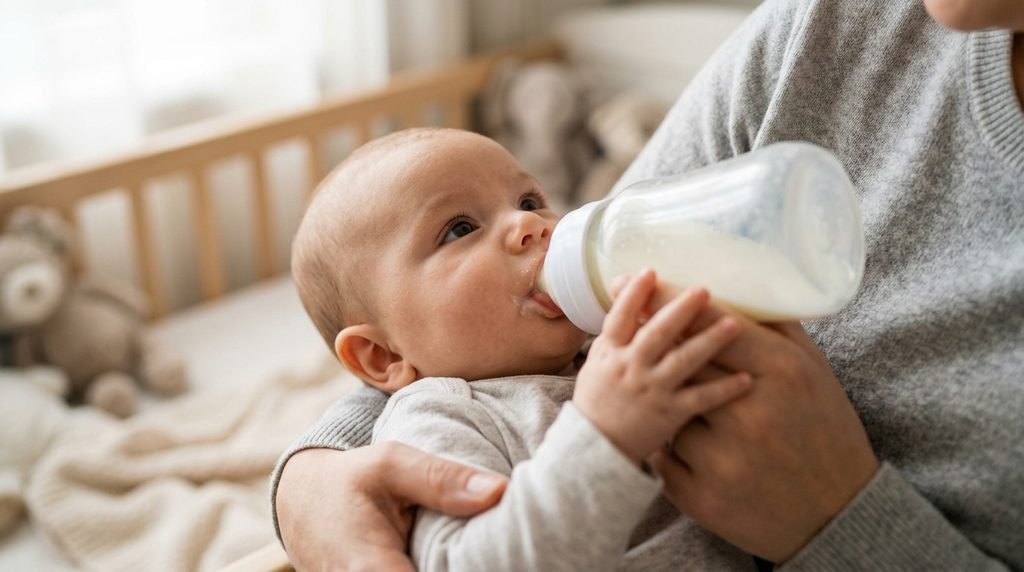
This matters for two reasons. First, it can look like your baby needs more milk than the tables above suggest, when really the delivery method is the reason they are finishing the bottle so fast. Second, consistently over-delivering expressed milk can send the body a signal that less milk is needed at the breast, which can chip away at supply over time.
Paced bottle feeding is the fix most lactation consultants recommend. Hold the bottle more horizontally so the baby has to actively suck rather than just swallow a steady stream, pause every 20 to 30 seconds to let them catch up, and switch sides partway through the way you would at the breast. Side lying the baby, similar to a nursing position, slows the flow even further and gives them a real chance to signal when they are done.
How Much Expressed Milk to Leave With a Caregiver
Once you know your baby’s daily total from the how much expressed milk to feed baby calculator math above, packing bottles for daycare or a night out is mostly arithmetic. A good rule of thumb is to send slightly more than your baby’s usual per feed amount split across a few smaller bottles, rather than one large one, since a caregiver cannot always predict exactly when your baby will get hungry.
For a full day away, for example an 8 hour stretch with 3 feeds expected, take your daily total, divide by the number of feeds your baby usually takes across 24 hours, then multiply that per feed number by 3 and add about 1 extra ounce as a buffer. A baby on a 24 oz daily total taking 6 feeds a day (4 oz per feed) heading out for 3 feeds would need roughly 12 to 13 oz packed, split into 3 or 4 labeled bottles so nothing goes to waste if the baby does not finish one.
Always send a little less per bottle than you think, since a caregiver using a fast flow nipple or skipping paced feeding can go through milk quicker than you would at home, and unfinished bottled milk from that same feed can typically be offered again within about an hour but should not sit out indefinitely.
Signs Your Baby Is Getting Enough Expressed Milk
Volume math is a starting point, not proof on its own. According to HealthyChildren.org from the American Academy of Pediatrics, the clearer signals of adequate intake are the ones you can actually observe day to day.

- Wet diapers. At least 5 to 6 per day after the first week.
- Steady weight gain. Most babies regain birth weight by 2 weeks old and then gain roughly 5 to 7 oz a week through the first few months.
- Settling after a feed. A baby who relaxes their hands, unclenches, and seems content, even without finishing every drop, is usually satisfied.
- Active alert periods. A well-fed newborn has stretches of calm alertness between feeds, not constant fussiness.
If your baby is consistently missing these markers, the tables in this guide are a starting conversation, not a diagnosis. A pediatrician or International Board Certified Lactation Consultant can look at growth charts and feeding behavior together in a way no calculator can.
When the Numbers Do Not Match Reality
Search around for how much expressed milk to feed baby calculator guidance and you will run into conflicting figures, some citing 120 to 160 ml per kilogram, others quoting numbers as high as 200. Part of that spread comes from real clinical variation, but a fair amount of it also comes from low quality, auto-generated pages that recycle numbers without checking them against an actual source.
The 150 ml per kilogram figure used throughout this guide is the one that lines up with CDC and American Academy of Pediatrics feeding guidance, so treat any number far outside the 140 to 160 range with some skepticism unless it comes from your own baby’s care team.
The other place the math breaks down is that plateau mentioned earlier. Research on exclusively breastfed infants shows daily intake commonly levels off around 750 to 800 ml between about six weeks and a year old, even though the baby keeps growing steadily. If a formula built purely on current weight is telling you to pack noticeably more than that for an older baby, lean on the plateau number and your baby’s actual feeding cues instead of the raw calculation.
Premature babies, babies recovering from a slow start with weight gain, and anyone using fortified breast milk fall outside all of these general ranges and need a feeding plan built directly with a neonatologist or pediatric dietitian rather than a standard calculator.
Frequently Asked Questions
How much expressed milk should I feed my baby at each feeding?
Start by dividing your baby’s estimated daily total, roughly 150 ml per kilogram of body weight, by how many feeds they take in 24 hours. A 4 kg baby taking 8 feeds a day would get about 75 ml per bottle, while the same baby on 6 feeds would take closer to 100 ml.
How much breast milk per feeding is normal at 2 months and at 4 months?
Around 2 months, most babies take 3 to 4 oz (90 to 120 ml) per feed, roughly 6 to 8 times a day. By 4 months, feeds typically run 4 to 6 oz (120 to 180 ml), usually 5 to 7 times a day, with the exact amount depending on the baby’s weight and appetite.
Is expressed breast milk calculated the same way as formula?
The same 150 ml per kilogram target applies to both, since the underlying goal, meeting daily fluid and calorie needs, is the same either way. The main difference is that formula has a fixed calorie count per ounce, while breast milk composition shifts slightly through the day and across a feeding session.
How much expressed milk does a newborn need in the first few days?
Very little at first. A newborn’s stomach in the first day or two holds only about a teaspoon or two, so early feeds might be just 0.5 to 1 oz (15 to 30 ml). That amount climbs quickly over the first week as the stomach stretches and milk supply increases.
How much expressed milk should I leave for daycare?
Pack slightly more than your baby’s typical per feed amount, split into a few smaller labeled bottles rather than one large bottle, and account for every feed expected during the time you will be away plus roughly one extra ounce as a buffer per feed.
Conclusion
The 150 ml per kilogram rule gets you a solid starting number fast, but three things matter more than the exact figure on the page. Weight based math works best in the first six to eight weeks, then the 750 to 800 ml daily plateau takes over even as your baby keeps growing. A bottle can push a baby to take more than they would at the breast, so paced feeding protects both your supply and your baby’s own fullness cues. And wet diapers, weight gain, and a settled baby after a feed tell you more than any calculator ever will.
Keep this guide bookmarked for the next weight check or daycare drop off, since the numbers are worth revisiting as your baby grows. What is your baby’s current feeding routine, and does the math here match what you are already seeing at home?
Related Post:
TOG Sleep Sack Guide: How to Choose the Right Warmth for Your Baby
When Should Babies Wear Shoes? 5 Safe, Essential Tips
Why Do Some Babies Wear Helmets? 7 Simple, Essential Facts

4 thoughts on “How Much Expressed Milk to Feed Baby Calculator: A Complete Weight-Based Guide”