
When do babies start using high chairs? Most babies are ready at around 6 months, once they can hold their head steady and sit upright with only a little help. Some get there closer to 4 or 5 months, and others take a few weeks longer. The calendar matters less than what your baby’s body can do.
That’s good news if you’re feeling pressure to buy the chair before you’re sure it’s time. This guide gives you the age range, seven clear signs of readiness, and the safety steps that prevent falls. You’ll also learn why online advice swings from 4 months to 9, and what to do about it.
When Do Babies Start Using High Chairs? The Short Answer
Babies usually start using high chairs at about 6 months, when they begin solid foods and can sit with minimal support. The American Academy of Pediatrics (AAP) recommends introducing solids around that age, and the chair follows the same timeline. If you’re still planning that step,
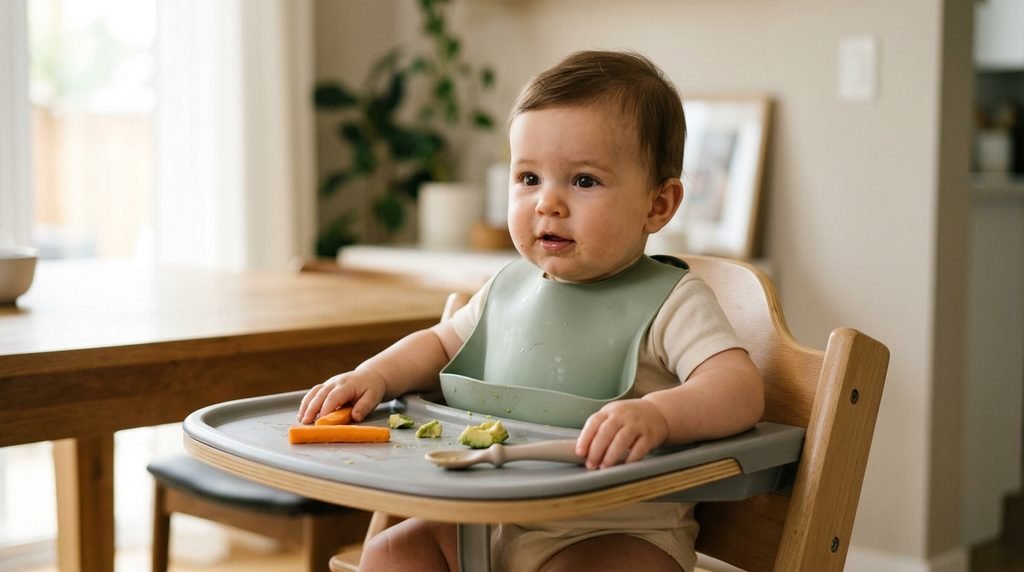
Here’s where the confusion starts. You’ll see “4 to 6 months” in a lot of articles. That range describes babies who are developing early and can sit with support. It doesn’t mean every 4-month-old is ready, and starting solids before about 4 months isn’t recommended at all.
So treat 6 months as the target and readiness as the test. If your baby slumps, tips sideways, or can’t keep their head steady, wait, even if the birthday says otherwise. A week or two of waiting costs you nothing. A fall from a high chair can cost a great deal.
Why Sitting Skills Matter More Than the Calendar
Parents asking when do babies start using high chairs tend to focus on age, but the chair really tests three skills. It asks your baby to do three things at once: hold their head up, keep their trunk upright, and swallow food safely. Each one depends on muscle strength that grows on its own schedule.
Head and neck control comes first. It usually settles in around 3 to 4 months. Trunk strength arrives later, and most babies sit with a bit of propping at about 6 months, according to HealthyChildren.org, the AAP’s parent site. That trunk strength is what keeps them from folding forward or leaning to one side once the food arrives.
Swallowing is the safety piece. A baby who is slumped or tilting back has a harder time moving food to the back of the mouth, and that raises the choking risk. Upright and steady makes swallowing easier.
Falls are the other worry. Federal data on high chair injuries show that most serious incidents involve children falling out or climbing in and out, often when the restraint wasn’t used or the chair tipped. A baby who can’t yet sit steadily is more likely to slide, slump, or wriggle in a way the harness can’t fix.
When Do Babies Start Using High Chairs, Month by Month
Use this table as a quick guide. Every baby moves at their own pace, so treat the ages as ranges.
| Age | High chair use | What to know |
| 0 to 3 months | Not for feeding | Some reclined newborn modes exist. Use them only as a supervised seat. |
| 4 to 5 months | Only if ready | Needs steady head control and sitting with support. Check with your pediatrician before solids. |
| 6 months | Typical start | Most babies sit with little help and show interest in food. |
| 7 to 9 months | Regular use | Sitting gets steadier. Finger foods and self-feeding begin. |
| 9 to 12 months | Daily meals | Babies wiggle more. Check the harness every meal. |
| 12 to 24 months | Still in use | Climbing starts. Watch for standing or leaning out. |
| 2 to 3 years | Winding down | Most kids move to a booster or a regular chair by about age 3. |
Notice the first row. A reclined chair can look tempting for a newborn, but it isn’t a feeding seat. More on that below.
Why Advice Ranges From 4 to 9 Months
Search this topic and you’ll see 4 months in one article and 7 to 9 months in another. Both can be “right,” because they answer different questions.
The lower number usually means sitting with support in a chair that reclines or has padding. The higher number means sitting completely alone without any help. One nutrition site notes that many babies sit fully independently somewhere between 7 and 9 months. A high chair doesn’t require that level of skill, but it does require enough steadiness to stay upright with the harness and a little propping.
A second mix-up is the difference between using the chair and starting solids. Some families put a baby in the chair at 4 months just to join dinner. That’s a social choice. Feeding solids is a nutrition choice, and the AAP puts that at around 6 months. When you read any age, ask which of the two it describes.
7 Essential Signs Your Baby Is Ready
Age is only a starting point. Before the first meal, look for these seven signs together, not one at a time.
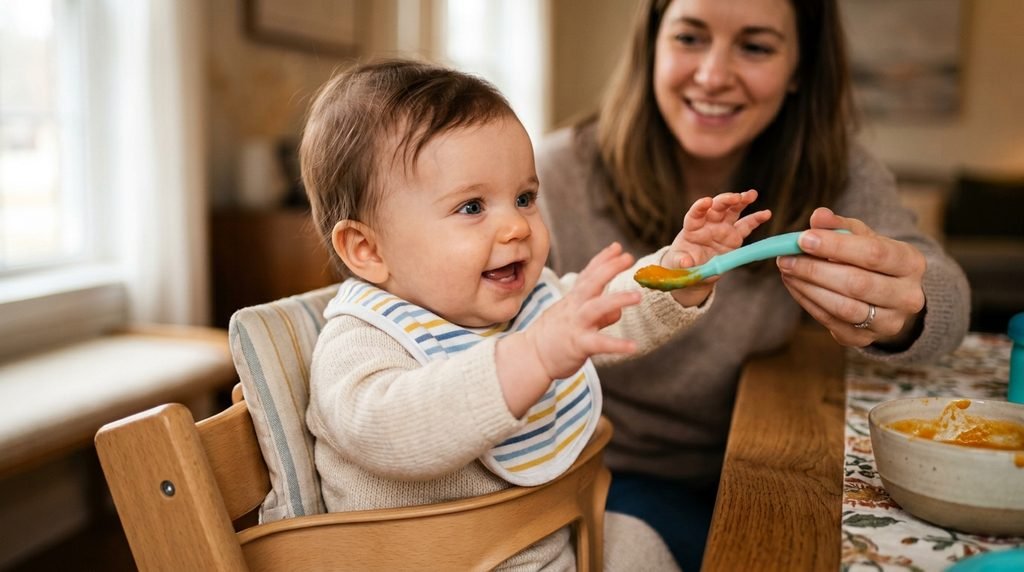
- Steady head. Your baby holds their head upright and still while seated, without bobbing, for about 15 minutes.
- Sitting with little help. They stay upright with minimal support and don’t slump to one side.
- Good trunk strength. Their back stays straight when you seat them, rather than curling forward like a question mark.
- Interest in food. You’ll catch them watching every bite you take, leaning toward your plate, or reaching for it.
- Reach and grab. They pick up a toy while sitting and bring it to their mouth.
- Open mouth. When a spoon approaches, they open up instead of turning away.
- Swallowing, not pushing. The tongue-thrust reflex has faded, so food goes back instead of getting pushed straight out.
If your baby shows most of these but not all, wait a week or two and check again. Solid Starts, a group of pediatric feeding experts, says to see every sign before you begin. The HealthyChildren.org readiness checklist lays out the same idea. Readiness at 5 months can look different than at 6, and a little patience is fine.
Can You Use a High Chair Before 6 Months?
Yes, but only as a seat, not as a feeding station. Many newer chairs recline, and some are marketed for newborns. That’s fine if your goal is to keep your baby close to the family table during meals.
Consumer Reports makes this point clearly. A reclined mode can pull a young baby up to the table, but it isn’t a safe position for feeding solids. Upright sitting is what the feeding position requires.
If you use a reclined seat, keep three rules in mind. Use the harness every time. Stay within arm’s reach. And stop using it as a bed, because babies can slump, tip, or fall asleep in a position that isn’t safe.
The federal high chair standard now includes stability testing for reclined seats. That’s reassuring, but it doesn’t remove the need for supervision. Standards reduce risk. They don’t replace your attention.
How to Set Up a High Chair Safely
A ready baby in a poorly set-up chair is still at risk. Spend ten minutes on the setup and you’ll prevent most common problems.
Use the harness, always. Federal rules require high chairs to have a restraint with waist and crotch straps. Buckle it snugly every time, even for a quick snack. The tray is not a restraint, and manufacturers say so in their manuals.
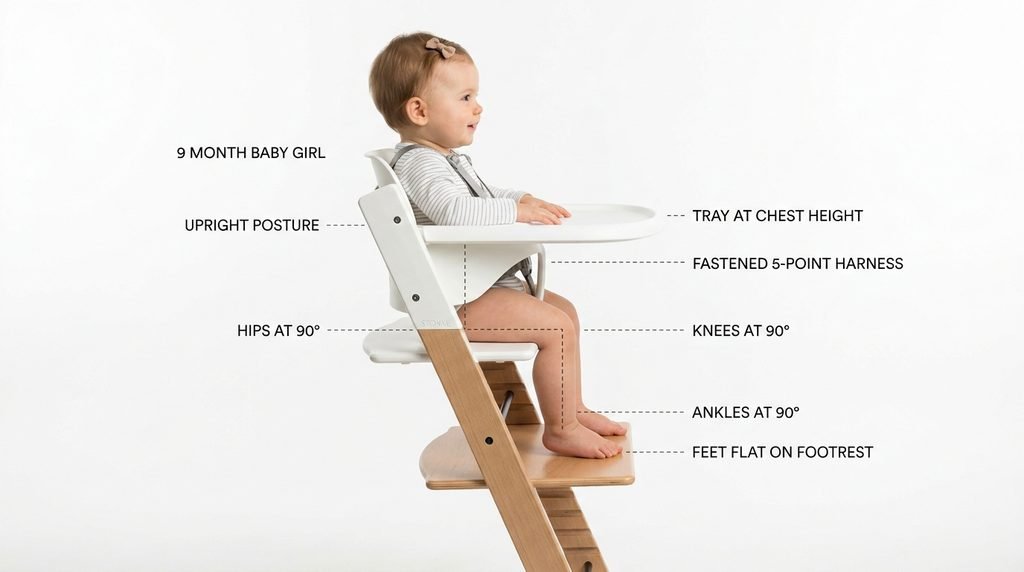
Follow the 90-90-90 rule. Your baby’s hips, knees, and ankles should each rest at about 90 degrees, with feet flat on a footrest and the tray at chest height or lower. Dangling feet make it harder to stay steady and to swallow.
Check stability. Place the chair on a flat floor, away from walls, counters, and table edges your baby could push against. That push is how chairs tip over. Read the official CPSC high chair guidance for what the rules cover, including tray, tip-over, and entrapment hazards.
Fit the chair to the baby. If your child is much smaller than the seat, they’ll slouch. A small rolled towel on each side can help, but don’t use thick cushions or pillows that lift your baby out of the harness range.
Choose useful features. A chair with a height-adjustable footrest, a wipeable seat, and a tray you can remove with one hand will serve you well for two years. Look for a wide, stable base. Skip chairs with lots of small crevices, because food will hide there.
Tighten and inspect. Screws work loose with daily use. Keep the tool that came with the chair and check it every few weeks.
Buy used with care. Check the model at CPSC.gov for recalls. Chairs made after June 2019 must meet the current mandatory standard, so older ones may lack safeguards.
What If Your Baby Isn’t Ready Yet?
Nothing is wrong if your baby is 6 months old and still wobbly. Sitting skill builds with practice, and there’s plenty you can do while you wait.
Give your baby lots of floor time and tummy time, since both strengthen the neck, back, and shoulders. Our guide to tummy time by age shows how to build it up. Sit them between your legs or in the corner of a sofa with your hands nearby, so they can practice balancing in short, supervised stretches. Put toys just out of reach so they have a reason to lean and rotate.
Meanwhile, keep feeding on your usual schedule. Breast milk or formula still gives most of the nutrition in the first year, so there’s no rush to hurry solids. If your baby is well past 6 months and still can’t sit with support, mention it at the next checkup. It’s a good moment to ask about motor development, and your pediatrician can tell you what’s typical.
When your baby is finally steady, you’ll have a clear answer to when do babies start using high chairs in your house. It’s the day the seven signs line up.
How to Introduce the High Chair
Once you know when do babies start using high chairs for your own child, don’t turn the first day into a big event. Treat it as practice.
- Start before food. Sit your baby in the chair for a few minutes at a time when they’re calm, with a toy on the tray. This lets them learn the feeling of the seat.
- Keep sessions short. Ten to fifteen minutes is plenty at first. You can stretch it as their stamina grows.
- Pick a good moment. A hungry but not desperate baby does best. Skip the chair when they’re tired, sick, or cranky.
- Sit close. Face your baby at eye level, talk, and eat your own meal in view. Babies copy what they see.
- Stay for the whole meal. Never step away, even for a moment. Seat, buckle, and stay.
If your baby fusses, end the session and try again tomorrow. There’s no rule that says the first week must go perfectly.
Common Mistakes to Avoid
Most trouble around when do babies start using high chairs comes from a short list of mistakes. Here are the ones that come up again and again.
- Starting too early. Putting a baby in before they can sit steadily strains the neck and back and raises the risk of slumping. It also tempts parents to start solids before the baby is ready.
- Propping with pillows. A rolled blanket at the sides is one thing. A thick cushion that changes how the harness fits is another, and it can let a baby slide out.
- Skipping the harness. It’s easy to skip when the meal is quick. Falls happen fast, and they happen most when the restraint isn’t used.
- Ignoring climbing. Once your baby stands, the chair becomes a launch pad. If your child is trying to stand on the seat, it’s time for a different setup.
- Leaving the room. A baby can slide, choke, or lean over in seconds. If you need to leave, take your baby with you.
Special Situations: Preemies, Baby-Led Weaning, Restaurants, and Siblings
The basic timeline is the same for most families, but a few situations change the answer to when do babies start using high chairs.

Premature babies. Doctors often judge development by corrected age, which counts from the due date. Ask your pediatrician which age to use when deciding on solids and the chair. For milestone timing more broadly,
Baby-led weaning. If you’re offering finger foods instead of purees how to start baby-led weaning post explains both approaches the chair matters even more. A steady, upright position is central to safe swallowing, so wait for every readiness sign.
Restaurants. Restaurant high chairs count too. Federal researchers estimated about 1,600 emergency room visits from restaurant high chair incidents between 2011 and 2016, and most involved falls. Use the strap every time, and don’t let your child climb in or out alone.
Siblings and guests. Older children love to help. Remind them not to climb, lean on, or shake the chair, and keep the baby’s tray clear of hot drinks.
How Long Do Babies Use a High Chair?
Knowing when do babies start using high chairs is only half of the picture. Most children use one from around 6 months to somewhere between 2 and 3 years. Some are ready to leave earlier, closer to 18 months, and others stay longer. There’s no right or wrong time.
The best signs are physical. When your child outgrows the weight or height limit, wants to eat at the table with everyone else, or keeps trying to stand up on the seat, the chair has done its job. Many kids move to a regular chair with a booster seat by about age 3.
Federal rules define a high chair as one intended for children up to 3 years old, so the limits on the label are worth a look. Convertible and “grow with me” chairs can stretch that timeline, but the same safety checks still apply. If you’re comparing options,
Frequently Asked Questions
Can a 3-month-old sit in a high chair?
Not for feeding. At 3 months, most babies lack the head and trunk control needed. A reclined newborn mode can work as a supervised seat, but solids aren’t safe yet.
Can a 4-month-old sit in a high chair?
Only if they have steady head control and can sit with support, and only with your pediatrician’s approval for solids. Many 4-month-olds aren’t ready, and waiting until about 6 months is the safer plan.
Is a booster seat the same as a high chair?
No. A booster raises a child on a regular chair, and it needs stronger sitting skills. For babies, a high chair with a full harness and footrest is the better choice.
How long can a baby sit in a high chair at one time?
Start with 10 to 15 minutes and build up gradually. Watch for slouching or fussing, and end the meal when your baby loses interest.
When do babies start using high chairs in restaurants?
The same rules apply as at home. Wait until your baby sits steadily, then use the restaurant’s chair with the strap fastened and stay beside them. If the chair looks wobbly, ask for another.
Conclusion
So, when do babies start using high chairs? Around 6 months, once they can hold their head steady, sit with little help, and show interest in food. Use the seven signs as your checklist, and let your baby’s skills set the pace rather than the date on the calendar.
Before the first meal, take five minutes to check the harness, the footrest, and the chair’s stability. If you’re still unsure, ask your pediatrician at the next visit. Then share this guide with anyone who will feed your baby, and let us know in the comments which sign your little one showed first.
Related Post:
How Long Does Baby Ear Piercing Take to Heal? A Simple Parent’s Guide
Does a Surrogate Mother Share Blood With the Baby? 5 Truths
Why Do Some Babies Wear Helmets? 7 Simple, Essential Facts

3 thoughts on “When Do Babies Start Using High Chairs? 7 Essential Signs”