When can you take a baby to the beach? No official minimum age exists. A healthy, full-term baby can go outdoors soon after birth, and many families make short, shaded beach visits in the first few months. What changes with age is the balance of risks: sun, heat, water and germs each matter more or less depending on how old your baby is.
The firmest line comes from the American Academy of Pediatrics (AAP): babies under 6 months should stay out of direct sunlight. Beyond that, online guides disagree, suggesting anything from “any age” to 2, 4 or 6 months. This guide separates what is firmly recommended from what is common practice, and points out where to ask your pediatrician.
It is general information, not medical advice.
Quick answer
- Minimum age? None set in the AAP sources I checked. Many guides suggest waiting until at least about 2 months for longer visits. Your pediatrician can tailor this to your baby.
- Under 6 months: Shade, covering clothing and a brimmed hat come first. Sunscreen is for small exposed areas only.
- 6 months and older: Add broad-spectrum sunscreen on all exposed skin.
- Water: Keep a hand on your baby, choose a lifeguarded area, and use a properly fitted life jacket near open water.
- Timing: Go early or late in the day, and keep the first trip short.
When Can You Take a Baby to the Beach? An Age-by-Age Guide
Guides disagree because no single rule covers it. The reasoning behind each suggestion differs: some focus on skin, some on temperature control, some on infection risk. The table below combines the official sun and water guidance with common practical suggestions. The ages are guideposts, not cutoffs.
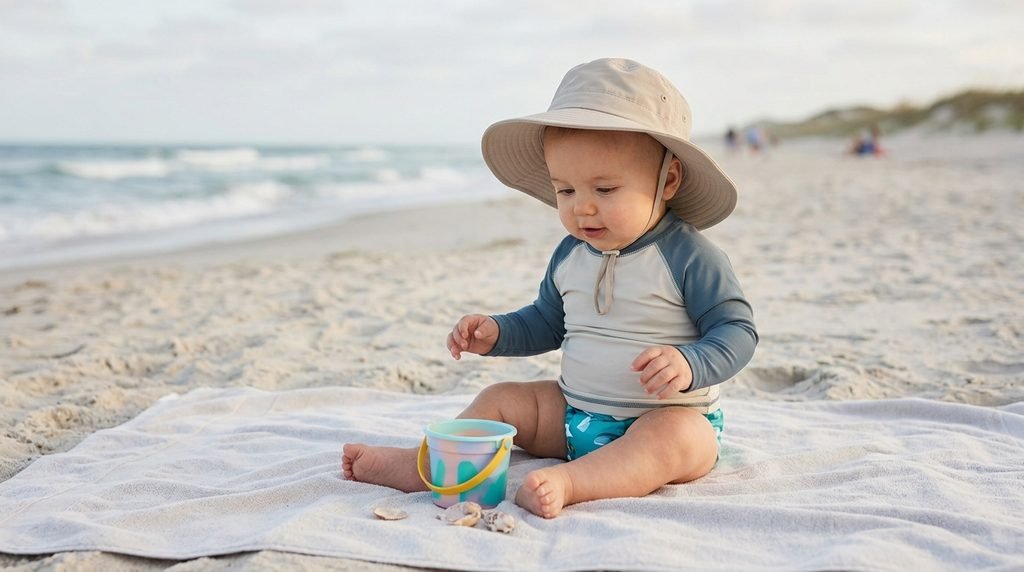
| Age | Beach visit | Sun | Water | Extra concern |
| Newborn to about 2 months | Possible for a healthy, full-term baby if your pediatrician agrees. Keep it brief, quiet and shaded. | Shade, clothing, hat | Skip dips; ask your pediatrician | Crowds and sick contacts |
| About 2 to 6 months | Short shaded visits at off-peak hours | Shade, clothing, hat; sunscreen only on small exposed areas if needed | Wading at the edge only with a hand on your baby, and only if your pediatrician agrees | Heat and glare |
| About 6 to 12 months | Longer visits with regular breaks | Shade plus sunscreen on all exposed skin | Shallow play with touch supervision | Sand in the mouth, water quality, drowning |
The First Weeks: Outdoors Is Fine, Crowds Are the Concern
Fresh air is not the problem for a healthy newborn. Pediatric commentary I found focuses on infection risk from crowds and sick contacts, plus extreme heat or cold.
Sources differ on how long to avoid busy places. Some suggest about six weeks. Others suggest the first two to three months, and one parenting site points to the first vaccines at around two months. There is no single official cutoff.
A beach on a summer weekend is a crowd. A quiet weekday morning is a very different setting. If you go early on, choose a spot with space around you.
One threshold matters more than the calendar. Pediatric guidance treats a rectal temperature of 100.4°F (38°C) or higher in a baby under 3 months as urgent, and advises calling your pediatrician right away. A warm baby after a sunny outing deserves a temperature check, not an assumption that it was “just the sun.”
Two to Six Months: The Popular Window
Many parent guides call this a comfortable stage. Babies nap often, they are easier to keep in the shade, and they are not yet mobile. Head control improves, which helps with carrying and with any time near the water’s edge.
The AAP sun rule still applies fully. Under 6 months, your plan is shade and clothing, not sunscreen and sunbathing.
Six to Twelve Months: More Fun, More Risk
Sunscreen becomes a routine part of the day. Babies at this age grab sand, put everything in their mouths and move toward the water quickly. Supervision has to tighten, not relax.
Sun Protection at the Beach: What the AAP Says
The AAP’s advice is consistent across its parent pages. Babies under 6 months should be kept out of direct sunlight, in shade under a tree, umbrella or stroller canopy. Dress them in lightweight clothing that covers arms and legs, plus a brimmed hat that shades the neck.
Sunscreen guidance is where many online guides get muddled. Some brand pages say the AAP advises no sunscreen at all before 6 months. The AAP text says something narrower: for babies younger than 6 months, use sunscreen on small areas such as the face if protective clothing and shade are not available.
| Baby’s age | First line of defense | Sunscreen |
| Under 6 months | Shade, covering clothing, brimmed hat | Small exposed areas only, if clothing and shade are not enough |
| 6 months and older | Shade, clothing, hat | Broad-spectrum on all exposed areas, avoiding the eyes |
For babies 6 months and older, AAP guidance suggests:
- Broad-spectrum sunscreen with SPF 15 or higher. The AAP notes the added benefit of SPF 50+ is limited, and many dermatology groups suggest SPF 30.
- Applying 15 to 30 minutes before going outside, then reapplying every two hours and after swimming, sweating or toweling off.
- Choosing zinc oxide or titanium dioxide for sensitive areas like the nose, cheeks and ears.
- Avoiding oxybenzone if possible.
- Wiping eyes and hands clean with a damp cloth if sunscreen gets in the eyes.
Babies put their hands in their mouths, so avoid heavy application on their hands. Test a new product on a small patch of skin first.
The AAP also suggests limiting time in strong sun during the middle of the day. Its parent pages point to the window from 10 a.m. to 4 p.m., while some UK guides cite 11 a.m. to 3 p.m. Either way, the practical advice is the same: go early or late.
Add UV-protective sunglasses once your baby will tolerate them. Wikipedia’s entry on sunscreen explains how products work and what SPF measures.
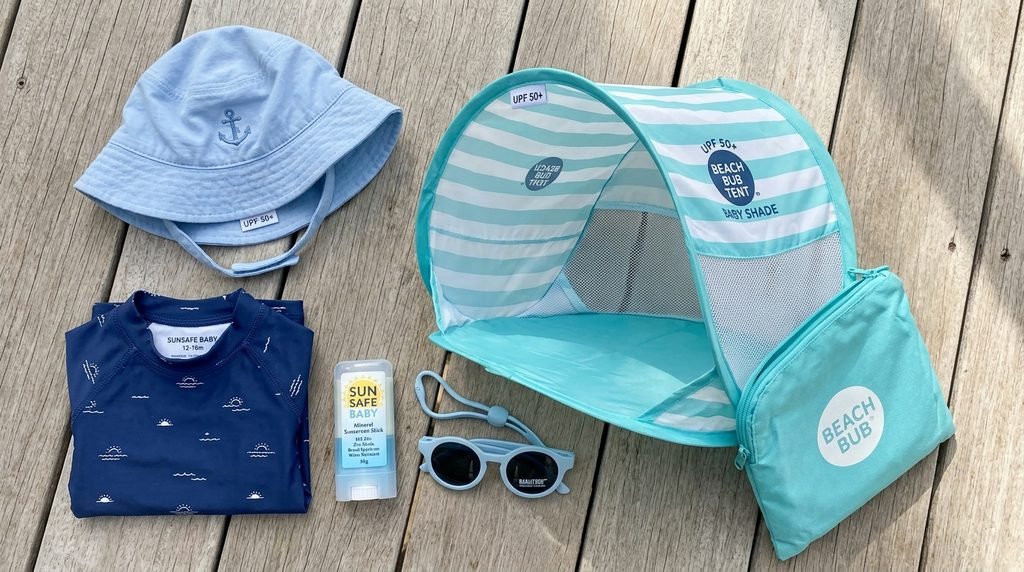
Image Suggestion: A flat-lay of baby sun-protection gear: brimmed hat, long-sleeve UPF top, mineral sunscreen stick, baby sunglasses and a small pop-up shade tent. Placement: Beside the sunscreen table. Alt Text: Sun protection gear to pack when you take a baby to the beach, including hat, UPF clothing and shade tent.
Heat, Hydration and Feeding
Shade does two jobs. It reduces UV exposure and it lowers the heat load on your baby. A UK skin health charity makes this point about babies under 6 months.
Some guides claim babies lose heat several times faster than adults. I could not verify that figure, so treat it as a rough warning, not a fact. What is well supported is that young babies cannot regulate temperature as well as older children.
Practical steps:
- Keep your baby out of the hottest part of the day.
- Use a wide umbrella or ventilated shade with good airflow. Fully enclosed tents can trap heat.
- Dress your baby in light, breathable layers, and remove layers as needed.
- Offer feeds more often than usual. Under 6 months, breast milk or formula provides fluids, so ask your pediatrician before offering water. Many guides suggest small sips of water from about 6 months.
- Watch for a flushed face, unusual sleepiness, fussiness or fewer wet diapers. Pediatric sources also list a dry mouth and no tears as signs of dehydration.
If your baby naps at the beach, keep their face visible and their airway clear, and never leave a sleeping baby unattended. Where practical, move a baby who falls asleep in a stroller or seat to a flat, firm surface, in line with AAP safe sleep guidance.
Water Safety: Can Babies Go in the Ocean?
Water is the highest-stakes part of a beach trip. The AAP revised its drowning prevention policy in July 2026, and its advice for infants is consistent: layers of protection, and close, constant supervision.
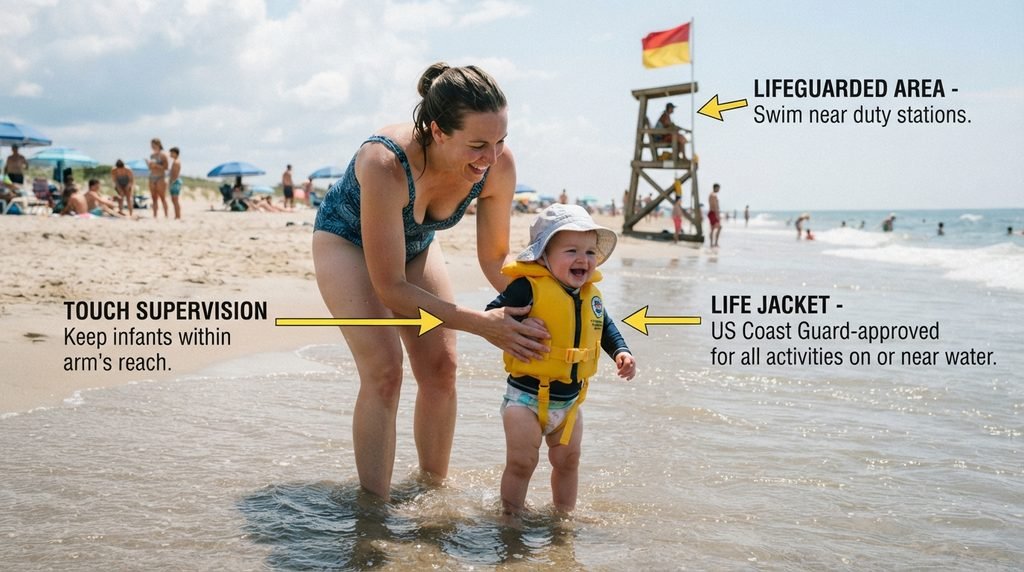
Touch Supervision and Life Jackets
For an infant, toddler or weak swimmer in or near water, the AAP recommends a supervising adult with swim skills within arm’s length, providing “touch supervision.” Its parent page adds that water does not have to be deep to be dangerous, because infants have little neck and muscle control.
AAP HealthyChildren.org, Infant Water Safety
Other AAP points that apply at the beach:
- The person watching the water should not be on a phone or otherwise distracted.
- Choose designated, lifeguarded areas when swimming in natural water.
- Young children and non-swimmers should wear U.S. Coast Guard-approved life jackets near water. Sizes are based on weight, so check the label.
- Swim ability is only one piece of water safety. Supervision still comes first.
A life jacket is a backup, not a babysitter. Pool floats, arm bands and inflatable rings are not life jackets.
Waves, Cold Water and Currents
Even gentle surf can knock over an adult, and a baby’s head control is limited. Cold water can chill a young baby quickly. Head control and warm, calm water are why several guides suggest waiting until babies are a few months old before wading.
I found no pediatric source that sets a firm minimum age for wading. If you are unsure, ask your pediatrician and start with your baby’s feet at the edge of calm water.
A baby pool or shallow tub in the shade can be a gentler alternative. The touch supervision rule still applies.
Currents matter too. A rip current is a strong channel of water flowing away from shore, and it can pull swimmers out quickly. A lifeguard station and posted flags are your best sources of local information.
Water Quality, Sand and Diapers
Natural water can carry germs. CDC guidance for oceans, lakes and rivers says swimmers can get sick from swallowing contaminated water, and that heavy rain can wash contamination into swim areas.
CDC, How to Safely Visit Oceans, Lakes, and Rivers
Practical steps:
- Check for posted beach advisories and skip the water when one is in effect.
- Avoid swimming after heavy rain, and stay away from visible discharge pipes.
- Do not let your baby swallow water.
- Check diapers often, about every hour. Change them in a bathroom or changing area, away from the water and sand.
- Do not rely on swim diapers. CDC says they are not leak-proof and only delay contamination by a few minutes.
- Keep your baby out of the water if they have diarrhea.
- Cover any open cuts or wounds, as natural water can cause infection.
Sand is a separate irritant. It can bother eyes, mouths and skin, so shield your baby from windblown sand and wipe hands before feeding.
Image Suggestion: A simple safety graphic of an adult holding a baby at the water’s edge with one hand on the baby, a lifeguard tower and flag in the background, and callouts for “touch supervision,” “lifeguarded area,” and “life jacket.” Placement: At the top of the “Water Safety” section. Alt Text: Parent using touch supervision at a lifeguarded beach where you can take a baby to the beach safely.
So, When Can You Take a Baby to the Beach? Your First-Trip Plan
A first trip goes best when it is small and easy to leave. Use these steps.
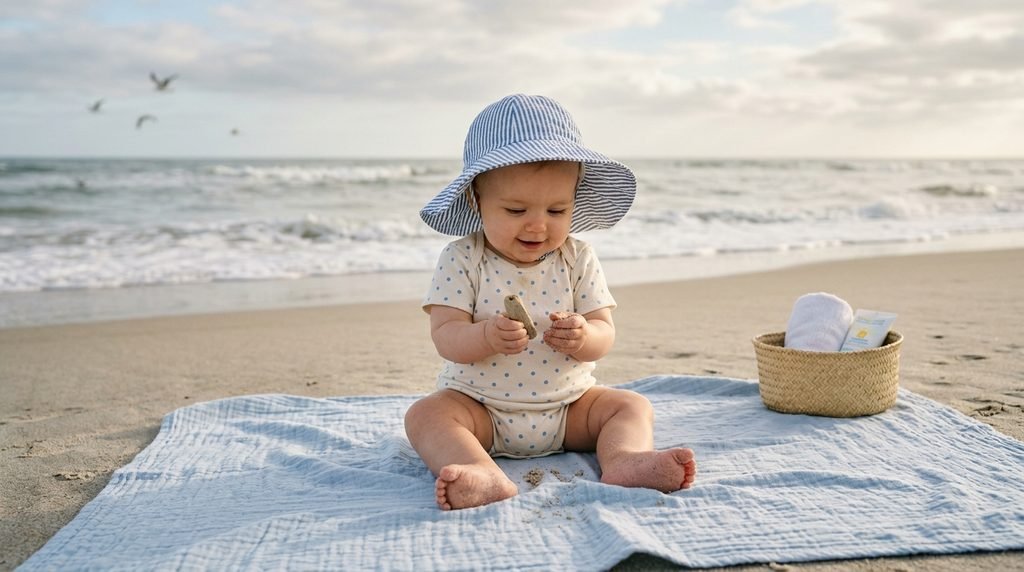
- Get a green light. Ask your pediatrician if your baby is healthy, full-term and feeding well, especially if they are under 2 months old or were born early.
- Pick the right beach. Look for lifeguards, shade, restrooms, a changing area and easy parking, as well as calm water and few crowds.
- Choose your time. Go early morning or late afternoon, outside the middle-of-the-day peak.
- Set up shade first. Put up the umbrella or tent before you unpack anything else.
- Plan around feeds and naps. Arrive after a feed, and aim for a time when your baby is usually rested.
- Keep the visit short. One to two hours is a reasonable first goal for an older baby, and often less for a young one. Leave at the first sign of fussing, heat or tiredness.
- Stay flexible. A short trip that ends calmly beats a long day that ends badly.
Image Suggestion: A step-by-step checklist graphic with seven numbered icons matching the first-trip plan. Placement: After the numbered list. Alt Text: First-trip plan checklist for when you can take a baby to the beach.
Beach Bag Checklist by Age
| Item | Under 6 months | 6 months and older |
| Shade (umbrella or ventilated tent) | Essential | Essential |
| Brimmed hat and covering clothing | Essential | Essential |
| Sunscreen | Small areas only if needed | Broad-spectrum, all exposed skin |
| UV sunglasses | Helpful | Helpful |
| Extra bottles or nursing cover | Essential | Essential |
| Water | Ask your pediatrician | Small sips |
| Diapers, wipes, disposal bags, changing pad | Essential | Essential |
| Swim diapers | Only if wading | For water play |
| Life jacket | Only near open water, correctly sized | Recommended near open water |
| Hooded towel and spare clothes | Essential | Essential |
| Stroller with canopy | Helpful | Helpful |
A streamlined bag beats a heavy one. Use zip bags for wet clothes and diapers.
What Parents Say: Forum Themes, Not Evidence
I could not access Reddit through my research tools, so this section draws on parent forum threads from The Bump and HelloBee. These are anecdotes, not research, and some threads are older.
Three themes stood out:
- First trips vary widely. Parents reported beach outings from about five weeks to six months, often with a shade tent or umbrella, a brimmed hat and a UV rash guard.
- Shade and short visits. Parents who felt comfortable at younger ages usually mentioned strict shade, off-peak hours and keeping the visit brief.
- Sand worries. One parent shared a story of sand causing a serious eye problem for a child they knew. I cannot verify that, but it is a reason to shield eyes from windblown sand.
One popular forum tip is baby powder to brush off sand. I left it out because loose powder near a baby’s face can be inhaled, so ask your pediatrician first.
Common Mistakes to Avoid
- Treating the calendar as the only rule. Age matters, but shade, timing and supervision matter just as much.
- Relying on an umbrella alone. Pair it with clothing and a hat.
- Skipping the water rules because the water looks calm. Touch supervision applies in shallow water and baby pools too.
- Trusting swim diapers. They are not leak-proof.
- Staying too long. Heat and tiredness build quietly.
- Ignoring advisories. Check for water quality signs before anyone gets wet.
- Forgetting yourself. Sunscreen, shade and water for the adults keep the trip calm, too.
When to Leave the Beach or Call a Doctor
Leave the beach and cool your baby down if you see a flushed face, unusual sleepiness, unusual fussiness or refusal to feed.
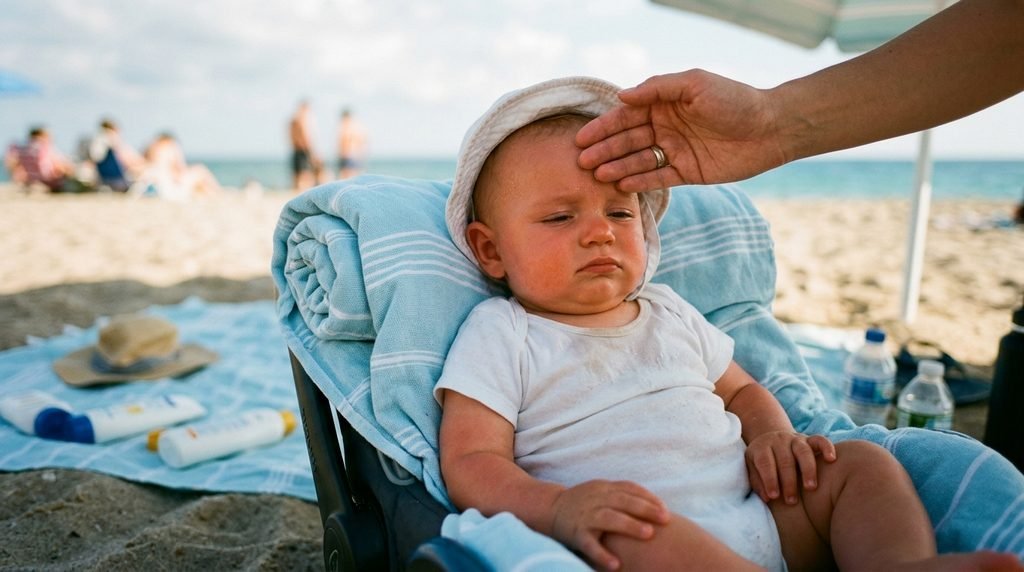
Call your pediatrician right away if:
- Your baby is under 3 months and has a rectal temperature of 100.4°F (38°C) or higher.
- Your baby has a sunburn with blisters, fever, chills or seems very unwell.
- Your baby shows signs of dehydration, such as a dry mouth, no tears or fewer wet diapers.
- Your baby swallowed water and has trouble breathing, unusual sleepiness or persistent coughing. Treat any breathing difficulty as an emergency and call your local emergency number.
In any emergency involving breathing, unresponsiveness or drowning, call emergency services first.
Frequently Asked Questions
Can you take a newborn to the beach?
A healthy, full-term newborn can go outdoors, but a beach adds sun, heat and crowds. Many families wait several weeks. Ask your pediatrician, choose a quiet time, and keep the visit short and shaded.
Can a 3-month-old go to the beach?
Many families do, with strict shade, covering clothing, a hat, off-peak timing and short visits. Sunscreen is limited to small exposed areas, and only if shade and clothing are not enough.
Can babies go in the ocean, and at what age?
I found no official minimum age. Wading at the edge of calm, warm water with a hand on your baby is the cautious approach. Check with your pediatrician, and avoid waves and cold water for young babies.
Do babies need sunscreen at the beach?
Babies 6 months and older need it on exposed skin. Under 6 months, the AAP prefers shade and clothing, and allows sunscreen on small areas if those are not enough.
How long can a baby stay at the beach?
There is no official time limit. For a first trip, one to two hours is a reasonable goal for an older baby, and often less for a younger one. Leave when your baby shows signs of heat or tiredness.
Should a baby wear a life jacket at the beach?
The AAP recommends properly fitted, U.S. Coast Guard-approved life jackets for young children and non-swimmers near water. A life jacket does not replace touch supervision.
Are swim diapers necessary?
They are useful for containing mess but not leak-proof. CDC advises checking diapers about hourly and changing away from the water.
Is sand safe for babies?
Sand is generally fine for play, but it can irritate eyes, mouths and skin. Shield your baby from wind, and keep hands clean before feeding.
Final Takeaway
When can you take a baby to the beach? There is no set age, but there is a clear order of priority: shade and clothing first, hands on your baby near water, a lifeguarded and clean beach, and short trips at cooler times of day. Start small, ask your pediatrician about your baby’s specific needs, and treat any fever in a baby under 3 months as an urgent call.
Related Post:
When Do Babies Start Using High Chairs? 7 Essential Signs
Moses Basket for Baby: 7 Essential Checks Before You Buy
Why Do Some Babies Wear Helmets? 7 Simple, Essential Facts

5 thoughts on “When Can You Take a Baby to the Beach? 7 Essential Steps”