
Move your baby out of the bassinet the moment they can roll over, or when they reach the weight, height, or age limit printed on your bassinet, whichever comes first. Age alone is a poor guide. Most babies get there somewhere between three and six months, but some hit a limit sooner and some later.
If you’re trying to work out when to move baby out of bassinet, the short version is this: watch your baby’s movement, not the calendar. This guide covers the signs that matter, the ones that don’t, where your baby should sleep next, and a realistic plan for the switch.
When to Move Baby Out of Bassinet: The Short Answer
There is no single birthday for this move. Bassinets are built for a narrow window: small, mostly immobile newborns. Once your baby gains new skills or size, the product stops matching the baby.
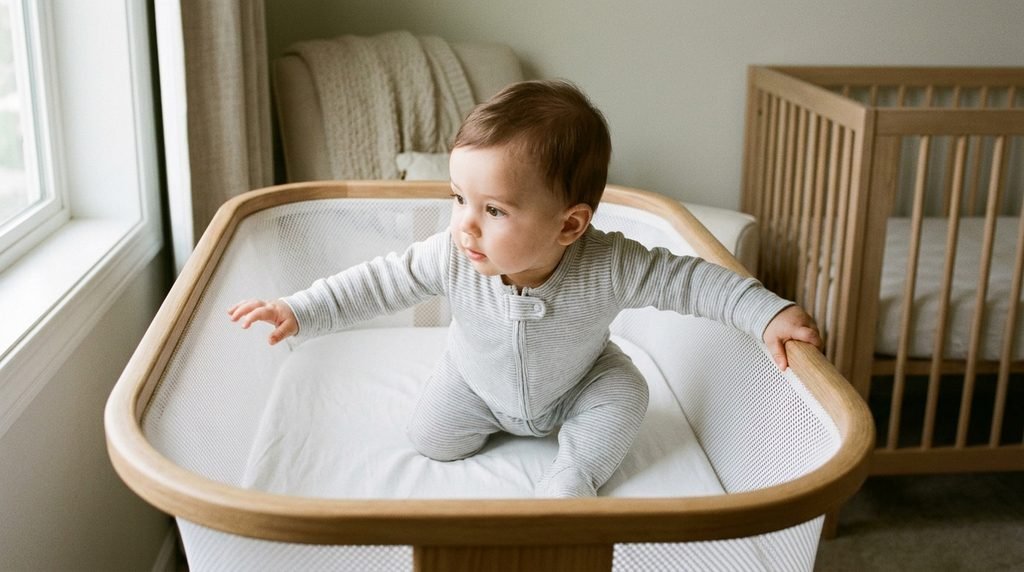
Follow the “First Limit You Hit” Rule
Think of it as a checklist with several finish lines. You move on when your baby crosses the first one.
- Rolling over. Health Canada says a bassinet is safe until an infant can roll over or reaches the manufacturer’s weight limit.
- Weight limit. Listed in your manual and often on a label on the product.
- Height or length limit. Some bassinets state one; others rely on the baby simply running out of room.
- Age limit. Some products state a maximum age in months.
- Hands-and-knees push-ups. Some manufacturers draw the line here, even before rolling.
Your manual outranks any article, including this one. Use the instructions for your specific product and act at the first limit that applies.
What About the 4–6 Month Rule of Thumb?
You’ll see “four to six months” almost everywhere, and it’s a fair description of what tends to happen. Forbes Vetted, for example, says most babies leave the bassinet between three and six months.
But that range is an observation, not a rule. A baby who rolls at three months is done at three months. A baby who stays small and still may fit comfortably a little longer, as long as every product limit is still met. The age range helps you plan. The signs tell you when.
Six Signs Baby Has Outgrown the Bassinet
Getting the timing of when to move baby out of bassinet right comes down to these six checkpoints. Any one of them is enough.
1. Rolling or Trying to Roll
This is the big one. A rolling baby can end up pressed against the bassinet’s side, in a position it wasn’t designed to handle. Health Canada advises moving a baby from a bassinet to a crib or cradle when they can roll over.
Watch for the lead-up too. Tipping onto a side, rocking hard, or flipping partway and getting stuck all suggest a full roll is close. Don’t wait for the first complete roll if your baby is obviously on the verge.
U.S. regulators use the same logic elsewhere. A CPSC safety alert about inclined sleepers told caregivers to stop using the product as soon as an infant can roll over.
2. Pushing Up on Hands and Knees
Even a baby who hasn’t rolled may start lifting their chest and getting onto hands and knees. One manufacturer, citing the ASTM standard, sets its bassinet limit at five months or the first hands-and-knees push-up, whichever comes first.
The reasoning is simple. A baby in that position can tip, climb, or topple the bassinet, and the sides are low.
3. Sitting or Pulling Up
Sitting unaided, or hauling themselves upright on the bassinet’s edge, raises the fall risk. A bassinet’s walls are far lower than a crib’s. Babies who start sitting up or pushing up on hands and knees are outgrowing the space and are safer in a crib.
4. Reaching the Weight Limit
Each manufacturer sets its own number. Brand guidance I found ranged from the high teens to about 20 pounds, for example 20 lb for one specific bassinet model. Your label is the only number that counts.
A heavy baby can hit this limit well before rolling. Weigh at checkups and compare against the label.
5. Running Out of Length
Not every bassinet states a length limit, but you can see when it’s a problem. If your baby’s head and feet touch the ends, or they can’t stretch out, the bassinet is too small. Forbes advises that even without a stated height limit, a baby who looks like they’re running out of room has probably outgrown it.
6. Hitting the Manufacturer’s Age Limit
Some products state a maximum age. If your bassinet does, treat it like the weight limit: a hard stop, not a suggestion. Also check whether your model has been recalled or updated.
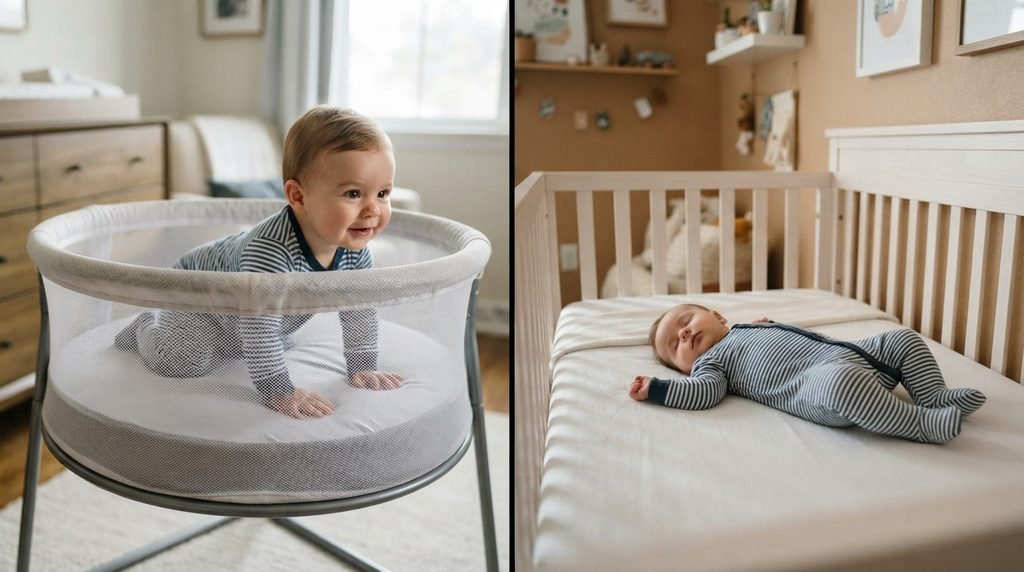
Signs That Are Less Reliable Than They Look
Some competitor pages list night waking, fussiness, or restlessness as signs your baby has outgrown the bassinet. One page says babies who previously slept well but start waking often might be uncomfortable from outgrowing the bassinet.
That can be true. It’s also a weak signal, because babies wake for dozens of reasons: developmental leaps, hunger, growth spurts, illness, a changing sleep cycle. Treat this as interpretation rather than established fact: waking alone is not evidence that the bassinet is the problem.
A more useful test is physical. Does your baby still fit? Can they move in ways the product can’t handle? If yes, move them. If the answer is no to both, look at other causes for the sleep trouble before changing their sleep space, and talk to your pediatrician if it persists.
The same goes for age. Hearing that “everyone moves at six months” is not a reason to move, and hearing it isn’t a reason to stay either. Go by your baby.
When to Move Baby Out of Bassinet If Your Baby Isn’t Rolling Yet
Some parents want the crib early: the bassinet feels cramped, it doesn’t fit their space, or they’re tired of the routine. Is that okay?
Generally, yes, provided the crib is a real, current-standard crib with a firm, flat mattress and a fitted sheet and nothing else in it. Forbes Vetted notes babies can leave the bassinet at any time as long as they move to a safe sleep surface. The bassinet isn’t a safety requirement. It’s a convenience for small newborns.
What matters is the setup:
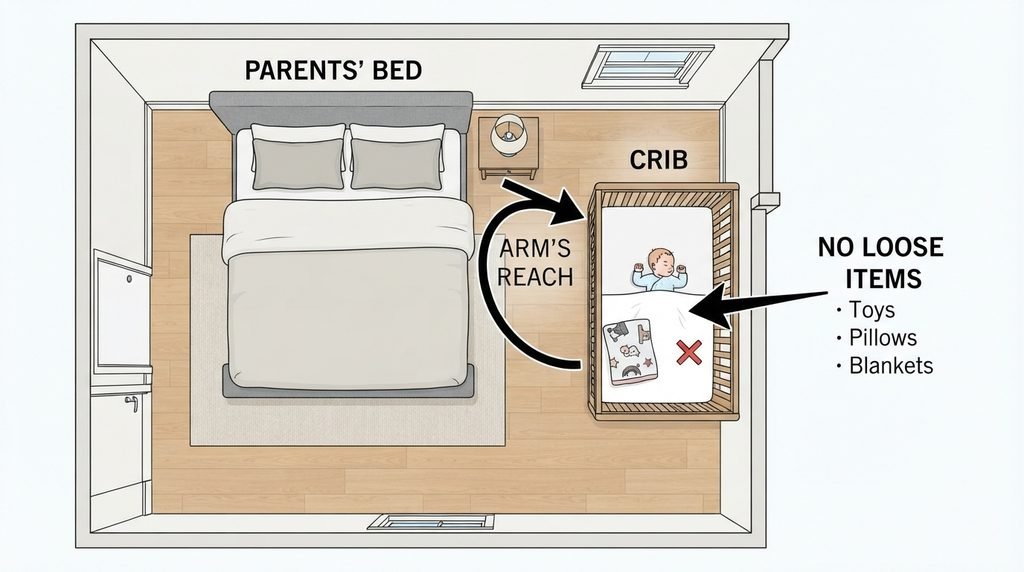
- A firm, flat mattress with a fitted sheet only
- No bumpers, pillows, loose blankets, or toys
- Baby on their back for every sleep
- A crib that meets current safety standards, not a hand-me-down of unknown age
Keep the room-sharing advice in mind. NICHD’s Safe to Sleep guidance recommends keeping baby in your room, on a separate surface, for at least the first six months and ideally the first year. It adds that room sharing is safer than putting baby in their own room. So moving to a crib early is fine, but moving the crib to another room early is a separate decision, and the guidance leans against it.
The UK’s Lullaby Trust gives the same six-month minimum for sharing a room, day and night.
Where Should Baby Sleep After the Bassinet?
A Crib in Your Own Room
For most families, the answer is a crib placed in the parents’ bedroom for the remainder of the room-sharing period. One guide suggests starting with the crib in your bedroom if you’re not ready for baby to move to a separate room.
This solves the most common parent worry: “If I move the bassinet, I lose my baby.” You don’t. You swap a small bed for a bigger one in the same spot.
When your baby starts pushing up or sitting, adjust the crib. Health Canada advises removing mobiles and toy bars and lowering the mattress support to its lowest level at that stage.
Play Yard or Convertible Bassinet
A play yard meeting current standards can work as a next step, particularly for small rooms or travel. A “grow with me” bedside sleeper may last longer, but check its own limits, because a convertible product still has a point where the baby outgrows it. Health Canada notes that bassinet attachments for playpens are for sleep until baby can roll over or reaches the attachment’s weight limit.
How to Move Baby Out of Bassinet: A Gentle 7-Day Plan
If your baby is already rolling, don’t drag this out. Safety comes first, and some babies adjust quickly. If you have a little time, a gradual approach often feels easier on everyone. This plan is a practical suggestion, not a medical protocol.
The Week-One Schedule
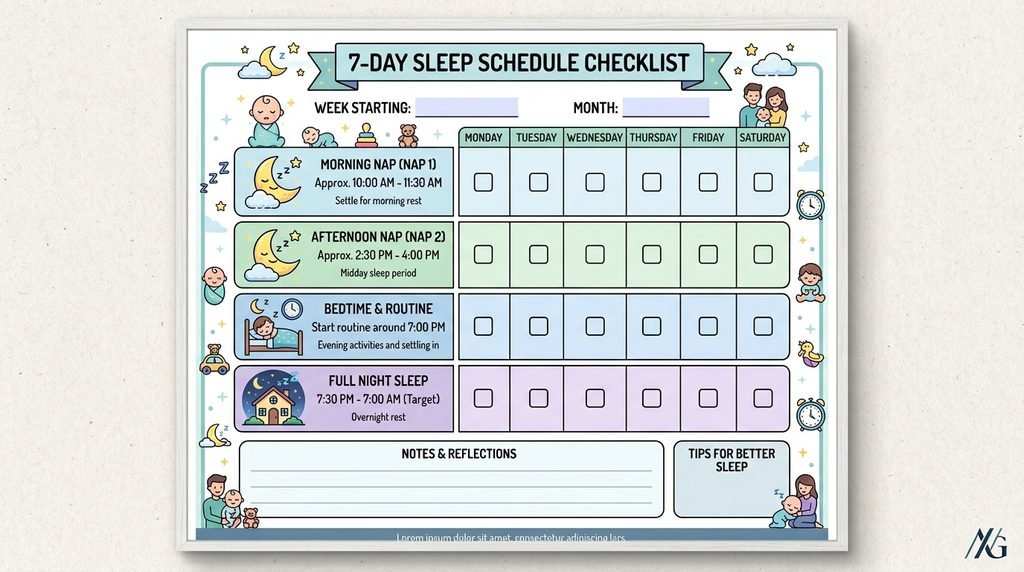
A gradual approach moves one sleep period into the crib at a time, then adds more over days. Here’s one way to do it:
| Days | What moves to the crib | Tips |
| 1–2 | One daytime nap | Choose the nap when baby is usually calmest |
| 3–4 | Two naps | Keep your usual pre-nap routine |
| 5–6 | Bedtime and the first stretch of night | Stay close; keep the crib in your room |
| 7 | Full night | If it goes badly, go back a step, not back to the start |
A few helpers:
- Same sheets, same smell. WebMD suggests using the same sheets in the crib that you used in the bassinet.
- Same routine. Feed, change, cuddle, and lay down in the same order.
- Same sound. If you use white noise, keep it the same.
- Wearable blankets, not loose ones. A sleep sack is a common choice; loose blankets stay out.
- Swaddle check. Standard advice, which I’d confirm with your pediatrician, is to stop swaddling once baby shows signs of trying to roll. A swaddled baby who rolls can’t use their arms to push up.
- Keep expectations realistic. HALO notes that adjusting can take days or weeks. A few rough nights don’t mean you’ve done it wrong.
Mistakes That Make the Switch Harder
- Waiting for a first roll during sleep. Move before it becomes a nighttime surprise.
- Changing everything at once. New bed, new room, new routine, and new sleepwear in one week is a lot for a baby.
- Adding soft items for comfort. Bumpers, pillows, and blankets are not safe, however cozy they look.
- Using a positioner to stop rolling. One Canadian safety guide warns against using positioners or other products to stop a baby from rolling.
- Ignoring the manual. A bassinet’s own limits can be stricter than general advice.
- Treating the room move as part of the crib move. Keep them separate.
Special Situations
Premature babies. Developmental milestones often follow your baby’s own pace rather than their birth date, so watch the skills, not the months. One parenting page notes that premature babies may need longer in a bassinet, but the safety limits still apply at every stage. Your pediatrician can tell you what to expect.
Twins. Each baby is on their own timeline. One may roll earlier, and you’ll need two safe spaces. Bed-sharing isn’t advised for multiples, so plan for two separate surfaces.
Stroller bassinets (prams). A bassinet attachment on a stroller follows the same logic: stop when your baby can roll or hits the listed limit. Sleeping in a pram bassinet is not a substitute for a flat crib surface for routine sleep, so check the manufacturer’s instructions for overnight use.
Bedside sleepers and inclined products. In the U.S., a bassinet or cradle is defined as having a resting sleep surface no more than 10 degrees from horizontal. Regulators updated the bassinet standard again in December 2025. Choose a product that meets the current rule, and don’t use one that’s been recalled.
Travel bassinets. Treat them like any bassinet: rolling, weight, and age limits all apply.
| Product | Typical stopping point (Health Canada) |
| Bassinet | Baby can roll over, or hits the weight limit |
| Cradle | Baby can push up on hands and knees, or hits the weight limit |
| Crib | Baby can climb out or is taller than 90 cm |
FAQ
When should I move my baby out of the bassinet?
When they can roll over, push up on hands and knees, sit, or reach any limit in your bassinet’s manual, whichever happens first. Many families reach that point between three and six months.
Is it okay to keep my baby in a bassinet until six months?
Only if every limit is still met. If your baby rolls or hits the weight, length, or age limit first, the bassinet is done regardless of months. Six months is a common upper range, not a guarantee of fit.
Can my baby sleep in a crib from birth?
Yes, in a crib that meets current safety standards with a firm, flat mattress, a fitted sheet, and no other items. Keeping that crib in your room follows the room-sharing guidance.
My baby is fussy in the bassinet. Does that mean it’s too small?
Not necessarily. Check for real size and skill limits first. If none apply, look at other causes for the fussiness and raise it with your pediatrician if it continues.
Should the crib go in my room or the nursery?
Safe to Sleep guidance supports keeping baby in your room for at least six months. A crib in your bedroom is the simplest way to do that after the bassinet.
What if my baby rolls in the bassinet at night?
Stop using the bassinet, move to a crib, and keep the sleep surface clear. Also stop swaddling if you haven’t already. Mention it at your next checkup.
Final Takeaway
Knowing when to move baby out of bassinet comes down to a short list: rolling, pushing up, sitting, weight, length, and the manufacturer’s age limit. The first one your baby reaches is your answer. Put the crib in your own room, make the move gradually if there’s time, and keep the sleep space clear of anything soft. If you’re unsure, your bassinet’s manual and your pediatrician are the two sources that count most.
Related Post:
Moses Basket for Baby: 7 Essential Checks Before You Buy
When Can You Take a Baby to the Beach? 7 Essential Steps
Why Do Some Babies Wear Helmets? 7 Simple, Essential Facts

4 thoughts on “When to Move Baby Out of Bassinet: 6 Must-Know Signs”